Agatha All Along has been exciting for three weeks. The show led by Kathryn Hahn has been full of surprises. It started as a spin-off of WandaVision, had a sad moment with Mrs. Hart’s death, and now confirms a couple that fans wanted to see together.
There has been tension between Agatha and Rio, played by Aubrey Plaza, since the beginning. Episode 4 suggests that they were once lovers.
This is a major advancement for Disney’s franchises, especially for the Marvel Cinematic Universe (MCU). Disney often targets a PG-13 rating, and for some unknown reason, sexual orientation has been a sensitive topic.
Although some films and shows included queer characters, this is the first time the main character identifies as part of the LGBTQIA+ community, and it truly matters to the story.
Disney Productions Have Often Disappointed with Queer Characters
Disney has a history of building up queer characters in their projects but failing to deliver real representation. There are often announcements about queer characters, followed by negative reactions from some viewers who boycott the shows.
Supporters expect to see these characters, but they are often disappointed. For example, in Star Wars: The Rise of Skywalker, there was a promise of a queer character, Commander Larma D’Acy, but her role was very small. She only had a quick kiss with her wife during a celebration.
In animated films, Pixar introduced a non-binary character in Elemental. However, besides using the correct pronouns, the character did not have much impact on the story. The show The Other Two humorously criticized shallow PR strategies that lack depth.
Recently, The Acolyte included queer characters, Mother Aniseya and Mother Koril, who are witches raising two other characters. Although there was good intention, the message got lost in the reaction from toxic fans.
This makes Agatha All Along’s reveal very important because it is not just a PR move. Agatha is the main character who identifies as queer, along with Plaza’s character.
Disney+ Has Previously Focused on Family-Friendly Content
Disney has been cautious about discussing topics like sexuality. For example, the Lizzie McGuire revival faced problems when creator Terri Minsky left the project after filming two episodes. Hilary Duff wanted a grown-up version of Lizzie, but Disney wanted a family-friendly version, and they could not agree.
Another example is Love, Victor, a spin-off of Love, Simon. Although it was set to be a Disney+ original, the show ended up on Hulu because Disney felt the scheme of Victor’s sexual orientation was not family-friendly enough. Disney could have chosen this route with Agatha All Along, but thankfully, they chose to represent queer identities correctly.
Agatha All Along Features Strong Queer Representation
From the first episode, viewers can see the strong connection between Rio and Agatha. At first, it seemed to be just the chemistry between Kathryn Hahn and Aubrey Plaza. However, Agatha’s hesitation to include Rio in the second episode suggested they had a complicated relationship.
In Episode 4, titled “If I Can’t Reach You/Let My Song Teach You,” Rio shares that she once loved someone but hurt them. Agatha quickly leaves after this, indicating deeper feelings.
Later, they embrace with great passion. Although they want to kiss, Rio feels the need to discuss Agatha’s emotional struggles. She makes it clear that Joe Locke’s character is not Agatha’s son. Agatha All Along openly accepts its main characters’ queerness.
The storyline does not just serve side characters or try to trick viewers. If Disney continues this direction, it will be a significant moment for the Marvel franchise.
Having a queer main character is a major step for the MCU and Disney, showing that their universe includes real people with various desires and sexual orientations. Allowing this freedom in storytelling should inspire the rest of Disney’s projects.
Agatha All Along is available to stream on Disney+ in the U.S.
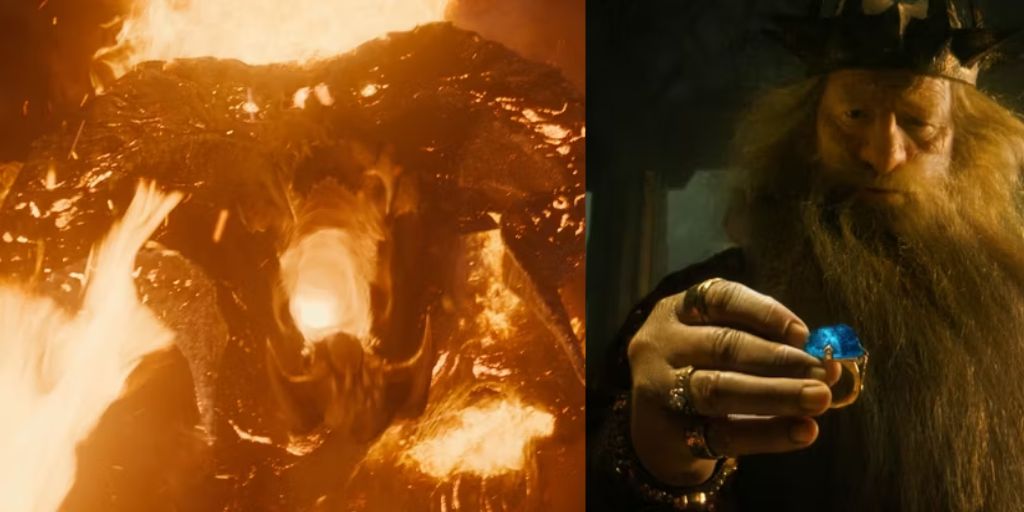
After a lot of teasing and a long wait, we finally see the Balrog in action in the Season 2 finale of The Lord of the Rings: The Rings of Power. In the episode titled “Shadow and Flame,” King Durin III (played by Peter Mullan) continues to dig deeper into the mithril mines of Khazad-dûm.
He does this under the influence of his own Ring of Power. While digging, a fiery glow catches him and his son, Prince Durin IV (played by Owain Arthur), by surprise. The Balrog, awakened by the digging, climbs up the shaft to confront the two Durins. However, he is ultimately buried in an epic fight with Durin the Elder.
We know from Peter Jackson’s The Lord of the Rings: The Fellowship of the Ring and J.R.R. Tolkien’s novel that this particular Balrog is known as Durin’s Bane. He is responsible for the downfall of Khazad-dûm, the wealthiest of all Dwarven realms.
His story is directly tied to the discovery of mithril, which brought the Dwarves a whole age of wealth and prosperity. However, it also awakened something dark, both within themselves and in the mountain.
As the Dwarves dug deeper to extract more of this miracle ore, they discovered that the depths were home to endless riches and this ancient evil, a servant of Morgoth himself.
A Balrog Is an Evil Spirit That Predates the World Itself
Balrogs are described by Gandalf (played by Ian McKellen) in The Fellowship of the Ring as demons of the ancient world. This description is essentially correct. Galadriel (played by Morfydd Clark) says in her very first line in The Rings of Power, “nothing is evil in the beginning,” and this was also true for the Balrogs.
They first came into being as Maiar, angelical beings created by Erú Ilúvatar, the equivalent of God in Tolkien’s Legendarium. They were once powerful spirits who served the Valar and helped them shape the world of Arda and Middle-earth.
When Melkor, a particularly rebellious Valar later known as Morgoth, broke away from his peers, many of the Maiar followed him into Arda. They became corrupted by the Dark Lord and turned into his evil minions. The transformation from good to evil is a significant part of their story.
Balrogs are extremely powerful and wield many forms of dark magic. They are present at many important events of the First Age under Morgoth’s orders. The Dark Lord rarely leaves his fortress of Angband in the far North. Instead, he sends his Balrogs to carry out his orders, and they usually accomplish these tasks excellently.
Still from The Rings of Power (Credit: Prime Video)
Balrogs first appear to the Elves when Feänor, who is the grandfather of Celebrimbor (played by Charles Edwards) and the creator of the Silmarils, attempts to attack Angband directly after the Dagor-nuin-Giliath, or “Battle Under the Stars.”
Feänor manages to fight multiple Balrogs at once, but he ultimately dies from a wound inflicted by one of them. This battle highlights the Balrogs’ formidable strength and the risk that comes with confronting them.
Later on, during the fall of the hidden Elven realm of Gondolin, another epic tale unfolds as the Elf Glorfindel battles a Balrog by himself. He does this to allow his kin to escape the destruction of their home. Glorfindel perishes in this duel, but his heroic acts impress the Valar.
They decide to reembody him with greater powers and send him back to Middle-earth during the Second Age. A version of his tale is told in The Rings of Power when Elrond (played by Robert Aramayo) and Gil-galad (played by Benjamin Walker) discuss the Song of the Roots of Hithaeglir in the fifth episode, “Partings.”
Slaying a Balrog is so difficult that it ultimately earns Glorfindel a strong reputation. In the novel The Fellowship of the Ring, he is the one Elrond (played by Hugo Weaving) sends to take Frodo (played by Elijah Wood) to Rivendell instead of Arwen (played by Liv Tyler). This decision is made because they know the Nazgûl would fear him.
The appearances of Balrogs have also changed from the books to the screen. There are many descriptions of these demons throughout Tolkien’s writings. They are usually around twice the size of a grown man and have a flaming mane on their backs but do not have wings.
However, Peter Jackson’s portrayal of Durin’s Bane is iconic. He is depicted as a being made of pure darkness, with his eyes and silhouette only visible because of the fire that permeates his skin. If The Rings of Power portrayed the Balrog differently, it would feel strange to many viewers.
According to Tolkien, Durin’s Bane Reveals Itself Only in the Third Age of Middle-earth
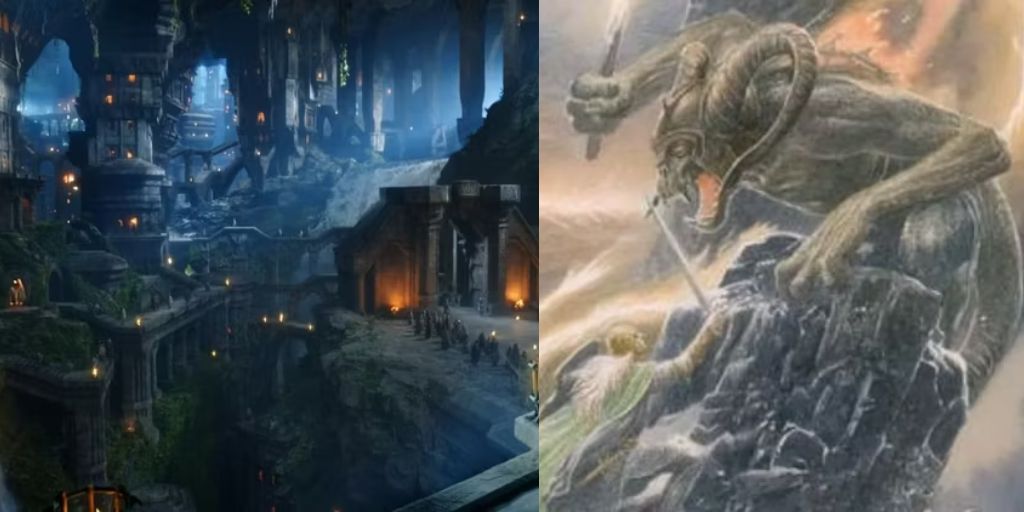
Somehow, one Balrog survives all the battles fought in the First Age and the War of Wrath, which is depicted in the prologue of The Rings of Power.
Still from The Rings of Power (Credit: Prime Video)
These events happen millennia before the events of the Prime Video series, which is why Gandalf describes the demon as ancient. It is also unclear how he finds his way into the deep roots of the Misty Mountains, where he takes residence.
Around the year 1600 of the Second Age, the Dwarves of Khazad-dûm—where the Mines of Moria are located, under the peak of Caradhras—discover a new ore called mithril. The Dwarves trade mithril mostly with the Elven smiths of Eregion. This trade creates a period of friendship between these two races and also brings economic prosperity to the Dwarves.
According to the books, this friendly relationship lasts until the Third Age. In the year 1980 of the Third Age, the Dwarves awaken the Balrog from his age-long sleep. When that happens, the Balrog wreaks havoc on Khazad-dûm, forcing the Dwarves to flee their homeland.
He also kills King Durin VI, which earns him the title Durin’s Bane. After this incident, Khazad-dûm is left in ruins and becomes the demon’s lair. In the following centuries, it is infested by Orcs.
There are two failed attempts to recolonize Moria during the remainder of the Third Age. The first attempt is made by Dáin Ironfoot (played by Billy Connolly) after the Battle of Azanulbizar, which is quickly depicted in The Hobbit: An Unexpected Journey.
The second attempt is by Balin (played by Ken Stott). This second attempt is referenced in both the movie and the novel of The Fellowship of the Ring. Both attempts fail, and Balin’s tomb is discovered by the Fellowship of the Ring during their passage through Moria.
The Balrog and the Dwarven Rings May Spell Doom for Khazad-dûm Very Soon
The Balrog made a brief appearance in Season 1, Episode 7, titled “The Eye.” However, this appearance was only a glimpse. It served as an omen of the dark fate awaiting Khazad-dûm. It is only in “Shadow and Flame” that the demon fully reveals himself.
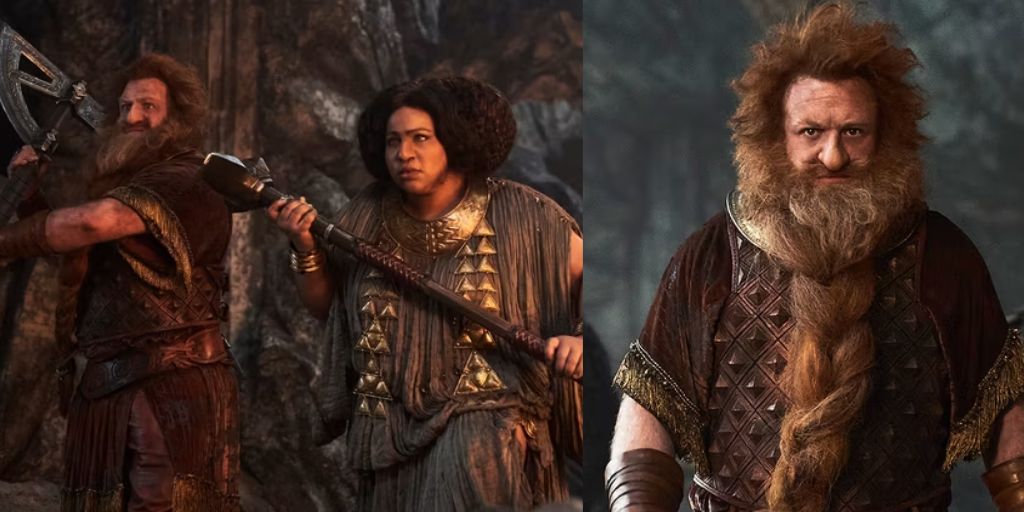
The Balrog may have only taken Durin the Elder with him to the depths of the mountain, but he is also seen by Durin the Younger, his wife Disa (played by Sophia Nomvete), Narvi (played by Kevin Eldon), and another unnamed Dwarf.
In their final scene of the episode, the Dwarves do not mention the Balrog; instead, they talk about Durin the Elder’s death. However, there will likely be repercussions in Season 3 because of the Balrog’s awakening.
Still from The Rings of Power (Credit: Prime Video)
The Rings of Power has made many significant changes to the timeline of Tolkien’s original writings. Tolkien’s notes in the appendices of The Lord of the Rings state that the Balrog slept throughout the entire Second Age. However, the series shows him fully awake, which is a deviation from the original lore.
The show has been taking a lot of creative liberties, usually for the better. Teasing the awakening of Durin’s Bane without following up on it would seem like a waste. Still, the timeline inconsistencies are significant, and it would not make much sense for the Balrog to destroy Khazad-dûm this early in history, a full age before it happens in the books.
Without His Father, Durin IV Must Take the Throne With a Ring of Power
The Dwarves’ final scene in Season 2 shows Durin the Younger, Disa, and Narvi staring at Durin the Elder’s Ring of Power. They discuss all the problems that await the new king.
A possibility is that the Balrog serves as a necessary narrative device to remove Durin the Elder and force Durin the Younger onto the throne, allowing his character to develop further.
He has been openly critical of his father’s use of the ring, but now he is put in a position where he does not have much choice, especially since the other Dwarf lords all wear their own rings.
Durin the Younger is already a beloved character in The Rings of Power. He fights for the Dwarves, is deeply in love with Disa, and has a beautiful friendship with Elrond. However, it is high time he faces some internal struggles, which may come in the form of his father’s ring.
Being aware of the Balrog, he would use it to know the limits of his control over the mountain until the beast’s existence fades into legend. This way, the Balrog can still wake up in the Third Age, with the Dwarves having forgotten all about it.
An interesting detail about Tolkien’s writings is that there are no stories about Durin IV and Durin VI. They are mentioned in passing, but no proper stories are told about them. This gap in Durin the Younger’s story is already being filled by the show.
Still from The Rings of Power (Credit: Prime Video)
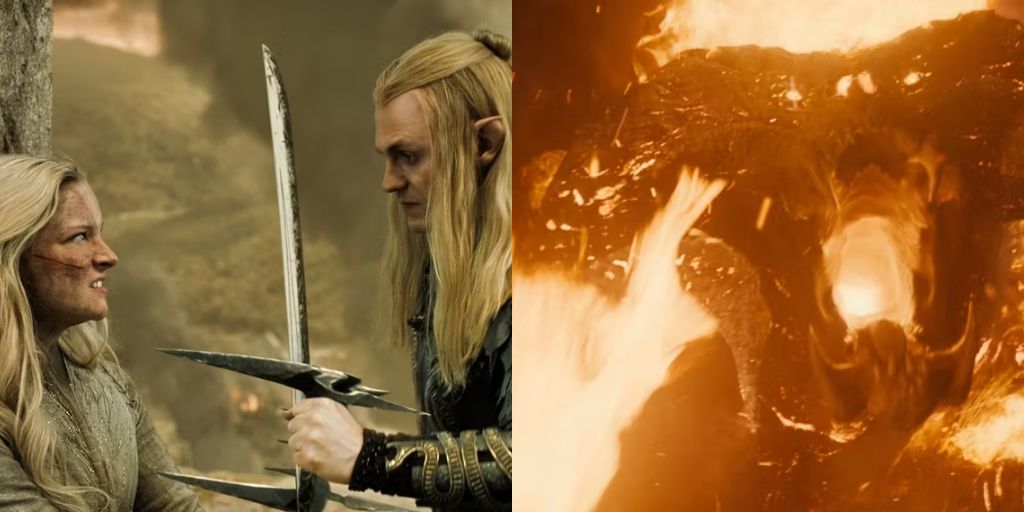
However, it seems likely that his narrative could lead to a tragic fate for his namesake, Durin VI, millennia later. With Durin the Younger under pressure, Khazad-dûm will likely have to dig even deeper into the roots of the mountain. Durin’s Bane is already awake and angry at the Dwarves. Unfortunately, he will probably become the bane of a different Durin.
Season 2 of The Lord of the Rings: The Rings of Power is now available to stream on Prime Video.
