In Episode 4 of Agatha All Along, the storyline about Alice Wu-Gulliver (played by Ali Ahn) and the mystery surrounding her mother unfolds. While for many, this episode seems like a mere continuation of trials within the coven, it resonates deeply with me. It serves as a reflection of a reality that is often not given enough attention – the immigrant struggle.
Specifically, it reminded me of the experiences of Overseas Filipino Workers (OFWs) and their families. For those of us who have gone through similar journeys, Alice’s trial is more than just a search of her mother’s journey; it echoes the sacrifices immigrant parents make to provide better opportunities for their children.
Alice’s journey, whether it was intentional by the show’s creators or not, mirrors the experiences many immigrant families go through. It illustrates how parents leave their home countries and face immense challenges to create a better life for their children.
While many films and television shows have touched on this topic from an Asian-American perspective—like Fresh Off the Boat, Ms. Marvel, and Everything Everywhere All At Once—the story in Agatha All Along brings to mind the specific struggles my family and many others have faced.
A Story of Generational Sacrifice
The episode “If I Can’t Reach You / Let My Song Teach You” goes deeper into Alice’s mother, Lorna (played by Elizabeth Anweis), and her selfless act of sacrificing herself on the Witches’ Road. She does this to protect her daughter from a generational curse that has been plaguing their family.
While my family’s situation doesn’t involve curses or supernatural elements, the parallel with Lorna’s story is easy to see. Just like Lorna, my parents—particularly my father—made sacrifices that allowed me and my family to have better opportunities.
In our case, it was the sacrifice of leaving the Philippines to seek a better life. Much like the struggle on the Witches’ Road, immigrant parents face countless challenges to create a brighter future for their children.
Lorna’s actions eventually take Alice by surprise, helping her realize how far her mother was willing to go to protect her and provide her with a better life. This revelation is a moment of clarity that many children of immigrant parents come to understand later in life.
When you’re younger, it’s easy to feel neglected or upset that your parents aren’t always there for you. But as you grow older, you begin to appreciate the magnitude of their sacrifices. Whether they’re working overseas or fleeing dangerous situations, parents will go to great lengths to ensure their children have opportunities they never had. My parents, and many others like them, go ahead on their own “Witches’ Road” of trials and hardships, all for the sake of their children’s future.

Still from Agatha All Along (Credit: Disney)
The Untold Journey of Immigrant Parents
There are many stories about the struggles that immigrant parents face, often highlighting the end result of their hard work: their children’s success. However, not enough attention is given to the journey that leads to that success. For many, including myself, it’s a story of becoming an OFW (Overseas Filipino Worker) and making significant sacrifices to support your family.
While several Philippine movies and television shows have addressed this topic, they often focus on either the abuse that OFWs face (A Mother’s Story) or romanticize the concept (Milan). For me, Lorna’s journey in Agatha All Along feels more authentic and relevant to the experiences of young Filipinos whose parents are OFWs.
Even when we feel neglected, we must remember that our parents are on difficult journeys, often far from us, so they can provide us with a better life.
I first heard about the details of my father’s journey back in 2014. Much like Alice, I initially thought it was just a story to guilt me into pursuing a specific career—becoming a nurse, in my case. But this was far from the truth. Watching Agatha All Along only deepened my appreciation for my father’s sacrifices and the journey he had to go through to give us a better life.
A Father’s Sacrifice: From Dreams to Reality
The story of how my family left the Philippines began with my father. He was an OFW nurse, working in multiple countries to provide for the family. His life, as I was told, was far from easy. He grew up in poverty, especially after his father passed away.
When Martial Law was declared in the Philippines in 1972, the political situation made life even more difficult for the working class. For my father, these hardships motivated him to seek a better future.
He made an important decision, one that would change the course of his life: he gave up his dream of becoming an engineer and instead pursued nursing. This was not an easy choice, but he knew that nursing offered better opportunities.
He studied hard and maintained his grades to keep his scholarship, a challenge that he tackled head-on. His “Witches’ Road” began in the early 2000s, a few years after I was born. Like the ballad in the episode, my father never wavered from his goal of getting our family out of the Philippines and into a country with better opportunities.
This path is not unique to my family. Many Filipinos face similar challenges in the hope of creating a better life for their families. According to the 2023 findings from the Philippine Statistics Authority, over 2.16 million Filipinos are working overseas.
Additionally, a report from Al Jazeera stated that many students studying nursing and healthcare plan to leave the country once they graduate because they believe the Philippines cannot offer them the life they want.

Still from the season (Disney+)
The Challenges of Being an OFW
Being an OFW is not easy. It’s often lonely, and the separation from loved ones can take a toll on mental health. Like Lorna Wu, who had to leave her daughter Alice to fulfill her mission, my father had to be away from us to achieve his goal. He formed close bonds with his fellow OFWs, much like forming a “coven” for emotional support during difficult times.
After over a decade of hard work, facing challenges that tested his mental strength, and showcasing his skills and expertise, my father succeeded in his mission. His story is one of perseverance and dedication, and it’s something that I now appreciate even more.
A Personal Connection to the Show
One moment that particularly stands out for me is when my father told me, during the process of sorting out our immigration papers, “You should feel lucky, as not everyone gets to do this.” This statement stuck with me, and watching Agatha All Along brought those words back to the forefront of my mind. Not every Filipino family gets the chance to leave the country, and even fewer can immigrate with their entire family.
After hearing about my father’s journey and visiting the places where he worked, I realized that being an OFW is not as glamorous as some might think. It’s a journey filled with hard work, trials, and immense sacrifice. Much like the show, you need to rely on your support system, your “coven,” to make it through the toughest challenges.
The song “If I Can’t Reach You, Let My Song Teach You,” which is featured in Agatha All Along, holds particular significance for me. The line “If I Can’t Reach You, Let My Song Teach You” reflects the love that parents have for their children, even when they are far away. The bridge of the song feels like a love letter from a mother to her child, reminding us of the bond between parents and their children, even when distance separates them.
Appreciation for Sacrifice
While it’s hard to fully comprehend everything my father went through—since my life today is a result of the opportunities he worked so hard to create—I can begin to understand his journey through Agatha All Along. Lorna’s story becomes a metaphor for the experiences of OFWs, and it’s a reminder that we should not take these sacrifices for granted.
Watching Episode 4 of Agatha All Along did something no other TV show or movie has done for me. It allowed me to reflect on my father’s sacrifices and the challenges he faced while pursuing a better life for our family. The episode also gave me a sense of reassurance that I’m not alone in feeling the way I do about my father’s absence during much of my childhood.
It has helped me to start appreciating everything he did to give us the opportunities we now have—something he himself did not have growing up. The journey of sacrifice and hardship that many OFW parents go through is not so different from the struggles depicted in Agatha All Along. The show serves as a powerful reminder that, while we may not always understand or appreciate it in the moment, our parents’ sacrifices shape the future they want for us.
While Agatha All Along may be a work of fiction, its themes resonate deeply with real-life experiences, especially for those of us who have witnessed or lived through the sacrifices made by our parents. Lorna’s journey on the Witches’ Road to save Alice is a powerful metaphor for the immigrant experience—specifically the journey of OFWs like my father.

Still from Agatha All Along (Credit: Disney+)
It’s a story of endurance, sacrifice, and love. Watching the show has not only given me a new perspective on my father’s life but also allowed me to reflect on my own role in this shared experience.
Many times, children of immigrant parents may not fully grasp the magnitude of what their parents have gone through until much later in life. It’s easy to feel resentment or frustration when your parent is absent for long periods.
For me, it took watching Agatha All Along to fully appreciate the weight of my father’s sacrifices. Seeing Lorna risk everything to protect Alice, knowing she might never see her daughter again, helped me better understand the emotional toll my father’s journey must have taken on him.
Like Lorna, my father had to make difficult decisions, often sacrificing his own desires and well-being for the sake of the family. His journey wasn’t just about providing financially; it was about ensuring we had a future, a chance to live a life with more opportunities than he had growing up.
The separation between Lorna and Alice in the show mirrored the emotional distance I sometimes felt from my father during his time working overseas. But, like Alice, I now realize that the physical distance didn’t lessen the love or commitment my father had for me and our family.
He was walking his own “Witches’ Road,” facing trials and challenges that I couldn’t fully comprehend as a child. Yet, every step he took was one that brought us closer to the life we now live—a life filled with the opportunities he worked so hard to create.
As I look back on the years my father spent as an OFW, I now recognize that his absence wasn’t a choice he made lightly. It was a sacrifice, much like Lorna’s, made out of love and a deep desire to give his children a better life. Watching the show allowed me to reflect on my father’s struggles in a way I hadn’t before.
It’s easy to take things for granted, especially when you don’t fully understand the reasons behind them. But Agatha All Along reminded me that love and sacrifice often go hand in hand, even when those sacrifices are made from afar.
My father’s journey was long and filled with obstacles, but like Lorna, he never wavered in his mission. Even when things were difficult, he stayed focused on his goal. He endured the loneliness, the challenges of working in foreign countries, and the emotional toll of being away from his family for extended periods.
But, much like Lorna’s journey, his story is one of perseverance and love. He, too, formed his own version of a “coven”—fellow OFWs who became his support system and helped him face the trials he faced along the way.
As I continue to reflect on the parallels between Agatha All Along and my own family’s experiences, I realize that the sacrifices made by immigrant parents are not always immediately understood by their children.
However, as we grow older and gain more perspective, we begin to see the immense love and dedication behind those sacrifices. For me, Agatha All Along served as a reminder that even when our parents are not physically present, their love and commitment are ever-present in the actions they take to secure our future.
In many ways, my father’s journey, like Lorna’s, is a testament to the resilience and strength of parents who are willing to sacrifice everything for their children’s well-being. It’s a reminder that the immigrant experience, particularly for OFWs, is not just about the pursuit of financial stability—it’s about love, hope, and the desire to create a better life for the next generation.

Still from Agatha All Along (Credit: Disney+)
Today, I have a deeper appreciation for the journey my father undertook. It wasn’t just about leaving the Philippines; it was about enduring hardship, loneliness, and emotional strain to give his children the opportunities he never had. His journey, much like Lorna’s, was filled with trials, but his love for us never faltered.
And while I can never fully repay him for everything he has done, I can honor his sacrifices by recognizing the depth of his love and the strength of his commitment to our family.
Watching Agatha All Along has not only given me a newfound appreciation for my father’s struggles but has also made me realize that his journey, like that of so many other OFWs, is a story of resilience, sacrifice, and unwavering love. The parallels between Lorna’s sacrifice for Alice and my father’s journey for our family are striking, and it’s a reminder that while the paths may be different, the destination is the same—a better life for the ones they love.
Agatha All Along has provided me with a profound lens through which to view my father’s journey as an Overseas Filipino Worker (OFW). The parallels between Lorna’s sacrifices for Alice and my father’s dedication to our family offer a reminder of the emotional toll and the strength required to create a better future.
Like Lorna, my father walked his own “Witches’ Road,” facing hardship and emotional distance, yet always motivated by love. His sacrifices, though not fully understood during my childhood, have shaped my life and provided me with opportunities he never had.
This reflection has deepened my appreciation for the immigrant experience, particularly the sacrifices made by OFWs. Their journeys are not just about financial stability; they are driven by hope, resilience, and unwavering love for their families.
While Agatha All Along is fictional, it speaks to the universal truths of love, sacrifice, and endurance that so many immigrant families understand. It has inspired me to honor my father’s journey and recognize the countless others like him who have made similar sacrifices, driven by the desire to build a better life for their children.
In the latest episode of Agatha All Along, the witches of the coven are facing yet another challenge on their dangerous journey along the Witches’ Road. The tension has increased after the tragic loss of Sharon, also known as Mrs. Hart, played by Debra Jo Rupp. The story becomes more intense as the stakes get higher, with the Salem Seven making their way onto the Witches’ Road. Their aim? To find the Green Witch.
They summon Rio Vidal, portrayed by Aubrey Plaza, but in doing so, they leave the door open for the Seven to enter. The episode raises the question: Will Agatha Harkness, played by Kathryn Hahn, and her group—Teen (Joe Locke), Jennifer Kale (Sasheer Zamata), Alice Wu-Gulliver (Ali Ahn), and Lilia Calderu (Patti LuPone)—survive this trial? And what deeper connections to Marvel’s lore will be revealed as the coven struggles to stay alive?
The episode opens with a flashback from WandaVision, revisiting Agatha and her Salem coven. In the flashback, we remember that Agatha was tied to a post by her coven, and they were trying to kill her. However, Agatha has a unique power: she can absorb the magic of witches who try to attack her, turning it against them. This is how she killed those witches in WandaVision. Evanora Harkness, Agatha’s mother, played by Kate Forbes, returns as a ghost in this episode.
Her spirit speaks to Agatha, declaring that she deserves a severe punishment. Agatha responds, saying, “I can be good,” echoing one of her famous lines from WandaVision. She had said the same words to her mother before the coven attempted to execute her. This moment hints at a deeper connection between Agatha and her past.
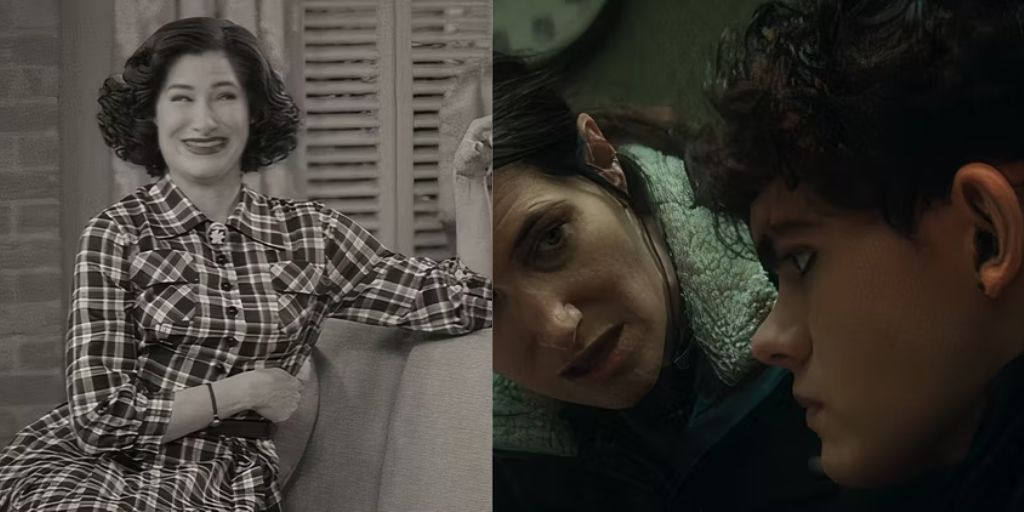
Still from Agatha All Along (Credit: Disney+)
We also discover that the Salem Seven are not random enemies but are, in fact, the children of the witches Agatha killed. Agatha had spared their lives when she killed their parents, and now, as adults, they have returned, wild and vengeful, to seek revenge on Agatha. This emotional connection between Agatha and the Salem Seven adds layers to the conflict and heightens the stakes of the story.
The episode continues to draw on WandaVision’s mix of references to real-world media. Each trial on the Witches’ Road has had its share of pop culture nods, and this episode is no different. The coven enters a new house, and as they step inside, their appearances immediately transform into something straight out of the 1980s horror genre.
This transformation brings back memories of classic horror films like Friday the 13th and The Evil Dead. The group of characters, trapped in a secluded cabin, is tormented by dark, supernatural forces. There’s even a nod to 1970s horror, as Agatha’s demonic possession in this episode reminds us of The Exorcist and its terrifying visuals. The showrunners clearly enjoy paying homage to these horror classics, making the episode feel both familiar and eerie for viewers who know the references.
As the episode progresses, it becomes harder to dismiss the theory that Rio Vidal could be Death herself. From the moment she is introduced, Rio appears to have a deep hatred for Agatha. In Episode 4, there’s a moment when Agatha believes Teen is dying, and she pleads softly with Rio, saying, “Don’t.” It almost feels as though Agatha is begging Death to spare Teen’s life.
In this episode, this idea becomes more concrete when the coven uses an Ouija board to communicate with the spirit world. As they spell out a word, the letters “D-E-A-T-H” appear. Rio laughs loudly when she sees this, reinforcing the idea that she might represent Death itself.
We also get to know more about Lilia Calderu, who is an interesting character in the coven. As a 450-year-old witch with the power of divination, Lilia often appears spacey and disconnected, but this is because she is in tune with premonitions about time and fate.
In previous episodes, Lilia has had moments where she shouts out random phrases, which seem meaningless at first. For instance, she once said, “Alice, don’t—” but didn’t finish the sentence. At another time, she screamed, “Try to save Agatha!” These moments seemed odd at the time, but when we look at them together, it seems like Lilia might have had a premonition. She might have been trying to warn Alice about what was going to happen to her.

Still from Agatha All Along (Credit: Disney+)
Alice’s power is drained when she tries to save Agatha by using her magic to banish Agatha’s mother’s ghost. In the process, Agatha absorbs Alice’s power, killing her. Lilia’s warning—“Alice, don’t try to save Agatha!”—might have been a prediction of this tragic moment. The episode leaves us wondering whether Lilia’s scattered thoughts are actually clues about what’s to come, hidden beneath the surface of her seemingly random outbursts.
A key moment in this episode happens when Agatha hears Teen mention the name Nicholas Scratch. This is important for several reasons. First, it confirms for the audience that Agatha’s son, Nicholas, is dead. He communicates with Teen through the Ouija board, which prompts Teen to say his name aloud. This breaks Agatha out of her attack on Alice, giving her a moment of realization.
The scene also suggests that Teen may not be Agatha’s son after all. Nicholas Scratch’s voice is heard calling out to his mother, and the fact that Teen can say his name, despite being under a spell that prevents him from speaking his own, hints that Teen is someone else entirely.
This leads to a big reveal at the end of the episode, confirming a long-standing fan theory. We learn that Teen is actually Wiccan, also known as Billy Kaplan or Billy Maximoff, the son of Wanda Maximoff, played by Elizabeth Olsen. The episode leaves many questions unanswered, though. Who placed the sigil on Teen that prevents him from revealing his true identity?
Did Teen always know who he was, or was he kept in the dark for some reason? When Agatha confronts him, he uses his powers to skillfully control Jennifer and Lilia, forcing them to push Agatha into a pit of magical energy. This shows that Teen has significant control over his abilities, which could mean that he has been pretending all along.
The reveal that Joe Locke’s character is Wiccan adds another layer of complexity to the story. We’re left wondering how Billy exists in this universe and what his real backstory is. In previous episodes, we’ve heard Teen talk about his childhood in Eastview, his parents, and his boyfriend. But now we know that much of what he said might have been false or misleading.
Who placed the spell on him, and why? Was it Wanda herself, trying to protect her son, or could someone else have been responsible? These questions create suspense for the next episode, keeping viewers on edge as they wait to see how this storyline unfolds.

Still from Agatha All Along (Credit: Disney+)
Agatha’s journey in Agatha All Along is becoming more complex with each episode. Her power continues to grow, but with it comes the risk of losing those close to her. The Salem Seven are closing in, and the dangers of the Witches’ Road seem never-ending.
As Agatha faces the consequences of her past actions, we’re left to wonder how much more she can endure and what other secrets will be revealed about her history and connections to the Marvel universe.
The latest episode of Agatha All Along intensifies the ongoing story, bringing more depth to Agatha Harkness’s character while introducing shocking twists about those around her. The revelation that Teen is actually Wiccan, the son of Wanda Maximoff, dramatically alters the narrative.
It forces us to question how much of Teen’s journey has been real and whether he’s been playing a larger game all along. The eerie presence of Rio Vidal, potentially representing Death, further complicates matters, leaving viewers to speculate about her true intentions and role in the storyline.
The tension between Agatha and the Salem Seven builds as the witches’ thirst for vengeance puts Agatha in more danger than ever before. With every trial along the Witches’ Road, Agatha is forced to confront her past, her choices, and the consequences of her actions.
Her powers, while formidable, come at a cost, as seen in her unintentional killing of Alice Wu-Gulliver. This moment highlights the dark, unpredictable nature of magic in the show and the constant threat of betrayal and loss among the coven members.
As the mysteries surrounding Agatha’s son, Nicholas Scratch, and the coven deepen, the episode leaves us eagerly anticipating what’s to come. With Agatha facing enemies from both her past and present, her journey seems far from over.
The next episodes promise more revelations about her connection to the broader Marvel universe and the ultimate fate of the witches who have followed her. Will Agatha be able to defeat her enemies and survive the trials ahead, or will her past continue to haunt her, leading to even greater sacrifices? The stakes have never been higher for Agatha and her coven, and fans can expect more thrills in the episodes to come.
