An old rivalry is about to ignite in The Lord of the Rings: The Rings of Power. In Season 2, Episode 5, titled “Halls of Stone,” Ar-Pharazôn (played by Trystan Gravelle) speaks to his son, Kemen (Leon Wadham), about seeing the shores of Valinor from Númenor. His words are filled with bitterness.
He resents that Elves live forever in the Undying Lands, while Men must face their mortality. This growing dislike for Elves is spreading across Númenor, but why do the people of this island dislike Elves so much? They once fought together, so what changed?
Númenor’s History Is Linked to the Elves
Listening to Ar-Pharazôn’s harsh words about Elves, it seems surprising that Númenor’s origins are tied to them. In the third episode of The Rings of Power, titled “Adar,” we see Galadriel (Morfydd Clark) and Elendil (Lloyd Owen) showing Númenor’s archives.
They discover information about Elros, the first king of Númenor and the brother of Elrond (Robert Aramayo). Both Elros and Elrond are half-Elven, meaning they were given the choice by the Valar to live as either Elves or Men. Elros chose to be a Man, while Elrond chose to live as an Elf.
The relationship between Elves and Men dates back to long before Númenor’s founding. In the First Age, Elves and Men had good relations.
There were even two important couples from both races, Beren and Lúthien, and Tuor and Idril, from whom Elros and Elrond are descended. At that time, Middle-earth was larger and included the continent of Beleriand, where many Elves and Humans lived.
However, the First Age was also a time of constant battles between the Free Peoples of Middle-earth and Morgoth, the Dark Lord. Elves and Men often fought together but were only able to defeat Morgoth when the Valar left Valinor to join the fight.
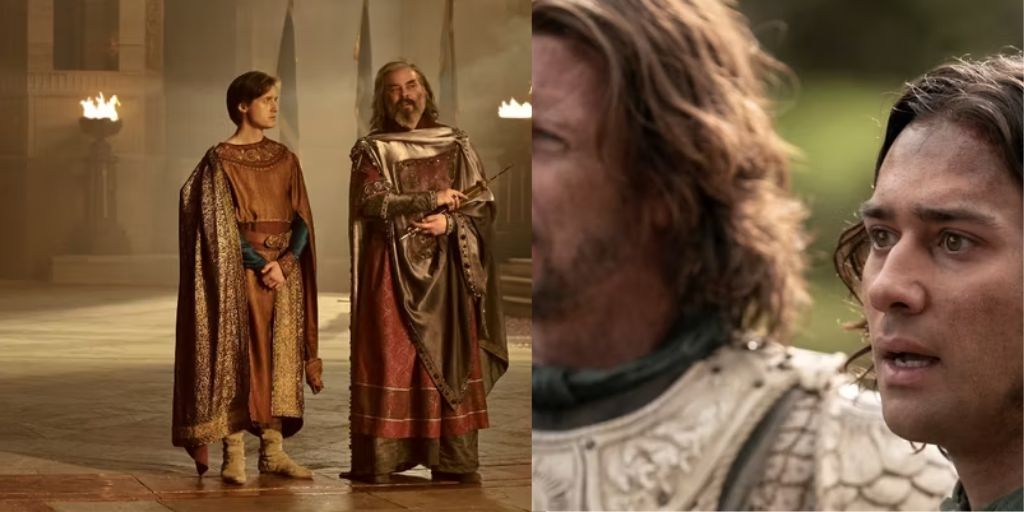
Still from Rings of Power (Credit: Prime Video)
This conflict, known as the War of Wrath, caused so much destruction that Erú Ilúvatar, the god-like creator of all in Tolkien’s world, decided to sink Beleriand, reshaping the geography of Middle-earth.
Rewards and Rivalries: The Changing Relationship Between Elves and Men
After the War of Wrath, both Elves and Men were rewarded for their bravery. The Elves, known as the Eldar, were allowed to return to the Undying Lands of Valinor. Meanwhile, the Humans who had helped fight Morgoth were called the Edain, and the Valar gave them the Isle of Elenna, where they founded the kingdom of Númenor.
The Edain were also blessed with longer lives and greater strength than other Humans. With their own kingdom and enhanced abilities, it seemed the Edain had everything they could wish for.
In the beginning, the people of Númenor kept close ties with the Elves, especially those from Eressëa in Valinor and from Middle-earth, like Gil-galad’s Elves in Lindon.
The Númenóreans learned much from them, including wisdom, craftsmanship, and knowledge about the world. Their friendship was considered valuable. Early Númenórean kings and their people were loyal to the Valar and continued to help Middle-earth in its fight against Sauron (Charlie Vickers).
But this did not last. As time passed, pride and corruption started to take over Númenor’s leaders and people. They began to envy the Elves’ immortality and resent their own mortality. Ar-Pharazôn’s bitter words in “Halls of Stone” reflect this growing tension.
The division between the Faithful, who remained loyal to the Valar and Elves, and the King’s Men, who envied and hated them, grew deeper. This schism became more pronounced after Ar-Pharazôn led Númenor in a war against Sauron and brought him to the island as a prisoner.
Sauron, however, soon manipulated Ar-Pharazôn and became his trusted advisor. Under Sauron’s influence, many Númenóreans began worshipping Morgoth, the first Dark Lord, further corrupting the island’s society.
Eventually, Ar-Pharazôn set his sights on Valinor, intending to conquer it and gain immortality. Erú Ilúvatar, seeing this as a threat, intervened once again.
He sank the Isle of Elenna, just as he had done with Beleriand, and reshaped the world to prevent Men from reaching Valinor. Before this event, the world of Arda (Middle-earth’s planet) was flat. Erú changed it into a sphere and separated the continent of Aman, where Valinor is located, from the rest of the world.
The Faithful’s Survival and the Elves’ Continued Role
After Ar-Pharazôn’s conversation with Kemen in The Rings of Power, we see Tar-Míriel (Cynthia Addai-Robinson) and Elendil discussing the visions revealed by the Palantir. Míriel has seen Númenor’s destruction many times, and she knows the island’s future is grim.
While she goes into seclusion, Elendil and the Faithful are labeled as outlaws. In Tolkien’s books, Elendil and his sons, Isildur (Maxim Baldry) and Anárion manage to escape Númenor during its fall, taking the Faithful with them. Guided by a storm sent by the Valar, they arrive safely in Middle-earth.
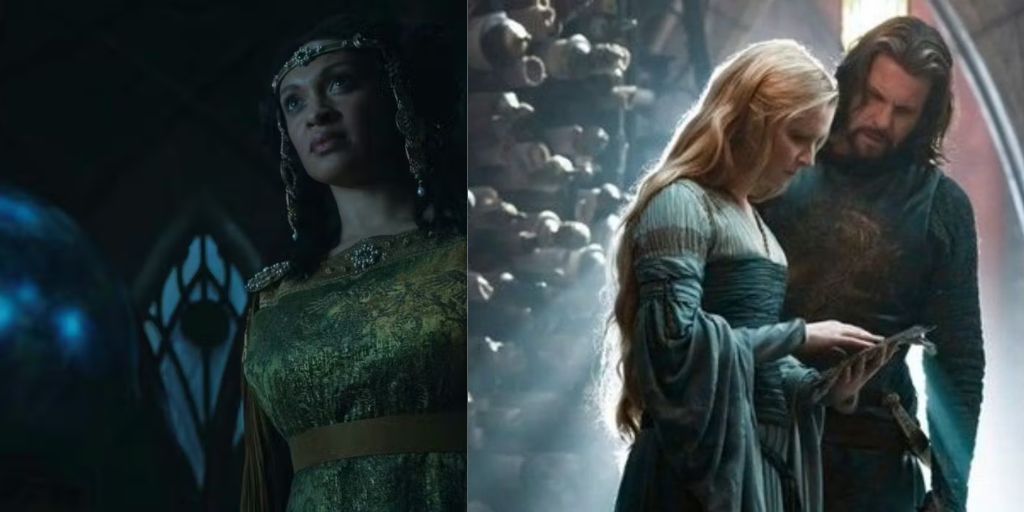
Still from Rings of Power (Credit: Prime Video)
After losing their homeland, the Faithful rely on the Elves for assistance in Middle-earth. With their help, Elendil establishes the northern kingdom of Arnor, while Isildur and Anárion create the southern realm of Gondor.
By the time of the Third Age, most of the Edain are gone, and the Faithful’s descendants are known as the Dúnedain. Among them, the most famous is Aragorn (Viggo Mortensen), who is a direct descendant of Isildur, making him the rightful heir to both Arnor and Gondor.
Season 2 of The Rings of Power is streaming on Prime Video in the U.S., with new episodes available every Thursday.
There’s a song in the Australian musical The Deb called “Pretty Strong,” and that’s a good way to describe Rebel Wilson’s first time directing a movie.
This bright and lively musical is about finding beauty in a dusty small town. At times, it’s as catchy as its songs, at times as bold as its wildest characters, and sometimes as boring as the scenery around the town of Dunburn, Australia.
Maeve is always quick to criticize people she disagrees with or take credit for any activism she decides to support. But after one too many risky moves, she exposes herself (literally) online and gets expelled from her fancy world, earning the nickname “cancel pig.”
What Is The Deb About?
Maeve’s mother sends her away to a small town about six hours from Sydney (or eight hours by bus) to stay with her cousin Taylah (Natalie Abbott). Maeve is a fashion-loving city girl, and she sees herself as the “feminist voice of [her] generation.” Taylah, on the other hand, lives in the country where her daily tasks include herding sheep and dealing with pigs.
This sets up the typical “city girl meets country girl” dynamic, where Maeve is fashionable and popular while Taylah is seen as frumpy and awkward. However, the movie doesn’t just rely on these stereotypes—it plays with them in a fun way, both celebrating and poking fun at them throughout the story.
When the local mean girl, Annabelle (Stevie Jean), arrives with her friends Daniele (Brianna Bishop) and Chantelle (Karis Oaka), Maeve quickly shows her sarcasm and rolls her eyes at the typical small-town drama.
Maeve arrives just in time for the preparations for the debutante ball. This is a traditional event where local girls are formally introduced to society, wearing big, marshmallow-like gowns made by a local seamstress (Tara Morice).
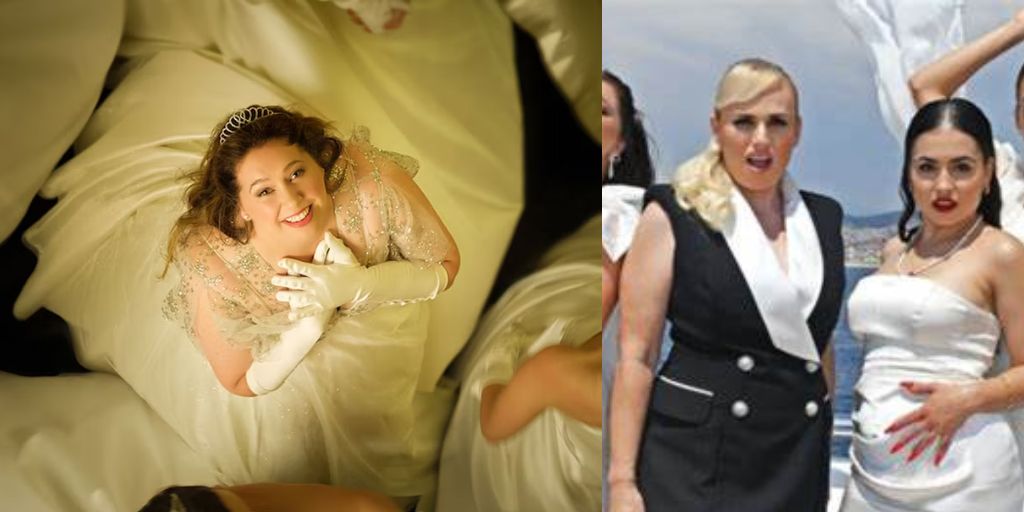
Still from The Deb (Credit: TIFF)
While Taylah’s father (Shane Jackson) struggles to keep the farm running during a drought, he also has his duties as the mayor to try and get funding from the city. The story is a comforting, if predictable, tale of rebellious teenagers and the ups and downs of being popular.
Many dramatic moments bring the characters closer or push them apart as things go wrong. Given Rebel Wilson’s background with movies like Bridesmaids and Pitch Perfect, it’s easy to see the connection here. Australia has a strong tradition of over-the-top musicals, and The Deb fits right in with that style.
Australian Musical Traditions
Australia has embraced both the seriousness and silliness of musicals for a long time. When Hollywood stopped making as many big musicals, Australian movies like Moulin Rouge by Baz Luhrmann, The Adventures of Priscilla, Queen of the Desert by Stephen Elliott, and Muriel’s Wedding by P.J. Hogan showed that there was still a place for these types of films.
These movies mixed music and drama in new ways, and The Deb follows in their footsteps. Rebel Wilson has made a career out of combining raunchy humor with broad comedy, and in this movie, she swaps Cats’ famous Jellicle Ball for a debutante ball.
It might seem like her character, Janette, a local hairdresser and stage mom, would steal the show, but Wilson blends in well with the other characters, even when her jokes are a bit silly. Her shop, “Curl Up ‘n Dye,” is a perfect example of this kind of humor—cheap, but funny.
The Deb Has Catchy Songs
The songs, which are the heart of any musical, are fun and clever. They’re a mix of pop music, hip-hop beats, and grand, dramatic moments that are sure to be popular in high school music groups as soon as the film comes out.
While the movie doesn’t reach the same heights as Hairspray—another musical with a curvy lead character and a mix of sincerity and camp—it’s still impressive. The camera work is sweeping, the performances are heartfelt but never too sappy, and the dancing makes good use of the different settings.
There’s also the issue of the lawsuits surrounding the film, which cast a shadow over its release. But if we ignore that and focus just on what’s on the screen, The Deb is a fun, rowdy film with enough humor and sass to entertain even the most skeptical viewer.
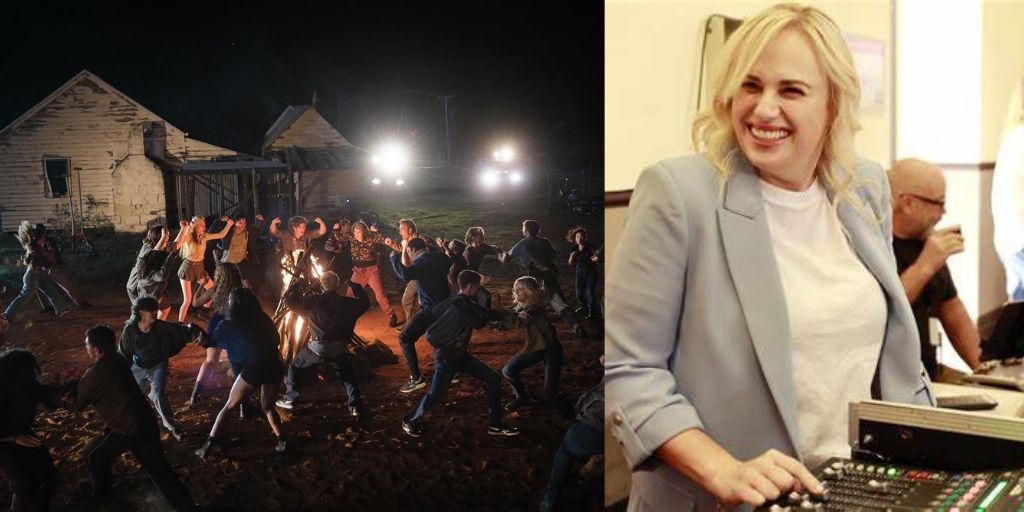
Still from The Deb (Credit: TIFF)
Whatever drama may have happened during filming, it doesn’t show in the final product. The characters go through a range of emotions, from over-the-top to heartfelt, and it’s hard not to be drawn in by the quirky townspeople deep in the Australian countryside.
A Fun, Heartfelt Musical
The Deb is both obnoxious and sincere, often at the same time. Its moments of musical fun perfectly express the feelings of the characters, who are all from different backgrounds but share the same small town.
The film could have used even more songs from the original stage production, but the ones that made it in are smart, energetic, and memorable.
With its clever lyrics, catchy tunes, and dedicated cast, The Deb is a shining example of Australian musical films. It’s a must-watch, even for people who are usually not fans of this kind of musical adventure.
