Blink Twice is a psychological thriller directed by Zoë Kravitz, who co-wrote the screenplay with E.T. Feigenbaum. The film explores dark and unsettling themes, propelled by a stellar cast and an intense storyline. Blink Twice is a haunting exploration of power, manipulation, and revenge, offering a triumphant yet devastating ending. At the core of its plot is the story of Frida and her survival on an isolated island controlled by the tech mogul, Slater King.
Blink Twice Ending Explained
As Blink Twice nears its end, Frida and Sarah discover the horrifying truth about the island. They learn that snake venom, introduced to them covertly, negates the amnesiac effects of a perfume designed to erase their memories. This realization sets the stage for a harrowing act of resistance. Frida and Sarah, who had been subjected to abuse and manipulation by Slater and his friends, secretly begin to use the snake venom to regain their memories.

Sarah (Image via Getty)+
Frida recalls that she had been on the island the previous year and begins to understand the full extent of what had transpired. Armed with this knowledge, she and Sarah fight back. The climax sees Frida and Sarah confronting Slater, Vic, and others. Some of the abusers are killed in the process. In a climactic scene, a candle is knocked over, causing Slater’s mansion to catch fire. Frida saves Slater, dragging him out of the burning building.
The film’s final moments reveal a drastic shift. Frida, who had once been a victim, is now the CEO of Slater’s company. Meanwhile, Slater, who is left in a state of confusion, has forgotten the events of the past.
What Happens to Sarah?
Sarah’s fate after the events of the island is left ambiguous. In the final scenes, she is conspicuously absent from a gala attended by Frida and Slater. While Frida and Sarah had teamed up to fight back against their abusers, Sarah’s departure suggests she was not as aligned with Frida’s plan. It appears that Sarah may not have wanted to continue her involvement with Slater or his world.
Sarah’s absence hints at her desire for healing, likely wishing to distance herself from the traumatic experience. She might have been uncomfortable with the dangerous plan Frida set in motion, a plan that put them both at risk. Although Sarah’s future remains unclear, she might have returned to her previous life, choosing to live with the painful memories instead of further confronting the past.
Frida’s Plan: Will It Last?
Frida’s new role as the CEO of Slater’s company seems to give her a position of power, but her plan to make Slater forget his past comes with risks. She continues to lace his vape with snake venom, ensuring that he remains unaware of his actions. However, the long-term viability of this plan is uncertain. As she exerts control over Slater, her actions may eventually attract suspicion, especially from those close to her.

Frida (Image via Getty)
Despite being married to Slater, Frida’s control over the situation might not last forever. While her position as his wife provides a perfect cover, the reality of continually using the venom on Slater and his therapist raises questions. Will Frida’s conscience catch up with her, or will she be able to keep the manipulative cycle intact for the foreseeable future? There is a sense of fragility in her control over Slater’s memory, and the possibility of it unraveling looms.
The Disconnect With Stacy
One of the more poignant moments in Blink Twice involves Stacy’s reaction to Frida’s plan. Frida, believing that giving Stacy the snake venom would allow her to join the effort against Slater, is met with disappointment. Instead of joining the cause, Stacy reacts with anger. She is unwilling to confront her past or the truth, preferring to live in forgetful bliss. This indicates a deeper complexity to Stacy’s character, revealing that she would rather ignore the trauma than deal with its aftermath.
Stacy’s actions also highlight a broader theme in the film: not all victims are capable of becoming allies. Despite being a victim herself, Stacy chooses to avoid the painful truths of her past, even if it means enabling Slater’s actions. She turns her back on Frida, Sarah, and the others who are attempting to fight back, choosing self-preservation over justice.
Slater King’s Belief in Forgetting Over Forgiving
A central theme in Blink Twice is the concept of forgiveness versus forgetting. Slater King, played by Channing Tatum, firmly believes in forgetting as the key to moving forward. He sees forgetting as a gift, a means of freeing oneself from the burden of painful memories. To Slater, forgiveness is unattainable as long as someone remembers their trauma. His belief in forgetting gives him power over others, allowing him to manipulate them without consequence.
Throughout the film, Slater’s perspective is revealed as part of his distorted view of reality. His refusal to accept forgiveness for his past actions is central to the way he controls those around him. For him, erasing the past is a way to maintain power, ensuring that he remains unburdened by the consequences of his abuse.
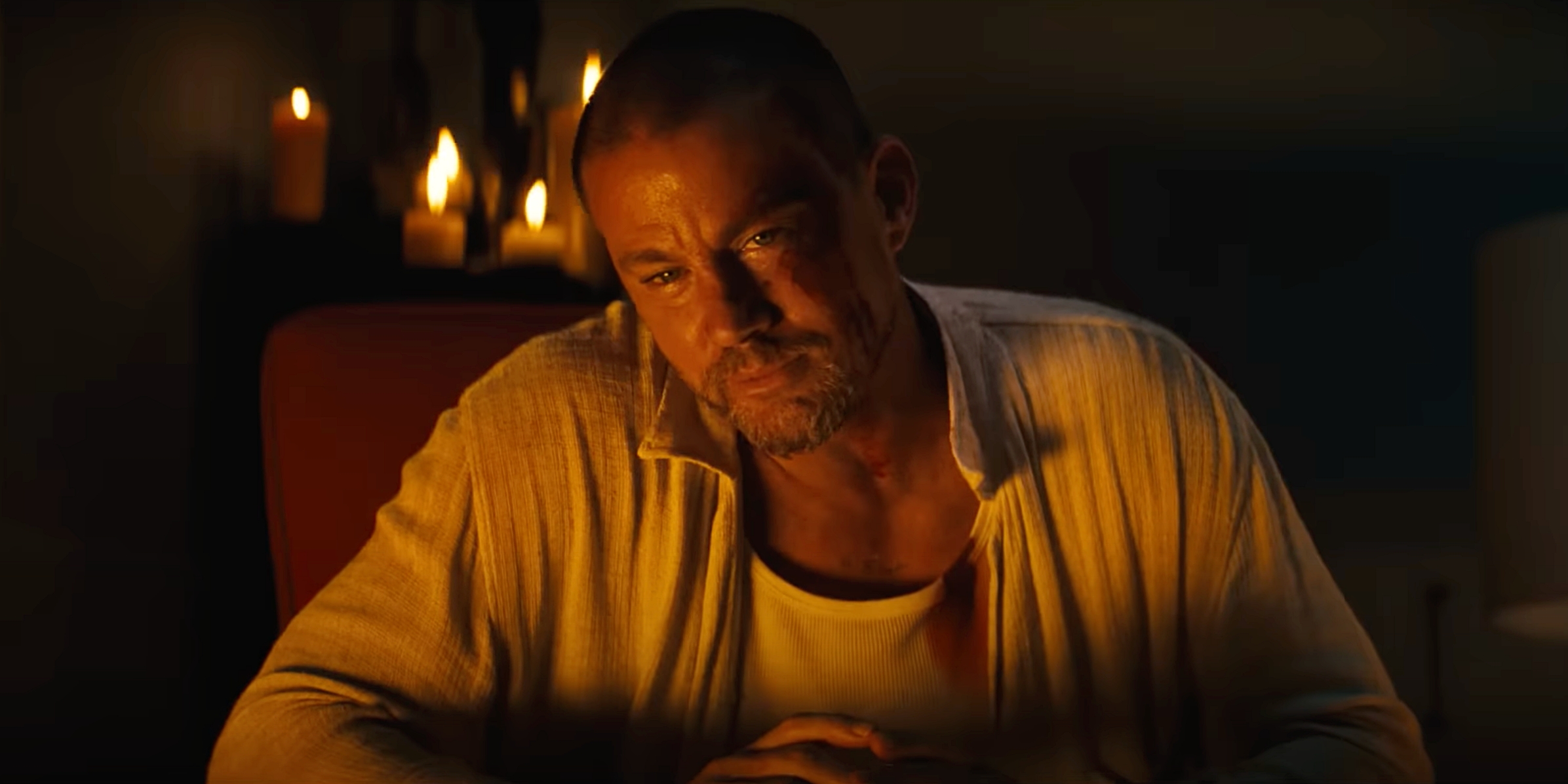
Slater King (Image via Getty)
The Cycle of Abuse in Blink Twice
Blink Twice delves into the cyclical nature of abuse, illustrating how victims can become abusers in turn. The film examines how power dynamics operate between those who hold influence and those who are subjugated by it. As Frida takes control of Slater’s company, she becomes a manipulator in the same way he once was. Although her actions are fueled by revenge, she ultimately assumes the same role that trapped her on the island.
This shift in power highlights the film’s critical message: without intervention, cycles of abuse are often perpetuated. Frida, though justified in her actions, becomes a reflection of Slater, reestablishing the very dynamics she had fought so hard to escape. The film suggests that breaking the cycle of abuse is difficult, and even when victims gain power, the scars of their experiences can push them to replicate the very behaviors they once suffered under.
Critical Reception and Audience Reactions
Blink Twice has been met with a mixture of praise and criticism. Many critics have lauded the film for its exploration of power dynamics and its commentary on abuse, with some comparing it to real-world cases of exploitation. Channing Tatum’s performance as Slater has been singled out for its intensity, and Naomi Ackie’s portrayal of Frida has been praised for its emotional depth. The film has garnered a Certified Fresh score of 75% on Rotten Tomatoes, with audiences offering a slightly lower 71% score.
E.L. Katz’s Azrael is a gripping action-horror film that follows its protagonist, Azrael, through a dark post-apocalyptic world. Set many years after the biblical Rapture—the final ascension of the righteous to Heaven—the movie presents a world riddled with demonic humanoid creatures known as the Burned Ones. These terrifying beings are relentlessly driven by an insatiable hunger for human flesh. In this bleak environment, survival is a constant struggle, and Azrael, played by the iconic Samara Weaving, stands at the center of this story.
The film begins with Azrael and her lover, Kenan, fleeing through the woods, desperate to escape a cult of survivors. The cult believes speech is a sin and has taken drastic measures—surgically removing their vocal cords in response to their belief that this is why they were not chosen during the Rapture. As the story unfolds, Azrael and Kenan are captured, separated, and tied up in what appears to be a sacrificial ritual. Azrael narrowly escapes the Burned Ones, who almost consume her. However, one of her captors is torn apart and dragged off by these creatures.
The cult’s belief system is rooted in the worship of the wind, which they see as an extension of God. Miriam, a pregnant leader of the cult, interprets the wind’s will for the group. As the film progresses, Azrael finds Kenan nailed to a tree, serving as a sacrifice to the Burned Ones. This discovery leads to her second capture, which she again manages to escape from, albeit with tragic consequences. Her guards and Kenan perish during this escape. Driven by a deep sense of rage and vengeance, Azrael decides to confront the cult head-on.
Upon returning to the cult’s camp, Azrael sets it on fire, using both a gun and a machete to eliminate the survivors one by one. Her bloodbath culminates in a final confrontation with Miriam and her right-hand woman, Josefine. Azrael kills Josefine and mortally wounds Miriam, who unexpectedly gives birth to a monstrous child. Seeing this baby causes Miriam to take her own life in horror. As the Burned Ones swarm the church in response to the baby’s cries, they close in on the scene, signaling the end of the cult’s reign.
Azrael Ending Explained

Azrael (Image via Getty)
The film takes a dark turn in its final moments. Miriam’s suicide is not only a reaction to the horrors of the world around her but also a horrifying realization that her child is the Antichrist, a figure deeply rooted in Christian lore. While the canonical Bible does not mention the birth of the Antichrist after the Rapture, many interpretations of Christian texts explore the concept. The Burned Ones, upon hearing the child’s cries, howl in what seems like triumph, suggesting their allegiance to Satan. This grim scene leaves the audience questioning Azrael’s true role in this dystopian world.
Azrael, however, is not fearful. She smiles while holding the baby, seemingly content with what has transpired. This moment is deeply significant, as it points to the true nature of her character and mission. The name Azrael itself provides a clue: in Abrahamic religions, Azrael is often referred to as the Angel of Death, a figure who carries out God’s will by transporting souls to the afterlife. In Azrael , this figure is portrayed not as a mere destroyer but as an agent of divine wrath.
The name Azrael may also reference the 2nd-century Christian text, the Apocalypse of Peter, where Azrael is described as the Angel of Wrath, who metes out punishments to the wicked. This suggests that Azrael’s violent journey is not just about seeking revenge for herself, but perhaps fulfilling a divine mission. Azrael’s smile, then, becomes an expression of satisfaction—she has successfully brought about the birth of the Antichrist, perhaps signaling her role as an agent of divine judgment.

Azrael (Image via Getty)
The Cult’s Religious Fanaticism and Why They Targeted Azrael
Throughout Azrael , the cult’s disturbing beliefs form a core part of the story. The followers’ extreme silence is a defining feature of their faith, with speech being regarded as a sin. While the film does not provide a direct explanation for this belief, the most likely reason stems from the cult’s deep-rooted fear of attracting the Burned Ones. These creatures are drawn not only to blood but also to sound, and the cult’s silence may serve as a method to protect themselves from detection.
The cult’s beliefs are twisted versions of Christianity, shaped by the aftermath of the Rapture. In an effort to avoid the same fate as those left behind, they have created a new, more extreme version of faith. The need for complete silence could be rooted in the same mindset as self-flagellation—punishing oneself for perceived sins in an attempt to atone. Yet, this silence is a voluntary practice among the cult members and sets them apart from other survivors in the post-rapture world.
Azrael and Kenan’s flight from the cult is an act of rebellion against their oppressive religious practices. Their departure marks them as targets, and it becomes clear that the cult views them as blasphemous. The cult’s efforts to sacrifice them to the Burned Ones are driven by their belief that Azrael and Kenan represent a threat to their rigid, distorted faith.

The Burned Ones: Agents of Hell or Human Punishments?
The Burned Ones are central to Azrael’s horror, and their true nature remains shrouded in mystery. They are humanoid creatures, resembling burned humans who have somehow managed to survive. While the film does not explicitly explain their origins, it hints at their connection to the Rapture, suggesting that they were created either during or after this cataclysmic event.
The Burned Ones’ insatiable hunger for human flesh and blood, coupled with their brutal methods of killing, points to their possible role as agents of Hell. They seem to exist to punish the wicked, particularly those who were not chosen during the Rapture. However, their tragic appearance—suggesting they were once human—leaves open the possibility that they are suffering a punishment of their own, inflicted by a higher power.
Azrael’s encounter with one of the Burned Ones in a tunnel provides a crucial moment in the film. When the creature smells the blood under her nails, it refrains from attacking her. This implies that Azrael may have unknowingly become a vessel for the Antichrist, making her untouchable to the Burned Ones. This moment of survival provides a key piece of the puzzle, offering a glimpse of Azrael’s true purpose.
