Clint Eastwood, at the age of 93, remains an iconic figure in the domain of movies. His legendary career has earned him four Academy Awards, and even now, he continues to make films. He shows no signs of slowing down, and it seems he will keep working until he physically cannot anymore.
With a career spanning several decades, he has directed 41 films, worked with Hollywood stars across generations, and is widely regarded as the most famous cowboy to ever appear on the big screen. Now, Clint Eastwood is preparing to return with what might be his final film, Juror No. 2.
Juror No. 2 is expected to be released on Friday, November 1, 2024. It faces competition from other potential Oscar-contending films, including Robert Zemeckis’ Here, Steve McQueen’s Blitz, and Jesse Eisenberg’s A Real Pain, which are all scheduled to open on the same day.
Before this official release, Juror No. 2 will have its world premiere on October 27, 2024, at the 2024 AFI Fest. Bob Gazzale, the president of AFI, expressed his excitement in a press release:
“There is only one Clint Eastwood — and AFI is proud to present the World Premiere of this next chapter in his historic canon. We are honored to bring the community together once again – artists and audiences – to celebrate an American icon.”
The film will first be released in a limited number of theaters, starting on November 1, 2024. There has been no official announcement yet about a broader release, but it is expected that the movie will likely expand into more theaters in the weeks following its initial release.
In 2021, Warner Bros. made headlines by releasing their entire film slate simultaneously in theaters and on HBO Max, including Clint Eastwood’s previous movie Cry Macho. However, this approach will not be used for Juror No. 2. Instead, Warner Bros. released the official trailer for the film on October 1, 2024, one month before its limited release.
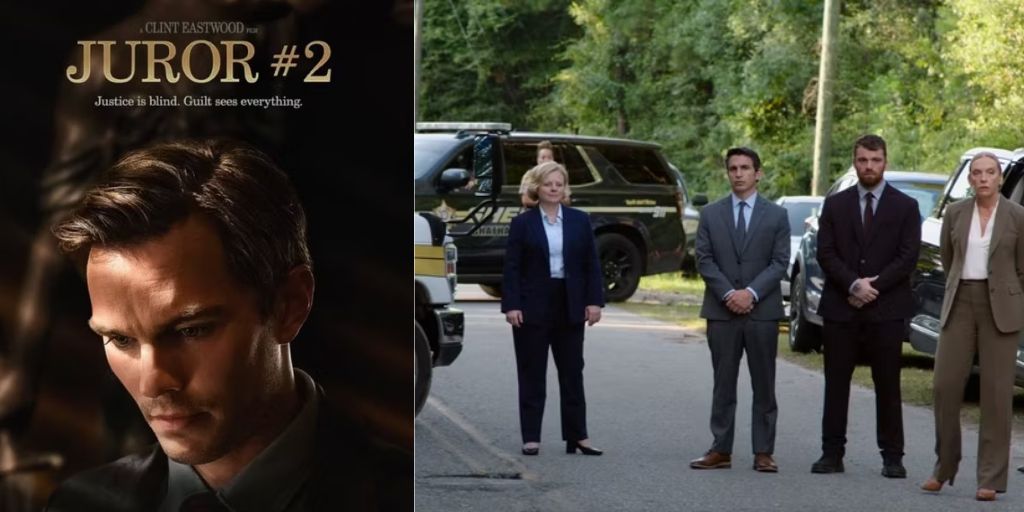
The trailer introduces the main character, Justin Kemp, as he talks about a drunk driving accident that he was involved in a year earlier. He believed he had hit a deer but later realizes he may have been responsible for a woman’s death in a hit-and-run accident.
As the story unfolds, we learn that Justin has been called for jury duty, and the accident aligns with the case he is now serving on as a juror. The hit-and-run he was involved in occurred the same night as the crime being tried in court, and Justin begins to question whether he is responsible for the woman’s death, not her abusive boyfriend who is on trial.
The trailer closes with a tense moment, showing Justin sitting in the juror’s seat as his Alcoholics Anonymous (AA) sponsor tells him, “You know what to do.” Juror No. 2 will be a courtroom drama, as suggested by the title. The film follows Justin Kemp, a family man, who begins to realize that he may have been responsible for the death of the victim in a case he is serving as a juror on.
As Justin faces this moral dilemma, he must find a way to save the defendant without incriminating himself in the process. Warner Bros. released the official synopsis of Juror No. 2, which reads:
“Juror #2” follows family man Justin Kemp (Hoult) who, while serving as a juror in a high-profile murder trial, finds himself struggling with a serious moral dilemma…one he could use to sway the jury verdict and potentially convict—or free—the accused killer.”
The lead role of Justin Kemp is played by Nicholas Hoult, known for his work in The Menu. The film also stars Academy Award nominee Toni Collette (Hereditary), who will play the district attorney, though her character’s name has not been revealed. This marks the first time Hoult and Collette have worked with Clint Eastwood, though they had previously played a mother-son duo in the 2022 film About a Boy.

Still from the season (Warner Bros)
Gabriel Basso, best known for his starring role in the Netflix series The Night Agent, will play James Sythe, the defendant on trial in Juror No. 2. Francesca Eastwood, Clint Eastwood’s daughter, will portray Kendall Carter, James’ girlfriend.
The cast of Juror No. 2 includes many other prominent names. J.K. Simmons, an Academy Award winner known for his role in Whiplash, will play Harold, one of the jurors. Zoey Deutch (Set It Up) will take on the role of Ally, Justin Kemp’s wife. Kiefer Sutherland, famous for his role in 24, will portray Justin’s AA sponsor, Larry Lasker.
Other members of the cast include Chris Messina (Air) as the public defender, Leslie Bibb (Palm Royale) as another juror, and Eastwood’s longtime friend and actor Donald Sutherland, with whom he starred in the 1970 film Kelly’s Heroes.
The cast also includes Amy Aquino (Bosch), Adrienne C. Moore (Orange is the New Black), Cedric Yarbrough (Reno 911!), Chikako Fukuyama (Blade of the 47 Ronin), Onix Serrano (Fantasy Island), Phil Biedron (Till), Hedy Nasser (The Idea of You), Drew Scheid (Mare of Easttown), Jason Coviello (Stranger Things), Rebecca Coon (The Menu), and Zele Avraopoulos (A Family Affair).
J.K. Simmons shared his thoughts about working with Clint Eastwood while speaking to Collider’s Steve Weintraub at the 2024 Toronto International Film Festival. He said:
“It was fantastic. When my wonderful agent sent it to me, he was like, ‘Eh, it’s not a great part, probably a pass.’ I read it, and it’s a very nice medium-small, little supporting part in it, but I was like, ‘Are you kidding me? It’s a Clint Eastwood movie. Am I gonna not do a movie with Clint Eastwood?’”
As mentioned earlier, Juror No. 2 will be directed by Clint Eastwood. This movie is rumored to be his final project before he retires. Clint Eastwood’s career needs no introduction. He began as an actor and became a global superstar for his role as “The Man with No Name” in Sergio Leone’s Dollars Trilogy. Another one of his most famous characters is San Francisco cop Harry Callahan from the Dirty Harry series.
Eastwood made his directorial debut in 1971 with Play Misty for Me, a psychological thriller in which he also starred. He has since won four Academy Awards, two for Unforgiven and two for Million Dollar Baby. He has also been nominated for seven additional Academy Awards, including nominations for Best Actor for both Unforgiven and Million Dollar Baby.
Still from the season (Warner Bros)
After Cry Macho, which received a lukewarm response from critics and didn’t do well at the box office, there were rumors that Warner Bros. wasn’t interested in working with Eastwood again. The company’s new CEO, David Zaslav, reportedly said, “We don’t owe anyone any favors,” after being told that Eastwood never turned in a film late or went over-budget. However, it seems that Zaslav has since changed his mind, allowing Eastwood to continue his work on Juror No. 2.
Clint Eastwood has brought together a talented team to work on Juror No. 2. Director of photography Yves Bélanger (Richard Jewell), production designer Ron Reiss (Cry Macho), and Academy Award-winning editor Joel Cox (Unforgiven) will be part of the crew. Joel Cox’s son, Dave Cox, will assist in the editing.
Deborah Hopper, who has worked with Eastwood on several projects, will handle the costume design. Mark Mancina, who composed the score for Cry Macho, will return to compose the music for Juror No. 2.
Filming for Juror No. 2 began in Savannah, Georgia, in June 2023, and additional photography took place in Los Angeles. However, production was halted in July 2023 due to the SAG-AFTRA strikes. Filming resumed in November 2023 after the strike ended. By April 2024, Eastwood had completed post-production on the film, and Warner Bros. executives were reportedly “thrilled” with the results.
As Clint Eastwood approaches what could be the final chapter of his illustrious career, Juror No. 2 serves as a fitting culmination of his legacy. With a storyline packed with tension, moral complexity, and a star-studded cast, the film promises to be a gripping courtroom drama that captures the essence of Eastwood’s directorial prowess.
Throughout his career, Eastwood has never shied away from finding characters in moments of deep moral conflict, and Juror No. 2 appears to be no different. The film’s coverage of guilt, responsibility, and justice is bound to resonate with audiences, making it not just a thrilling legal drama but a poignant reflection on human conscience.
For over half a century, Clint Eastwood has left an indelible mark on Hollywood, both in front of and behind the camera. His ability to tell compelling stories with minimal flash but maximum impact has earned him a unique place in cinematic history.
Whether Juror No. 2 is truly his last film or not, it stands as a testament to his continued relevance in the film industry. As fans and critics eagerly await its release, one thing is clear: Clint Eastwood’s impact on cinema will endure, long after the final credits roll.
“Queenie,” streaming on Hulu, brings to life the emotional and psychological journey of a young Jamaican-British woman, Queenie, following a turbulent phase in her life. The series is based on the best-selling novel by Candice Carty-Williams and features a deep scheme of Queenie’s internal struggles after a significant breakup.
However, her emotional journey is not limited to the heartbreak. It goes deeper into her personal history, cultural expectations, and sense of identity.
At the heart of the story is Queenie’s character (played by Dionne Brown), who is 25 years old and dealing with the emotional aftershocks of a breakup with her long-term boyfriend, Tom (Jon Pointing). The separation acts as a trigger, unresolved issues from her past.
As she grapples with the immediate pain of the breakup, she also finds herself confronting old wounds, strained family relationships, and her place in a society where race and gender play critical roles.
Queenie’s journey is multifaceted, touching on personal identity, relationships, family dynamics, and cultural expectations. Her inner monologue, used as a storytelling device, allows viewers to experience her emotions and thought processes in real-time, creating an intimate connection between Queenie and the audience.
This unique approach to narration sets “Queenie” apart from other book-to-TV adaptations, giving the show a distinct voice that resonates with its viewers.
A Closer Look at Queenie’s Life Post-Breakup
The central event that sets Queenie on her emotional journey is her breakup with Tom, a white British man with whom she shared a long-term relationship. This breakup doesn’t just end a romantic relationship; it opens up a floodgate of emotions that Queenie has long kept bottled up.
She tries to distract herself by engaging in casual relationships with other men, but it quickly becomes clear that these encounters are not fulfilling. The emotional attachment to Tom remains strong, and Queenie struggles to reconcile her feelings.
Queenie stays at her grandmother’s house as she attempts to move on from Tom. Her grandmother’s home represents a sanctuary, but it also brings its own emotional challenges. Queenie has a strained relationship with her mother, who abandoned her as a child, and being near her only exacerbates her feelings of discomfort and abandonment.
The women in Queenie’s family, particularly her grandmother, have always maintained a stoic, religious approach to life, repressing their emotions and focusing on survival. Queenie, however, breaks away from this family tradition by deciding to go to therapy, marking a pivotal moment in her journey toward self-discovery and healing.
Through therapy, Queenie begins to unpack the layers of trauma that have shaped her life. Her emotional struggles are not only rooted in her recent breakup but also in her unresolved childhood trauma, her complicated relationship with her mother, and the societal pressures she faces as a Black woman in a predominantly white society.
The show does an excellent job of portraying Queenie’s inner turmoil, showing how her past and present are in constant conversation with each other, affecting her self-worth and ability to form healthy relationships.
The Importance of Queenie’s Internal Monologue
One of the most distinctive aspects of the show is the way it uses Queenie’s internal monologue as a narrative device. From the very beginning of the series, it’s clear that Queenie often gets lost in her thoughts, and her internal dialogue becomes a key part of how she sees the world.
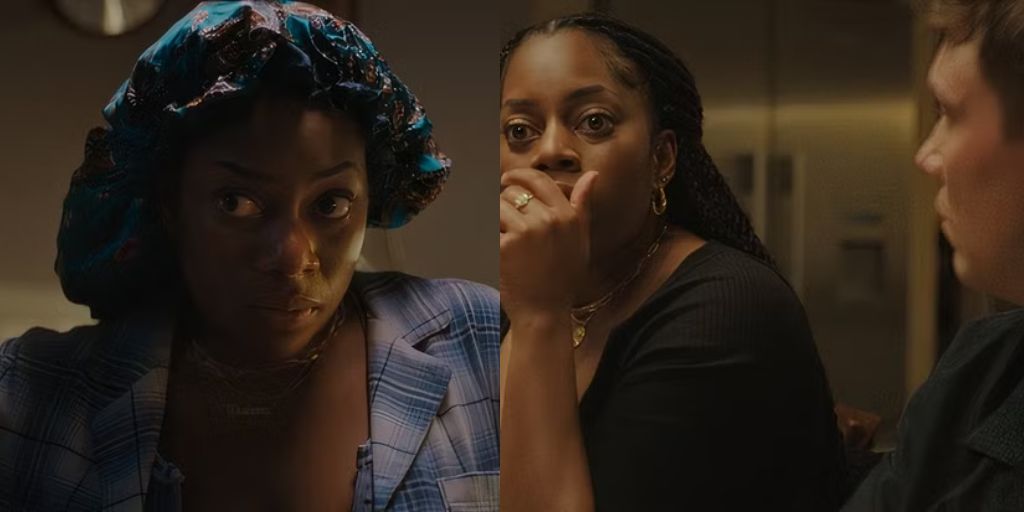
This is illustrated in a memorable scene early on, where Queenie is having dinner with Tom’s family. As the only Black person at the table, she already feels out of place, but when Tom’s grandmother makes an insensitive comment about any future children they might have being mixed-race, Queenie, caught up in her thoughts, accidentally blurts out an uncomfortable remark: “Hopefully, you’ll be dead and gone long before you even get to meet her.”
This moment, while awkward, perfectly captures how Queenie’s tendency to get lost in her thoughts can have real-life consequences. It’s a relatable experience for anyone who has ever been so consumed by their inner dialogue that they say something without thinking.
The show uses these moments of internal dialogue not only to provide insight into Queenie’s character but also to create a deeper connection with the audience. Queenie’s thoughts are often relatable, and hearing them aloud allows viewers to experience her emotions in a way that feels personal and authentic.
In many adaptations of novels, the connection between the narrator and the audience can be lost when the story is translated to the screen. Internal monologues, which are often a key feature of novels, are difficult to convey in film or television.
However, “Queenie” manages to preserve this connection by using voiceover narration in a way that feels natural and effective. Queenie’s thoughts are not just used for exposition; they are an integral part of the storytelling, allowing the audience to experience her journey from her perspective.
Queenie’s Struggle with Self-Worth and Identity
One of the central themes of “Queenie” is the protagonist’s struggle with self-worth and identity. As a Jamaican-British woman living in London, Queenie faces a unique set of challenges.
She often feels caught between two worlds – her Jamaican heritage and the predominantly white society she lives in. This sense of not fully belonging to either culture is a source of tension throughout the series, and it plays a significant role in Queenie’s emotional journey.
Queenie’s relationship with Tom, a white man, highlights some of the complexities of interracial relationships. While Queenie clearly loves Tom, there are moments where the cultural differences between them become apparent, particularly when they are around his family.
The scene at the dinner table is a prime example of how these differences can create discomfort and tension. Queenie’s internal dialogue during these moments reveals her anxiety about not fitting in and her fear of being judged based on her race.
In addition to the external pressures she faces, Queenie also grapples with internalized feelings of inadequacy. Throughout the series, she struggles to see her own worth and often seeks validation from others, particularly from the men she dates after her breakup with Tom.
Still from Queenie (Credit: Hulu)
These casual relationships, however, only serve to reinforce her feelings of low self-esteem. The men she encounters often treat her body with aggression and disrespect, which further erodes her sense of self-worth.
Therapy becomes a turning point for Queenie, as she begins to confront these feelings and unpack the emotional baggage she has been carrying for years. Through her therapy sessions, she learns to acknowledge the impact that her past has had on her present, particularly in terms of how she views herself and her relationships.
This process of self-discovery is not easy, and Queenie experiences both highs and lows as she goes her way through it. However, it is through this journey that she begins to reclaim her sense of self and gain a better understanding of who she is.
The Role of Family in Queenie’s Story
Family plays a significant role in Queenie’s story, particularly her relationship with her mother and grandmother. Queenie’s mother abandoned her when she was a child, and this act of abandonment has left a deep emotional scar.
Throughout the series, Queenie struggles to come to terms with her mother’s absence and the impact it has had on her sense of self-worth. Her feelings of abandonment are compounded by the fact that the women in her family, particularly her grandmother, have always been highly religious and emotionally reserved. They have built a practice of keeping their feelings in, focusing on survival rather than emotional expression.
This emotional repression is something Queenie has inherited, and it becomes a source of tension as she begins to break away from her family’s tradition by seeking therapy. Her decision to go to therapy represents a significant departure from the way her family has dealt with emotional issues in the past.
It is also a powerful statement about the importance of mental health and the need to confront emotional trauma rather than burying it.
Queenie’s relationship with her grandmother is also a key part of the story. While her grandmother’s home provides a sense of stability, it is also a place where Queenie is forced to confront her past.
Her grandmother’s stoic demeanor and strict religious beliefs create a challenging environment for Queenie, who is struggling to come to terms with her emotions.
However, despite these challenges, Queenie’s grandmother is also a source of strength for her, representing the resilience and survival that has been passed down through generations of women in her family.
The Impact of Race and Gender on Queenie’s Experience
Race and gender are central to Queenie’s experience, and the series does an excellent job of showing how these factors intersect in her life. As a Black woman living in a predominantly white society, Queenie faces both overt and subtle forms of racism.
This is particularly evident in her interactions with Tom’s family, where she often feels like an outsider. The series highlights how these experiences of racism can take a toll on a person’s mental health, contributing to feelings of isolation and inadequacy.
In addition to the challenges she faces as a Black woman, Queenie also grapples with the societal expectations placed on women in general. There is a recurring theme throughout the series of Queenie being expected to be strong and resilient, often at the expense of her own emotional well-being.
This idea of the “Strong Black Woman” is one that Queenie struggles with, as she is constantly trying to live up to the expectations of others while neglecting her own needs.
The series does a great job of showing how these societal pressures affect Queenie’s mental health and sense of self-worth. It also emphasizes the importance of mental health care, particularly for women of color, who are often expected to carry the weight of the world on their shoulders without complaint. By seeking therapy, Queenie challenges these expectations and takes a step toward prioritizing her own well-being.
The Power of Narration in Storytelling
One of the standout features of “Queenie” is its use of narration to tell the story from Queenie’s perspective. The series makes extensive use of voiceover narration, allowing viewers to hear Queenie’s thoughts as she faces the challenges in her life.
This narrative technique is highly effective in creating a sense of intimacy between Queenie and the audience. We are not just watching her story unfold; we are experiencing it alongside her, hearing her thoughts and reactions in real-time.
The use of narration in “Queenie” is particularly powerful because it allows the audience to understand the complexity of Queenie’s emotions. Her internal monologue is filled with self-doubt, anxiety, and conflicting emotions, all of which are familiar to anyone who has ever experienced emotional turmoil.
By hearing Queenie’s thoughts, we gain a deeper understanding of her character and the challenges she faces. It also makes her more relatable, as we are privy to the kinds of thoughts and feelings that many of us experience in our own lives.
This approach to storytelling is not often seen in film or television adaptations of novels, where the internal monologue of a character is usually downplayed or omitted altogether.

Still from Queenie (Credit: Hulu)
However, in “Queenie,” the narration is a central part of the story, and it is used to great effect to create a strong emotional connection between Queenie and the audience. It is a reminder of the power of storytelling and how the right narrative techniques can enhance the viewing experience.
Conclusion: Why Queenie is a Must-Watch
“Queenie” is more than just a story about a young woman going through a breakup. It is a deeply emotional and thought-provoking series that shows themes of identity, race, gender, and mental health. Queenie’s journey is one that many viewers will find relatable, as she grapples with issues of self-worth, family dynamics, and societal expectations.
The series stands out for its use of narration, which allows viewers to experience Queenie’s thoughts and emotions in a way that feels intimate and personal. By preserving the internal monologue that is central to the novel, “Queenie” creates a strong connection between the protagonist and the audience, making her journey all the more impactful.
For anyone looking for a show that offers a raw and honest portrayal of the complexities of life, love, and identity, “Queenie” is a must-watch. It is a powerful reminder that we all carry emotional baggage, but by confronting it head-on, we can begin to heal and find our way forward.
“Queenie” is available to stream on Hulu in the U.S.
