Claim
A viral picture authentically shows the night sky on Mars as a dazzling, hyper-detailed Milky Way above a rover deck, demonstrating “what Mars really looks like at night.”
Rating
Misleading
About this rating: The foreground appears Mars-like, but the sky is a composited/repurposed star field, not a rover photograph. NASA’s authentic rover imagery of Mars at night—including the well-known frame where Earth appears as a tiny dot —shows a much dimmer, dust-muted sky. The viral image is therefore misrepresented as documentary photography.
Context
In late 2025, posts across X, Instagram Reels, YouTube Shorts, and Facebook claimed to reveal an astonishing view of the Martian night sky : a rover or rover-like platform in the foreground beneath a glittering, color-rich band of the Milky Way. Captions typically asserted that this is how Mars looks after dark, sometimes implying the picture came from NASA’s Curiosity or Perseverance rover, or from a “new telescope on Mars.”

Fake photo of Mars Night Sky going viral on social media
NASA has, in fact, published real night-sky imagery from Mars. The most iconic example is Curiosity’s 2014 frame taken from Gale Crater, where Earth appears as a faint star-like point above the horizon. NASA’s official resource page for that image is here: https://science.nasa.gov/resource/earth-from-mars/ https://mars.nasa.gov/mars2020/multimedia/raw-images/

Earth from Mars Night Sky (Source: NASA)
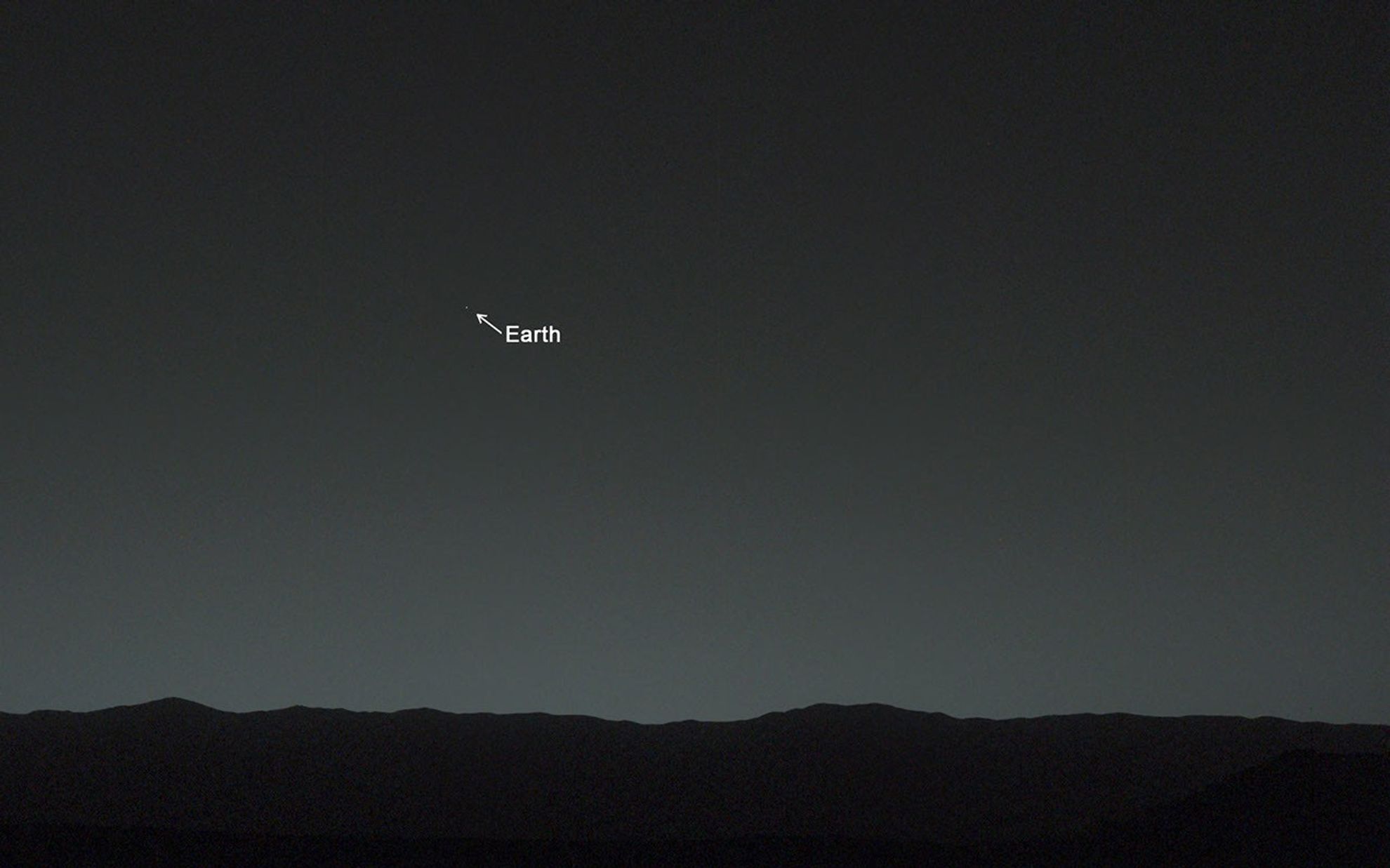
Earth from Mars Night Sky (Source: NASA)
That authentic photo, and others like it, establish the baseline for how Mars’ sky is recorded by rovers: subdued, dusty, and comparatively low-contrast—nothing like the viral composite.
You can check over 146,000 photos by NASA:
https://mars.nasa.gov/mars2020/multimedia/raw-images/

What the authentic record shows
- Dim, dust-affected skies: Mars’ atmosphere is thin but dusty. Fine particles scatter sunlight, especially at dusk and dawn when rovers often point cameras skyward. This reduces contrast and mutes the Milky Way’s glow.
- Rover cameras are geology-first: Systems such as Mastcam (Curiosity) and Mastcam-Z (Perseverance) are engineered to document rocks, layers, and hardware—not to operate as tracked deep-sky observatories.
- No sky tracking: Rovers do not use equatorial mounts that compensate for planetary rotation. Long exposures would trail stars, so sky frames are short, limiting faint detail.
- Provenance and metadata: Authentic rover photos are accompanied by a sol (Martian day) number, instrument name, and mission context, and they appear in NASA/JPL archives. The viral image lacks these identifiers and does not appear in official repositories.
In short, when NASA releases a night view from Mars, it looks modest and scientifically calibrated. The famous 2014 frame shows Earth as a small, bright dot against a dark horizon—powerful precisely because it is understated.
Why the viral picture is miscaptioned/misleading
Improbable Milky Way brightness and structure. The sky in the viral composition displays the kind of razor-sharp, high-contrast star field that, on Earth, requires tracked, multi-minute stacked exposures or a mosaic from professional observatories. A stationary rover mast camera cannot produce that look in a single frame.
Foreground/sky mismatch. The noise pattern, color curve, and dynamic range of the lower (terrain/rover) portion do not match the star field. This is a common giveaway that two unrelated images were combined.
Optical/pixel-scale tells. Across a very wide field, the stars remain ultra-pinpoint and evenly resolved—behavior typical of large, fast optics designed for astrophotography. Rover cameras have different pixel scales and aberration profiles.
Shifting attributions. As the image spreads, captions alternately credit Curiosity, Perseverance, and a speculative “Mars telescope.” Conflicting origin stories are a hallmark of repurposed or fabricated visuals.
Could Mars’ Milky Way ever look like that to a camera?
In principle, a human observer on a very clear, dust-low night on Mars could perceive the Milky Way band, just as on Earth at dark sites. But to record the Milky Way with the clarity and depth shown in the viral picture, you would need tools the rovers don’t carry: a tracking mount , long/stacked exposures , a large, fast aperture , and extensive post-processing . Mars missions prioritize science and safety, not gallery astrophotography; night imaging windows are short and tightly constrained.
How people get misled online
- A kernel of truth: NASA really did show Earth in Mars’ night sky —as a tiny dot—so viewers find dramatic “Mars night” claims plausible.
- Algorithmic aesthetics: Platforms reward eye-popping visuals. Subtle, accurate science images lose out to spectacle.
- Context collapse: With reshares, credits and caveats vanish; artwork or composites are retold as “NASA just released this.”
- Technical opacity: Most users don’t know instrument limits; without that context, nearly any space claim can feel believable.
What the real image looks like (and why it matters)
The authentic benchmark for a Mars night scene remains NASA/JPL’s 2014 Curiosity frame: a dark horizon under a dust-softened sky , with Earth as a star-like point . That quiet reality underscores scale, distance, and the constraints of imaging from another world. Presenting a composited Milky Way as a rover photograph blurs the line between art and documentary , undermining public trust and overshadowing the genuine achievements of planetary exploration.
How we verified
- Primary source review: NASA’s “Earth from Mars” page (Curiosity, 2014) establishes how the Martian night appears in official rover imagery and provides mission context and instrument information.
- Archive and capability check: Public NASA/JPL galleries list no rover images matching the viral sky’s star density and coloration. Rover camera documentation and usage confirm they are not tracked deep-sky systems.
Our verdict
False portrayal / Misleading. The viral picture is not a documentary photo of Mars’ night sky. It is a composite or otherwise manipulated image miscaptioned as a rover capture. The authentic appearance of a Martian night sky in NASA releases is restrained; at most, you may see a faint Earth as a small point of light.
Sources
- NASA: Earth from Mars (Curiosity, 2014) – https://science.nasa.gov/resource/earth-from-mars/
- NASA/JPL mission galleries and instrument overviews for Curiosity Mastcam and Perseverance Mastcam-Z (general capability context). – https://mars.nasa.gov/mars2020/multimedia/raw-images/
After her unforgettable performance as Rey in the Star Wars saga, Daisy Ridley has chosen a striking new direction with We Bury the Dead, a sobering blend of horror and emotional drama directed by Zak Hilditch.
The story follows Ava, a woman shattered by loss, who joins a body retrieval unit after a world-changing catastrophe. Her mission takes a devastating turn when she learns that the dead don’t stay buried.
The trailer showcases Ridley’s character trudging through desolate terrain, haunted by memories and the distant hope of finding her husband. This central emotional drive sets the film apart from typical apocalypse stories, as love fuels Ava’s resilience amid a world consumed by death.
Ridley portrays grief and determination with raw energy, carrying the story’s heart through both silence and chaos.
Since the Star Wars trilogy’s conclusion, Ridley has made deliberate choices to prioritize emotionally complex roles. With previous performances in The Marsh King’s Daughter and Young Woman and the Sea, her path has evolved toward stories grounded in personal turmoil rather than spectacle.
We Bury the Dead fits perfectly into that journey, portraying survival as both a physical and psychological struggle.
Brenton Thwaites joins Ridley in the leading cast, bringing his own action experience from Pirates of the Caribbean and Titans. The dynamic between their characters elevates the emotional tension, as their shared mission reveals the human cost of facing the undead.
Their chemistry holds the potential for some of the film’s most affecting scenes, where despair meets faint hope.
Zak Hilditch’s Vision: Humanity Amid Horror
Zak Hilditch has long displayed a fascination with disaster, choice, and remorse. His previous works, the grim apocalyptic drama These Final Hours and the Stephen King adaptation 1922, each dealt with ordinary people cornered by extraordinary catastrophe. We Bury the Dead continues this approach but magnifies it through the lens of love and loss.
The SXSW Film & TV Festival premiere earlier this year gave critics and audiences a first look at Hilditch’s understated yet terrifying direction. The film earned an 89% rating on Rotten Tomatoes from 19 reviews, with praise for its tension and emotional sincerity.
Reviewers commented on the film’s haunting sense of realism, as the horror stems not from exaggerated effects but from how people crumble and rebuild under trauma.
The teaser reflects Hilditch’s signature pacing, deliberate, quiet, and filled with dread. Light flickers through broken ceilings, muddy roads stretch endlessly, and silence becomes the most effective scare.
Rather than presenting the undead as endless hordes, the film turns each reanimated body into a symbol of guilt and memory.
This approach could make We Bury the Dead one of 2026’s standout horror releases. By centering heartache instead of chaos, it may connect with viewers seeking substance beyond shock value. In a genre saturated with jumps and bloodshed, Hilditch’s work delivers something rarely emphasized: empathy within darkness.
Timing and Competition in the Zombie Genre
The film’s January 2, 2026 release places it directly ahead of 28 Years Later: The Bone Temple, one of next year’s most anticipated blockbusters.
That timing could prove strategically wise. With a quiet pre-release window, We Bury the Dead may attract viewers eager for a haunting start to the new year, marking itself as a precursor before the major sequel lands.
Industry watchers suggest the movie’s smaller scale and emotional storytelling could help it stand out despite competition. The zombie genre faces renewed popularity thanks to 28 Days Later, but Ridley’s film offers a distinct tone, reflective, tragic, and grounded.
If it’s marketing leans into human emotion and survival rather than high-intensity horror, it may find strong resonance among both drama and horror fans.

We Bury the Dead (Credit: Umbrella Entertainment)
Grant Hermanns from ScreenRant highlighted the movie’s “modest execution” and its success in presenting zombie tropes through human emotion.
Both Ridley and Thwaites earned critical approval for authentic performances that keep the horror believable and emotionally rooted. The film’s strength lies in its quiet anguish how humanity survives when love itself feels buried.
Such praise suggests We Bury the Dead may not just appeal to genre fans but also broader audiences seeking character-driven storytelling.
The current wave of emotionally charged thrillers, from Leave the World Behind to The Marsh King’s Daughter, points toward a growing appetite for stories mixing psychological realism with fear. Hilditch’s latest creation arrives at precisely the right moment to meet that demand.
Ridley’s Career Rebirth and Audience Connection
For Ridley, We Bury the Dead marks another chapter in redefining her career after blockbuster fame. She’s proving her range not through high-budget productions but through atmosphere and emotion.
In interviews, Ridley has spoken about choosing roles with deeper psychological impact, and Ava’s journey exemplifies that ambition.
We Bury the Dead revolves around survival powered by love, a theme that sits perfectly with Ridley’s expressive acting style.
The trailer’s powerful visual moments depict her trembling gaze and weary persistence against dreadful odds. Watching Ava’s fight to find her husband gives audiences a deeply relatable motive amid the terror.
Fans have responded strongly online since the trailer’s release. Social posts featuring the film’s tagline and stills have gone viral, with #WeBuryTheDead and #DaisyRidley trending steadily. Many viewers praised the film’s mood and Ridley’s evolution as an actor willing to take bold risks after mainstream success.
Critics’ early reactions underline this shift. They describe the project as Ridley’s most emotionally layered role yet, one that demands viewers engage with loss rather than merely fear it.
That perspective could easily enhance the film’s reputation, turning it from a simple zombie thriller into a story about the endurance of human connection amid chaos.
A Haunting Start to 2026
With its chilling atmosphere and emotional depth, We Bury the Dead may offer more than traditional horror thrills. It’s a film about remembrance, survival, and the fragile line between life and grief. The story doesn’t rely solely on the undead; it focuses on those who are still breathing but spiritually buried by tragedy.
Ridley’s performance anchors that theme, portraying Ava’s determination with pain and vulnerability. Hilditch’s slow-building direction amplifies the tension, making each silence feel heavier than screams. Every frame reflects solitude, humanity clinging to hope when the world around it decays.
If audiences respond as critics predict, We Bury the Dead may stand among Ridley’s finest works and secure Hilditch’s reputation as one of horror’s most thoughtful storytellers. Its January release could make it the film that sets the emotional tone for 2026, proving that horror thrives not only through fear but through feeling.
As the countdown to release begins, We Bury the Dead looks ready to claim its place as an unforgettable cinematic experience, one that blends despair, devotion, and dread in unforgettable fashion.
