At the start of this week’s episode of Fire Country, things between Bode (Max Thieriot) and Gabriela (Stephanie Arcila) have escalated to a full-blown mess. Their heat-wave-induced hook-up has turned into a risky friends-with-benefits situation.
The two have been meeting up in Vince’s (Billy Burke) Airstream, and it’s clear that this isn’t a casual fling. In fact, Bode and Gabs have been hooking up three times in the past week, showing no signs of stopping, despite both being possibly late for work.
Gabs is upfront about her feelings: this is all physical for her. She’s still reeling from the collapse of her wedding, which she would have ruined herself if a helicopter hadn’t blown it up first.
To top it off, she’s not speaking to her dad, and she’s secretly living in an Airstream. In her eyes, now isn’t the time to reignite any sort of romance with Bode, especially considering their messy past.
When you look at it from her perspective, it’s hard to argue with her. But Bode doesn’t see it that way. He’s clear about what he wants: a real relationship. He wants to call her his girlfriend, take her to dinner, and even put a ring on her finger.
He compares Gabs ending things with Diego (Rafael de la Fuente) at the altar to his own past actions, like robbing a liquor store. He’s completely oblivious to the fact that Gabs is emotionally unavailable and isn’t looking for anything serious.
He’s delusional, and the way he justifies their situation is almost laughable. Despite all of this, Gabs isn’t ready to give up the physical relief she gets from Bode. While she knows this can’t end well, she still holds on to the stress relief that comes with their secret meetings.
As this messy situation continues to unfold, it’s clear that things are about to get more complicated, especially with the new developments in the episode.
New Captain in Town
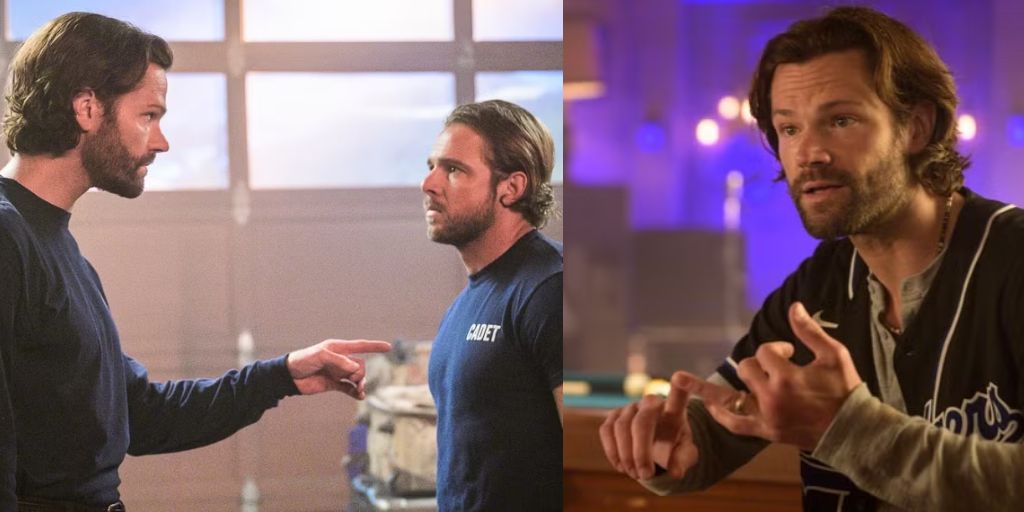
This episode introduces a new character who’s going to shake things up at the firehouse. It’s Smokey’s re-opening day, and to mark the occasion, we meet Cam Casey (played by Jared Padalecki), who steps into the scene like a storm.
He arrives in a Dodgers jersey, cargo shorts, and flip-flops, giving off the vibe of a laid-back guy, but don’t let his outfit fool you—he means business. Cam quickly makes an impression on the locals, putting Tom Petty’s “Mary Jane’s Last Dance” on the jukebox. But he doesn’t stop there.
The first time we really see him in action is when he steps in during an argument between Bode and some of Diego’s old co-workers at Smokey’s. These co-workers have come to confront Bode about being a “bro-code-violating homewrecker.”
While they’re right to call him out, they go a little overboard by destroying Sharon’s (Diane Farr) flyers for Smokey’s reopening in the process. Cam immediately intervenes by throwing his flip-flop at one of the guys involved in the altercation.
If you’re a fan of Jared Padalecki as Sam Winchester from Supernatural, this scene will have you laughing. For those who aren’t fans of feet, however, this moment is just plain bizarre. But either way, Cam’s action works—he takes down the guys and puts an end to the confrontation.
Once the fight is over, Cam introduces himself to Bode in a rather unconventional way. He’s revealed to be the new Stage 3 cadet coach for Ladder 42, meaning he’s Bode’s new boss. This is a big deal because it sets the tone for what Bode’s next phase of training will look like under Cam’s leadership. And judging by the way Cam handles himself, things are about to get a lot more intense for Bode.
Cam’s Leadership Style
The episode doesn’t waste time showing us what kind of boss Cam is. Just moments after meeting Bode, Vince (Billy Burke) brings news of a plane making an emergency landing in Edgewater.
Still from Fire Country (Credit: CBS)
Edgewater, a small town with no airport, has had its fair share of accidents in recent episodes, and this plane crash is no exception. The plane lands, but it’s burning out of control when Bode and the rest of Ladder 42 arrive on the scene.
Cam quickly takes charge, ordering Bode and Audrey (Leven Rambin) to work together on putting out the fire in the engine and cockpit and rescuing the passengers trapped at the front of the plane. They need another exit to evacuate the passengers, or they risk losing them to smoke inhalation.
Despite Bode being a cadet, Cam sends him straight to the top of the plane to tackle the fire in the cockpit. Jake (Jordan Calloway), who’s more cautious about procedure, watches in disbelief. But Cam, who values action over rules, is unbothered. He trusts Bode to do what needs to be done.
Despite the risk, Bode successfully puts out the fire in the cockpit and opens the front door of the plane, allowing the passengers to escape safely. This quick thinking turns Bode into a hero, and soon, his actions are all over the internet. As wild as Bode’s behavior can be, it’s clear that when he’s given the right direction, he’s capable of extraordinary things.
In one of the most memorable lines of the episode, Cam tells Bode, “You have a wolf inside you, and you got to feed it. Don’t ever put it in a cage.”
He even tells Jake later that he’ll take care of Bode, ensuring that Bode will be free to run into danger without worrying about the consequences. Cam’s unorthodox style might seem reckless, but it’s clear that he believes in Bode’s potential.
Gabs’ Airstream Drama
While Bode’s training takes center stage, Gabriela’s life is equally chaotic. After her emotional breakdown earlier in the season, Gabriela is now staying in an Airstream outside the firehouse. She’s not ready to talk to her dad about it, though, as he doesn’t know she’s living in the Airstream.
Gabs is staying there temporarily to save up money to pay back Diego’s parents for the wedding that never happened. However, it seems like Gabriela is still struggling emotionally.
This all comes to a head when she finds a strange guy smoking pot in her Airstream. He’s one of the plane passengers, and after accidentally setting some rare film on fire, he ends up crashing in the Airstream.
Gabs, who has been trying to find solace in her secret meetings with Bode, is understandably frustrated. She just wants to relax and unwind, but this unwanted surprise has her screaming. Her outburst alerts the others, and soon everyone learns that Gabs has been living in the Airstream.
This revelation doesn’t sit well with her father, Manny (Kevin Alejandro). He confronts Bode, telling him that while he loves him, he believes Bode is bad for Gabriela. Manny sees Bode as part of Gabriela’s spiral, and he makes it clear that Bode can’t help her until he realizes that. It’s a tough conversation, but one that Gabriela may not be ready to hear.
Later, Manny finds Gabriela and tries to reach her. He urges her to let someone help her, even if it isn’t him. He recognizes that Gabriela is isolating herself, and he doesn’t want her to fall into the same pattern of self-sabotage that he’s been stuck in. It’s a difficult moment, as Gabriela knows he’s right but isn’t ready to open up to anyone just yet.
Smokey’s Re-Opening and Audrey’s Singing Talent
After the intense events of the day, Smokey’s finally reopens, and it’s time for a little celebration. Vince takes the stage for a grumpy serenade, but the real surprise comes when Audrey James (Leven Rambin) steps up to the mic and starts singing.
Bode, who’s already dealing with his complicated emotions toward Gabriela, is immediately transfixed by Audrey’s performance. It’s clear that Bode is drawn to her, and this marks the beginning of a new emotional twist in his already messy love life.
Gabriela, feeling isolated and rejected, retreats to the Airstream. Meanwhile, Bode is increasingly interested in Audrey, despite knowing she has a boyfriend. This love triangle could lead to even more drama in future episodes.
Eve’s Family Drama
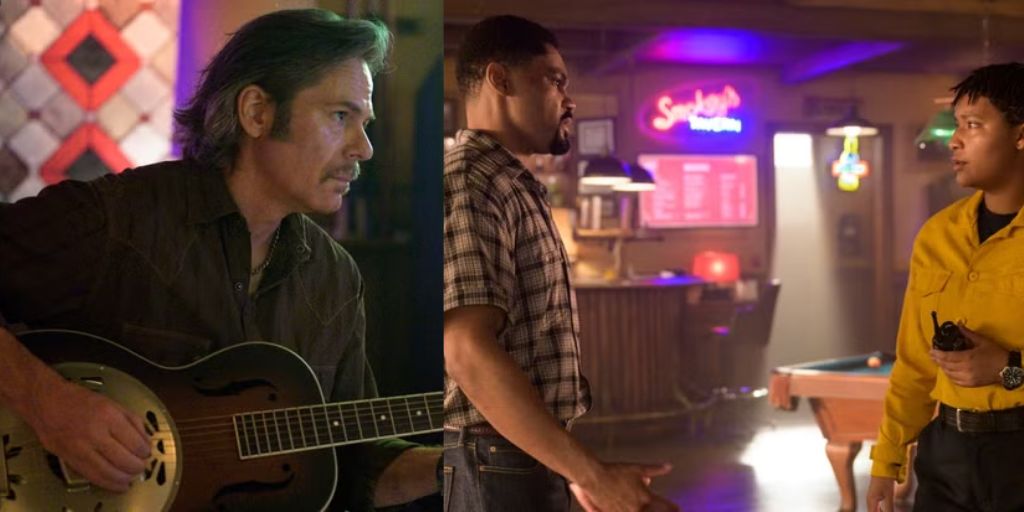
While Bode and Gabs deal with their complicated relationship, Eve (Jules Latimer) is facing her own family struggles. After a rocky start, she finally reaches out to her brother Elijah (Jeff Pierre).
They meet for drinks at Smokey’s, and it’s clear that there’s still unresolved tension between them. Eve wants to make things right, but Elijah isn’t as open to reconciliation. He’s still hurt by the past, and Eve is unsure of how to fix things.
This storyline adds depth to Eve’s character as she faces the difficult terrain of family conflict. It seems like she’s finally starting to realize that the firehouse may be the only place where she truly belongs.
Sharon’s Health Scare
The episode ends with Sharon struggling with a health issue that could affect her role at Smokey’s. Sharon has been dealing with health concerns for a while, but this episode pushes her to confront them head-on.
Still from Fire Country (Credit: CBS)
She’s afraid of what it might mean for her future, but she doesn’t want to burden anyone with the news. The support of the firehouse crew is crucial as they rally around Sharon during her moment of uncertainty.
Fire Country continues to keep things interesting with its tangled relationships and intense action. As Bode and Gabriela struggle with their feelings, Cam challenges Bode’s training, and the rest of the characters face their personal lives, this season promises even more drama, heart, and challenges ahead.
Telling stories about generational trauma is a delicate challenge. Many films attempt to address this complex issue, but they often end up portraying one of two extremes: either the trauma is too easily overcome, or it permanently tears the family apart.
Both of these outcomes rarely reflect the reality of how trauma affects families. In life, trauma doesn’t just disappear, and family ties can’t be broken so easily. People can’t escape their trauma, and they can’t truly escape their families either.
With this in mind, it’s clear that telling a story about generational trauma in a truthful and meaningful way is no small task.
Exhibiting Forgiveness manages to do so by skillfully facing the complexities of healing, offering a depiction of a family struggling to reconcile their past while acknowledging the difficult reality that true healing is not easy or immediate.
Titus Kaphar’s Exhibiting Forgiveness focuses on Tarrell, played by André Holland, who returns to his childhood home with his wife, Aisha (Andra Day), and their son. They arrive to help Tarrell’s mother, Joyce (Aunjanue Ellis-Taylor), pack up the house.
Upon arrival, Tarrell is confronted by his estranged father, La’Ron (John Earl Jelks). This reunion forces Tarrell to face the trauma and abuse he suffered at the hands of his father while grappling with the painful contrast between the man he once knew and the man his father is now.
Tarrell, like Kaphar, is an artist who communicates through his work, using evocative images to express complex emotions. Kaphar’s unique perspective as an artist translates perfectly to the medium of film, allowing him to tell a deeply personal story with sensitivity and emotional depth.
The Reality of Generational Trauma in Exhibiting Forgiveness
In fictional stories, there’s often a tendency to conclude with a neatly satisfying ending. Audiences frequently seek closure or catharsis, which can result in unrealistic depictions of generational trauma and healing. However, real change is rarely instantaneous.
Years of pain and suffering don’t disappear simply because someone says they’re sorry. Exhibiting Forgiveness avoids this mistake by showing a more grounded and honest depiction of trauma and healing. Kaphar is fully aware that the wounds from past experiences don’t simply vanish after an apology, and he brings this to the forefront of the film.
When we first meet Tarrell, it’s clear what kind of person he is. He is a successful and influential artist, but he is also a devoted father to his son and a supportive husband to Aisha, who has sacrificed her own career to focus on their family.
Aisha is a musician and performer, but her professional life has taken a backseat to their family’s needs. This sacrifice is a key aspect of the film, as it sets the stage for the family dynamics and reveals Tarrell’s deep desire for balance and equality.
This is especially important to him because of his own childhood experiences. While Tarrell is an accomplished artist, he is also determined to be a different kind of father than the one he had. He is committed to being emotionally present for his son and ensuring that his son has the opportunity to experience a childhood that he himself never had.
One of the first challenges Tarrell faces is the pressure to do another art exhibition, suggested by his pushy art agent, Janine (Jaime Ray Newman).
Although Tarrell is reluctant, he knows that he hasn’t fully stopped painting, but he is also deeply aware that his wife, Aisha, has had to put her own career on hold to support their family. This situation is symbolic of the delicate balance between personal ambition and family responsibilities that Tarrell constantly tries to maintain.
The Challenge of Forgiveness in Exhibiting Forgiveness
Despite the film’s title, forgiveness is anything but easy for Tarrell. When he finally comes face-to-face with his father, all of his childhood trauma resurfaces. The memories of the abuse and neglect he suffered are overwhelming, and he is haunted by nightmares.
These recurring dreams fill him with anxiety and panic, and he is unable to escape the emotional scars that his father left on him. His father, La’Ron, is a living embodiment of those painful memories. When they meet, Tarrell’s reaction is one of irritation and resistance. He is not ready to forgive his father, and Kaphar doesn’t try to force a quick resolution.
Rather than offer a simple narrative of forgiveness, Kaphar gives us a much more realistic and nuanced portrayal of the process. The film makes it clear that just because Tarrell learns more about his father’s painful past does not mean that he is ready to forgive him.
Understanding the reasons behind his father’s actions doesn’t erase the hurt that has been done. Tarrell’s struggle to forgive is a central theme of the film, and Kaphar is careful not to offer any easy answers. The pain of the past remains with Tarrell, and healing is a slow and complicated journey.
The film’s realism in addressing generational trauma is what makes it stand out. Kaphar doesn’t sugarcoat the experience of healing. There is no magical moment when everything is forgiven and forgotten. Instead, the story shows the ongoing struggle of trying to reconcile the past with the present.
Tarrell’s journey is one of understanding, but that understanding doesn’t instantly make everything okay. The scars of the past continue to affect him, and it’s clear that he is far from being able to fully forgive his father, no matter how much he may try.
A Masterful Performance by André Holland and John Earl Jelks
While Kaphar’s storytelling is undeniably powerful, the performances of André Holland and John Earl Jelks upgrade the film to another level. Their portrayal of Tarrell and La’Ron is a masterclass in acting. Both actors bring a raw emotional depth to their roles, making their characters’ pain and struggle feel real and relatable.
John Earl Jelks’s portrayal of La’Ron is especially noteworthy. He is able to convey the complex emotions of a father who is trying to make amends, but also an addict who has been consumed by his past mistakes. La’Ron’s regret and desire to reconcile with his son are palpable, but so are the lingering effects of his addiction.
In one particularly powerful scene, La’Ron recounts the cruelty of his own father, telling Tarrell how his father’s abuse shaped him. La’Ron tries to justify his actions by claiming that his tough love made Tarrell the man he is today.
This type of rhetoric, common among older generations, highlights the toxic cycle of abuse that has passed down through the generations. Jelks plays this scene with heartbreaking sincerity, capturing the tragic contradiction in his character: a man who believes he is doing good while perpetuating harm.
André Holland’s performance as Tarrell is equally compelling. He conveys the emotional weight of Tarrell’s experience with subtlety and depth. While Tarrell is a successful artist and a loving father, he is also deeply scarred by his past.
Holland expertly portrays the conflict within Tarrell: his understanding of his father’s pain, his love for his own son, and his inability to forgive his father. The emotional tension between Tarrell and La’Ron is palpable in every scene, as Holland’s portrayal shows the deep, unspoken pain that Tarrell carries with him.
The Complexities of Family and Healing
At the film’s climax, a tragedy strikes the family. However, rather than serving as a moment of reconciliation, this tragedy pushes father and son even further apart. This is a crucial moment in the film, as it emphasizes that time does not heal all wounds.
Exhibiting Forgiveness shows us that some pain remains with us, and that healing is not a linear process. The family does not come together in a moment of catharsis, and past mistakes are not easily forgiven. The trauma of the past continues to haunt the characters, but there is a sense that the anguish is not permanent.
The film offers a form of peace, but it is not the traditional fairy tale ending. It is a peace that comes with acceptance of the complexity of family relationships and the understanding that healing takes time.
The final moments of the film highlight this reality. Although Tarrell and La’Ron come to a certain level of understanding, it is clear that their relationship will never be the same. The past cannot be erased, and Tarrell cannot forget the pain his father caused.
However, there is a glimmer of hope in their relationship, even if that hope is uncertain and fragile. The film doesn’t offer a neat resolution, but it does show that there is room for growth and healing, even if it’s not immediate or perfect.
Titus Kaphar’s Artistic Vision
Titus Kaphar’s talent as an artist shines through in Exhibiting Forgiveness. While this is his first feature film, Kaphar’s background as a visual artist informs his storytelling.

Still from Exhibiting Forgiveness (Credit: Sundance)
The film shows themes of family, art, and societal privilege, drawing from Kaphar’s own experiences. In particular, the film touches on the tension between artistic success and personal growth, as well as the way that art can both reflect and shape identity.
Ultimately, Exhibiting Forgiveness is a raw, unflinching look at the complexity of generational trauma. Kaphar doesn’t try to simplify the experience or offer easy answers. Instead, the film presents an honest portrayal of a family struggling to heal, showing that forgiveness is not an immediate solution but a long and difficult process.
With stunning performances and a nuanced scheme of trauma and healing, Exhibiting Forgiveness is a film that will resonate with anyone who has ever tried to reconcile with their past.
