The third season of MGM+’s sci-fi horror series From continues, bringing viewers back to its eerie, mysterious town.
Harold Perrineau’s character, Sheriff Boyd, keeps working to understand the strange forces holding everyone captive.
In the previous season, the townspeople and residents of Colony House struggled with food shortages, worsening after a storm. Sleep became dangerous with the introduction of the music box storyline.
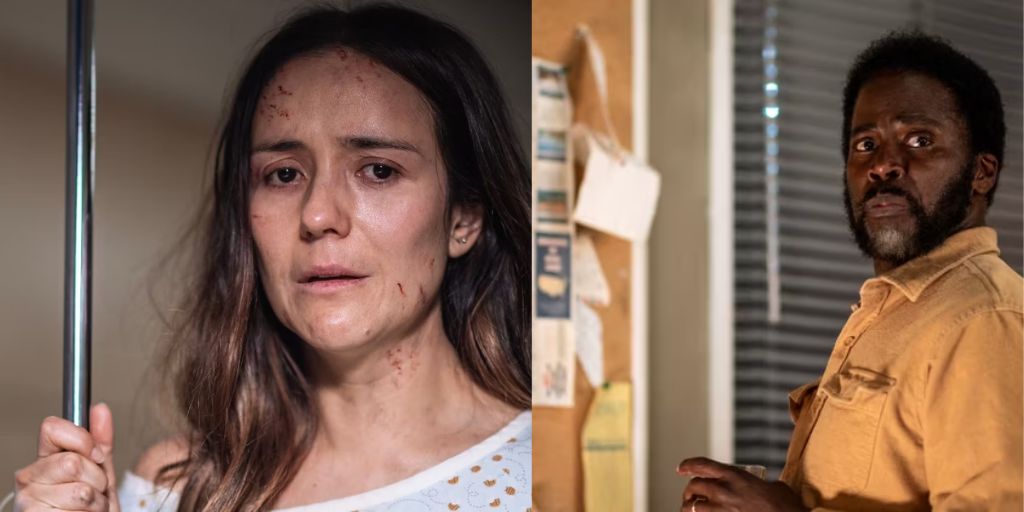
There were several cliffhangers, including Jade (David Alpay) being troubled by a strange symbol, Boyd wondering if destroying the music box was the right choice, and Tabitha (Catalina Sandino Moreno) being thrown off a lighthouse into a hospital in what seems to be the real world — but is it?
The nurse tells her that hikers found her unconscious in the woods, and she had been in a coma. They are in Camden, Maine, and the nurse is concerned about the bruises and scratches on Tabitha’s body.
Tabitha tries to make sense of this, all while worrying about how she can reunite with her family, who are still trapped in the mysterious town that is now changing in alarming ways.
Jim and Kenny Discover Strange Statues in From Season 3
Boyd starts the season by tending to his shotgun wound, which he got from the relative of the first victim of the sleep demon. While wrapping his wound, Boyd talks to Father Khatri (Shaun Majumder), an imaginary priest.
He shares his concerns about the town’s situation — from the food shortages to new dangers, including the interaction he had with his hallucinated wife.
Just before Boyd destroyed the music box and freed the three victims, his dead wife (Lisa Ryder) eerily asked him to reconsider because the forest was feeding on his hope.
Their conversation gets interrupted when a commotion occurs outside. Ethan (Simon Webster) is brought home after trying to find his mother in the forest.
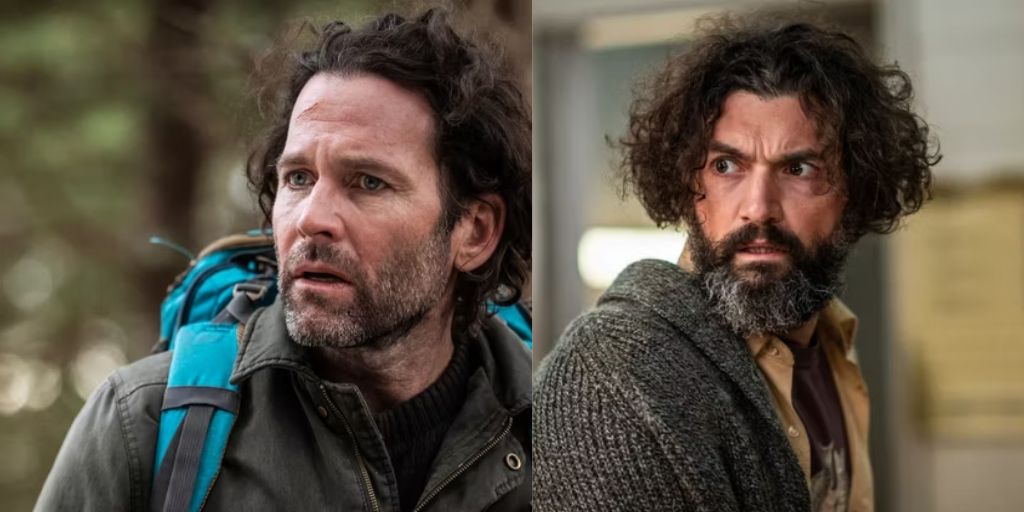
Jim (Eion Bailey), Ethan’s father, is then determined to search for his wife, but Boyd only allows him to go with Kenny (Ricky He).
Leaving his tense relationship with his children behind, Jim and Kenny follow Boyd’s directions and head into the woods.
There, they discover strange, ritualistic figures made of sticks, twigs, and skulls. Instead of fleeing, they decide to stay the night in a nearby hut, armed with a talisman.
Still from From’ Season 3 (Credit: MGM+)
As night falls, Jim realizes the reason Tabitha left them alone — she wanted their kids to have at least one parent. Realizing his mistake, Jim decides to return to town the next day.
Tabitha Struggles with Reality in From Season 3
Back in what seems to be the “real” world, Tabitha leaves the hospital after learning the police are coming to question her.
Fearing she might sound insane and end up in a mental institution, she decides to avoid the authorities and instead walks through the sunny streets of Maine.
The contrast between this place and the dark, terrifying town she was trapped in overwhelms her.
She notices two teenage girls with phones and borrows one to call her mother. During their emotional conversation, Tabitha keeps her situation a secret, unsure of what to do next.
Feeling lost, Tabitha finds refuge in a church and enters a confession booth. Without revealing everything she has been through, she shares her guilt over the death of her baby son, Tomas. This emotional moment overwhelms her, and she leaves the church.
As she walks out, the priest follows her, and they discuss Victor (Scott McCord) and his lunch box, which Tabitha is still carrying. Inside, she finds an address for Victor in Camden.
With a renewed sense of purpose, she makes her way to his house and is surprised to find his father, Henry (Robert Joy), living there.
Starvation Threatens in From Season 3
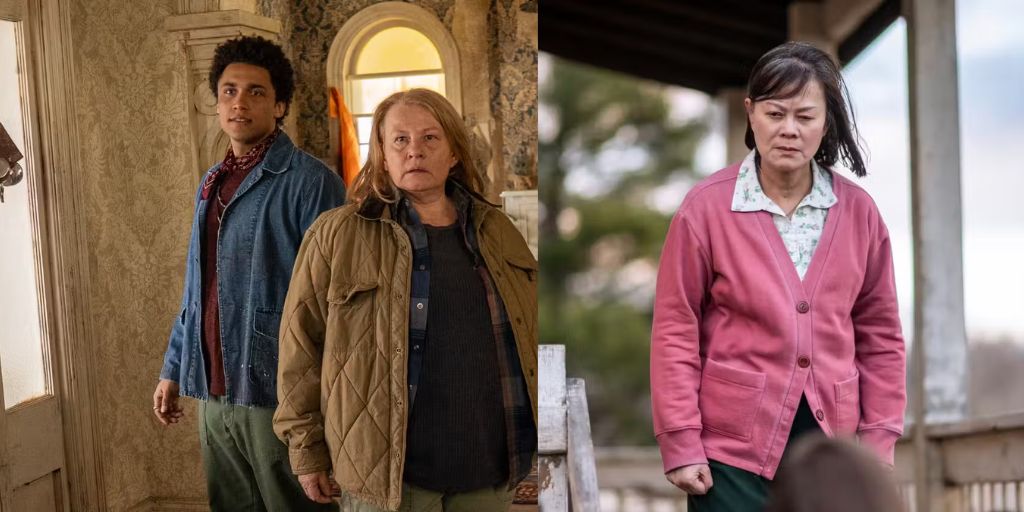
At Colony House, things have taken a dire turn. Fatima (Pegah Ghafoori), who is unexpectedly pregnant despite being previously diagnosed as infertile, suffers from severe morning sickness. Her partner, Ellis (Corteon Moore), is deeply worried about her as her health seems to worsen.
Donna (Elizabeth Saunders) pulls Ellis away from Fatima to help salvage any remaining crops after the storm.
Meanwhile, Elgin (Nathan D. Simmons), one of the new bus passengers, is haunted by terrifying nightmares of a female spirit, leading him to avoid sleep at all costs.
Still from From’ Season 3 (Credit: MGM+)
When Donna and Ellis arrive at the garden, they find all the crops have rotted. What was once a worrying food shortage has now become a life-threatening problem. Boyd, Donna, and Tian Chien (Elizabeth Moy) meet to plan how to feed the town.
They decide to rely on animals while attempting to grow crops in different soils, hoping to find a suitable location.
Ethan overhears their conversation and becomes upset. Boyd, who recently broke up a fight between Ethan and Randall (A.J. Simmons) over Ethan’s favorite goat, Alba, tries to console the boy. Ethan asks Boyd to kill Alba first so she won’t have to watch the other animals die.
Night Brings Fear in From Season 3 Premiere
As night falls, the tension escalates. Boyd is in the police station with Jade, who wakes up from a drunken sleep after Boyd dragged him out of the bar.
They look outside and see a cow walking down the street — the night creatures have let the animals out of the barn.
Boyd, Jade, and Tian rush outside to get the animals back, all while watching for danger. Ethan also sees Alba wandering and opens the door to find one of the creatures waiting.
His sister, Julie (Hannah Cheramy), quickly grabs him and escapes through the back door. Sarah (Avery Konrad) pulls them into the bushes, and they hide in Randall’s bus, watching the chaos unfold.
Still from From’ Season 3 (Credit: MGM+)
Jade witnesses one of the creatures kill a cow, leaving him frozen in shock. He is eventually pulled to safety, unable to do more. Tian, however, helps Boyd, who is struggling to get a cow into the barn. Once they lock it inside, they feel relief — but it’s short-lived.
The smiling creatures were hiding in the barn, and they capture both Boyd and Tian. The creatures tie Boyd up and begin torturing Tian, forcing him to watch.
The scene focuses on Boyd’s face as he begs for mercy and tries to encourage Tian, all while he breaks down inside. From Season 3 Episode 1 is now streaming on MGM+ in the U.S.
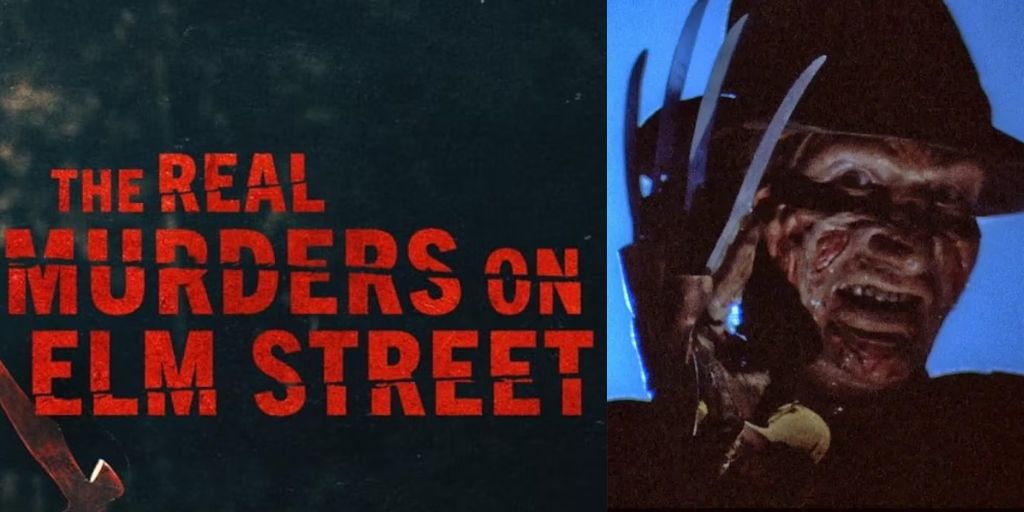
For 40 years, the Nightmare on Elm Street franchise has captured audiences’ attention. Its main character, Freddy Krueger, portrayed by Robert Englund, is a notorious villain.
Freddy, a child killer, seeks revenge on those who ended his life by targeting their children while they sleep. This explains the “nightmare” in the title. But why Elm Street?
Director Wes Craven deliberately picked the name because it was the street where John F. Kennedy was assassinated. For Craven, “it was where the innocent world ended.”
However, there’s another reason. Freddy Krueger declares, “Every town has an Elm Street.” He’s not wrong. Research from the Census Bureau shows that “Elm Street” ranks 15th among common U.S. street names, with 5,233 listings. This suggests that horrifying events could happen anywhere.
Investigation Discovery harnesses this idea in its new true-crime documentary series, The Real Murders on Elm Street.
The show is quickly gaining a following, as it examines six real-life murders on various Elm Streets throughout the country. The series blends dramatic reenactments with interviews from those linked to the cases.
The first episode, titled “Killer in the Walls,” follows the disturbing story of Daniel LaPlante, a social outcast who grew up on Elm Street in Townsend, Massachusetts. As a teenager, LaPlante was frequently arrested for breaking into homes.
However, things took a more sinister turn on December 8, 1986. LaPlante broke into the Bowen family’s house.
Before this, Tina and Karen Bowen had reported to their father, Frank, that strange things were happening in their home—items being moved, TV channels changing. Frank assumed it was just pranks or possibly paranormal activity.
That day, Frank noticed someone had used the bathroom and searched the house.
He found LaPlante, dressed in face paint and a hairy jacket, armed with a hatchet and wrench. LaPlante calmly held Frank, his daughters, and their friend hostage in a bedroom. Luckily, Tina escaped to get help, but LaPlante had already fled.
Still from the show (MAX)
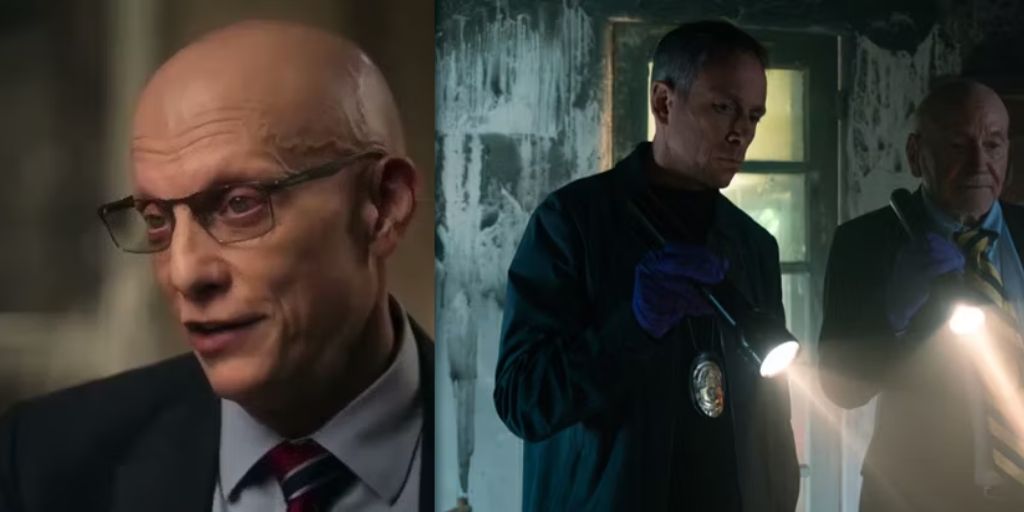
Two days later, Officer Steven Bezanson returned to the house after Frank spotted a suspicious man. Inside, Bezanson found pictures stabbed into the walls with knives, displaying messages like “I’M STILL HERE. COME FIND ME” and “I’M GOING TO KILL YOU ALL.”
Police found LaPlante hiding in the walls, where he had been living for weeks, spying on the family. He was arrested and held until October 1987 when his mother paid his $10,000 bail.
LaPlante’s release proved to be a grave mistake. On December 1, 1987, he broke into Andrew and Priscilla Gustafson’s home. Priscilla returned with her 5-year-old son, William.
LaPlante locked William in a closet, tied up Priscilla, raped her, and shot her twice in the head. He then drowned William in the bathtub and did the same to their daughter, Abigail, when she came home from school.
LaPlante was caught hiding in a trash can on December 3. Convicted of three murders in 1988, he received a 45-year prison sentence.
The second episode, “And We Have Serial Killers,” opens with firefighters responding to a house fire on Elm Street in Spokane on February 28, 2008. Two weeks earlier, 20-year-old Justin Crenshaw arrived in Spokane after completing rehab for heroin addiction. He was visiting his long-lost sister, Nikki Vanvlymen.
Justin started dating Nikki’s friend, Sarah Clark, and decided to stay. That night, Justin, Sarah, and Tanner Pehl, a coworker of Justin’s, were drinking at Pehl’s house.
According to The Spokesman-Review, Deputy Prosecutor Jack Driscoll believes Crenshaw killed Clark because she refused to have sex with Pehl.
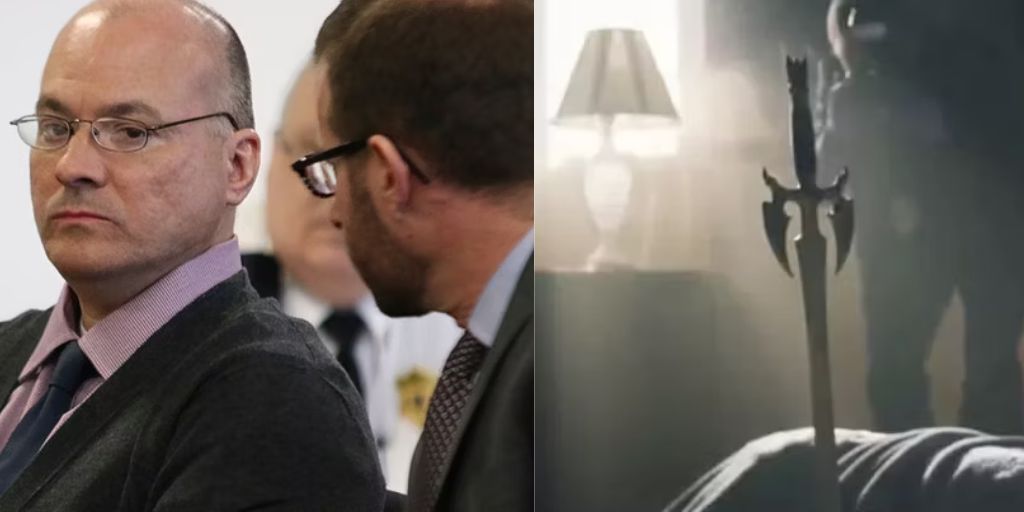
Clark was stabbed 26 times, and her body was positioned with a samurai sword near her head. Pehl was stabbed more than a dozen times, then covered with a blanket.
A broadsword was driven into his abdomen four times. Crenshaw started a fire to cover up the crime but left a bloody fingerprint at the back door. At trial, Crenshaw claimed that drinking caused him to black out. His defense failed, and he received two life sentences.
In California, Gerald Cruz, leader of a group known as “the Camp,” was found guilty of murder. The Camp was a cult-like group mixing voodoo and white supremacist beliefs.
On May 21, 1990, police found four bodies in a house on Elm Street. A survivor, Donna Alvarez, described Jason LaMarsh, a member of the Camp, as one of the attackers. Officers searched Cruz’s house, discovering bomb materials, satanic writings, and a “wheel of punishment.”
Still from the show (MAX)
LaMarsh told investigators that one of the victims had been expelled from the Camp for using drugs. On May 20, 1990, Cruz ordered LaMarsh and two others to kill the victim and leave no witnesses.
They stormed the house and brutally murdered everyone inside. LaMarsh personally killed one victim by repeatedly striking his head. Cruz, LaMarsh, and two others were convicted and sent to death row.
The Real Murders on Elm Street sticks to a classic true-crime format, presenting a premise. Future episodes include titles like “Halloween Horror,” “What Lies Beneath,” and “Cruel Intentions.” The series is available on ID and Max, with new episodes released on Mondays.
The Real Murders on Elm Street has tapped into a deep cultural fear—the unsettling idea that horror can exist right next door, on the very streets we walk every day.
This is not just a clever play on the well-known Nightmare on Elm Street franchise, but rather a tale of how truly horrific events can unfold in ordinary places, turning familiar names and locations into something sinister.
The series manages to highlight this eerie possibility by drawing viewers into real-life cases that took place on various Elm Streets across the country, showing how the mundane and the horrific can intertwine in ways that are both shocking and fascinating.
The true-crime genre has always had a strong following, but the creators of The Real Murders on Elm Street seem to understand that adding the element of a familiar street name makes the stories feel that much more immediate. It’s one thing to hear about a gruesome crime that took place in a faraway city, but it’s another thing entirely to think, “This could happen on a street just like mine.”
The fact that “Elm Street” is one of the most common street names in the United States helps drive home this terrifying notion.
This familiarity creates an eerie connection between the real world and the fictional horror icon of Freddy Krueger, making viewers wonder if their own neighborhood could be hiding similar dark secrets.
As the series continues, it’s likely to build even more momentum. True crime fans are always looking for the next big story, and The Real Murders on Elm Street delivers in a way that feels both fresh and chilling.
The cases presented are not only horrifying in their own right, but they also speak to larger social issues such as the failures of the justice system, the complexities of mental illness, and the ways in which people can fall through the cracks.
Daniel LaPlante’s story, for instance, is not just about a disturbed individual who committed heinous crimes. It also reflects the tragic consequences of a system that allowed him to be released on bail, despite clear signs that he posed a danger to society.
Similarly, the case of Justin Crenshaw touches on issues of addiction, rehabilitation, and the terrifying unpredictability of human behavior under the influence.
The Real Murders on Elm Street also benefits from its mix of dramatic reenactments and interviews with those connected to the cases.
This combination of narrative and firsthand accounts makes the stories feel grounded and real, giving viewers a sense of the emotional toll these crimes have had on the victims’ families and communities.
The reenactments are effective without being overly sensationalized, striking a balance between storytelling and respect for the victims.
This thoughtful approach adds depth to the series, ensuring that it resonates with both seasoned true-crime enthusiasts and casual viewers alike.
What sets this series apart from other true-crime shows is its ability to weave together the familiar and the frightening. It reminds us that even in places we consider safe and ordinary, darkness can lurk.
The infamous quote from Wes Craven’s Freddy Krueger—“Every town has an Elm Street”—rings true in a way that is deeply unsettling.
Still from the show (MAX)
The Real Murders on Elm Street doesn’t just entertain; it leaves viewers with a lingering sense of unease, a reminder that evil doesn’t only exist in faraway, unfamiliar places—it can strike anywhere, even on the most unassuming of streets.
This chilling reality is what makes the show so compelling, ensuring that it will continue to impress audiences as more episodes are released.
As more episodes of The Real Murders on Elm Street are released, it is clear that this series is not just another true-crime show—it taps into a deeper psychological fear that horror can exist in the most familiar places.
By drawing connections between these real-life murders and the infamous Elm Street of the Nightmare on Elm Street franchise, the show creates an unsettling atmosphere that lingers long after the credits roll.
This blend of factual storytelling, emotional depth, and chilling reenactments ensures that it will continue to engage, shock, and disturb viewers with each new case it takes.
