Wayfarer Studios and American High have done a great job providing quality teen entertainment in recent years.
I enjoyed films like Five Feet Apart and Clouds from Wayfarer, and Crush and Plan B from American High.
So, when I saw both logos at the start of Empire Waist, I felt excited. I was pleased to find that the film adds positively to both companies’ collections.
What Is ‘Empire Waist’ About?
Empire Waist tells the story of Lenore (Mia Kaplan), a teen girl who feels invisible at school and prefers it that way.
She is bigger than most of her classmates, making her a target for bullies like the mean girl Sylvie (Isabella Pisacane). Instead of trying to make friends, Lenore stays safe by embracing her loner status.
She avoids eye contact and spends her time sketching outfits. Her home life is not easy either. While her quirky dad (Rainn Wilson) is supportive, her mom (Missi Pyle) is always working out and dieting, putting pressure on Lenore to follow suit.
Lenore’s life changes when she partners with Kayla (Jemima Yevu) for a class project. Although Kayla is also plus-sized, she does not hide anything about herself.
Confident and charismatic, Kayla helps Lenore come out of her shell and encourages her to enter a competitive fashion design showcase.
They gather the school outcasts as models, including the queer and disabled Marcy (Daisy Washington), shy and petite Diamond (Kassandra Tellez), and trans tall girl Tina (Holly McDowell).
Despite their differences, they all struggle to find clothes they like that fit. Lenore helps her new friends feel empowered with the outfits she makes, and in doing so, she starts to build her self-esteem.
‘Empire Waist’ Captures the Nuances of Fatphobia
As someone who has been fat and dealt with body image issues my entire life, Empire Waist impacted me deeply.
The scene where Lenore stands on the scale during her physical is more disturbing than many horror films. Many people can sadly relate to the trauma tied to that experience.
The moment when a nutritionist tells Lenore that a single slice of pizza counts as an entire serving was painful. These interactions with doctors are meant to help but can cause lasting mental harm, especially for young girls.
Kaplan delivers a touching and raw performance, tackling these hard and sensitive insecurities. She breaks your heart repeatedly as she shares her feelings of being disgusting and unworthy of nice things.

Still from Empire Waist (Credit: Blue Fox)
Empire Waist adds another layer by focusing on Lenore’s complicated relationship with her mother. It would be easy to show her mom as a cruel villain, but writer-director Claire Ayoub wisely avoids that route in her script and direction. Missi Pyle’s performance is genuine.
Lenore’s mother cares about her but shows it in a harmful way. She tries to protect Lenore by shielding her from the world and pushing her to change instead of accepting who she is.
This behavior comes from Lenore’s mother constantly nitpicking her own appearance, a pattern likely passed down from her own mother. This illustrates how toxic thinking can often be passed through generations.
Unfortunately, Sylvie does not have the same complexity. The mean girl is a cliché antagonist, and the attempt to explain why she bullies others feels oversimplified and lacks a satisfying end.
While much of the writing is sharp and witty, Sylvie’s dialogue feels dated and amateurish, making her character flat even as an adversary. There are ways to have fun with these roles, but Empire Waist relies too much on predictable tropes.
‘Empire Waist’ Never Loses Its Sense of Fun and Celebration
Empire Waist faces a similar issue as Prom Dates, another American High production, because it is hard to define the target audience.
Many dialogue and plot points would fit right in on Disney Channel, but there are also some edgier moments—like Kayla going into a bedroom with a boy and a revealing photo of her getting shared—that seem aimed at older viewers. The film struggles to know who it is for.
Still, there is undeniable charm in the film, no matter your age. The jokes are not always groundbreaking, but they are often funny.
Watching the actors deliver their lines is enjoyable. The entire ensemble has a delightful chemistry, bringing energy and authenticity to their roles.
Yevu stands out, bringing a special spark to her first role. Though she has less screen time, McDowell also shines as a comedic standout, delivering her quirky lines with perfect timing.
She would fit right into a movie like Bottoms. The cast is wonderfully diverse, and each character celebrates their differences without feeling boxed in or reduced to one trait. Their friendship is beautiful to watch.
The platonic love in Empire Waist is the strongest aspect, but the romantic subplot is sweet as well.
It is hard not to root for Charlie (Aric Floyd), Lenore’s supportive crush who enjoys photography and LARPing. Mrs. Hall (Jolene Purdy), the encouraging teacher, also deserves praise.
Ayoub smartly casts a plus-size woman in this role, making the dynamic even more impactful. Purdy makes the most of her time on screen, and her line, “I was gonna yell at you about that Wikipedia-ass presentation,” made me laugh out loud.
Empire Waist features a moving tribute to friendship dressed in a bright, colorful package. While it is not free from tropes and predictable story beats, it tackles body image issues uniquely and refreshingly.
This film is essential for younger viewers who can relate to Lenore’s journey, and it is healing for those who have moved on but still carry painful memories from their past.
Twilight of the Gods more than lives up to its name. The animated series created by Zack Snyder, Jay Oliva, and Eric Carrasco presents a bold and bloody interpretation of Norse mythology. The art style, crafted by Xilam Animation, is beautiful and striking.
The series feels similar to the epic films Snyder has made in theaters. It also marks his return to animation since the underrated film Legend of the Guardians: The Owls of Ga’hoole. But how does Twilight of the Gods conclude its story, and does it leave room for a sequel?
‘Twilight of the Gods’ Begins With a Wedding Gone Wrong
Twilight of the Gods starts with preparations for a wedding between the Viking king Leif (voiced by Stuart Martin) and his true love, Sigrid (voiced by Sylvia Hoeks). The couple’s love story is central to the plot and sets the tone for the events that follow.
Sigrid has one request for Leif: she wants him to visit her homeland and meet her family. This journey is not just a simple visit; it is a significant moment that introduces the audience to Sigrid’s background and her ties to her people.
Sigrid’s family is made up of giants because she grew up in Jotunheim. This revelation adds a layer of complexity to Sigrid’s character. It shows her connection to a world of formidable beings, which contrasts sharply with the Viking world of Leif. The dynamics between these two worlds are key to understanding the conflicts that arise later in the story.
Before Leif and Sigrid can get married, the God of Thunder, Thor (voiced by Pilou Asbæk), arrives looking for his brother Loki (voiced by Patterson Joseph).
Thor’s entrance is dramatic and signals the chaos that is about to unfold. When the Jotunn refuse to show respect to Thor, he unleashes his fury and kills them all, leaving Sigrid as the only survivor. This act of violence sets the stage for Sigrid’s quest for revenge and showcases Thor’s brutal nature.
Sigrid vows to kill the Thunder God, and Leif decides to join her on this dangerous journey. This commitment to vengeance is a critical turning point for both characters, as it drives the narrative forward and emphasizes themes of love, loss, and loyalty.
A Group of God-Killing Warriors Unite in ‘Twilight of the Gods’
To help them kill Thor, Leif and Sigrid gather a group of warriors. This group includes poet and sorcerer Egill (voiced by Rahul Kohli), Sigrid’s fellow shield maiden Hervor (voiced by Birgitte Hjort Sørensen), Áile (voiced by Jamie Clayton), who is a mysterious witch known as the Seid-Kona, and the dwarven blacksmith Andvari (voiced by Kristofer Hivju).
Each character brings unique skills and backgrounds, which enrich the story and create a diverse team united by a common goal.
Andvari proves especially helpful because he crafts weapons from steel that can kill gods. However, this power comes at a high cost, hinting at the darker aspects of their quest.
The weapons symbolize not only physical strength but also the moral choices the characters must face in their pursuit of revenge. The sacrifices made for power are a recurring theme in Norse mythology, and the series highlights these complexities.
During their journey, the warriors encounter various challenges that test their abilities and resolve. They meet a mysterious maiden named Thyra (voiced by Thea Sofie Loch Næss) who is chained up by the villagers of a small settlement.
Thyra’s introduction adds an element of intrigue to the story. After Thyra helps them escape a dangerous situation, it is revealed that she serves the old gods known as the Vanir.
The Vanir have been weakening since their war with the Aesir, the gods of Asgard. This historical conflict between the Vanir and Aesir provides a rich backdrop for the story.
Sigrid makes a deal with the Vanir; if she and her warriors can retrieve the golden apples of immortality and defeat the dragon guarding them, the Vanir will join her cause. This quest for the golden apples is not only a physical journey but also a metaphor for the pursuit of power and immortality.
Although they succeed in retrieving the golden apples, the apples turn out to be poisoned. This twist adds a dramatic turn to the narrative, leading to Leif’s apparent death while he holds off the Vanir’s forces.
This moment is heartbreaking for Sigrid, who loses her partner in their shared quest for vengeance. The poison symbolizes the corruption and consequences of seeking power at any cost.
Loki Turns Out To Be the Driving Force Behind ‘Twilight of the Gods’
In reality, Leif and Loki find themselves trapped inside the mind of one of the Vanir. This situation forces them to relive their past experiences. Loki later reveals to Leif that he manipulated Sigrid into seeking revenge on Thor. This revelation shifts the focus of the story from Sigrid and Leif’s quest to Loki’s motives.
He wants to trigger Ragnarök, or the twilight of the gods, as revenge for Odin’s (voiced by John Noble) imprisonment of his children, Hel (voiced by Jamie Chung), Jörmungandr (voiced by Tove Lo), and Fenrir.
Odin discovered the prophecy of Ragnarök after hanging from Yggdrasil, the World Tree, for nine days. This act of self-sacrifice emphasizes Odin’s determination to understand and control fate.
He was committed to preventing Ragnarök at all costs, which involved sending Thor to kill Jörmungandr’s mother and imprison the children. This backstory deepens the character of Odin and highlights the lengths to which he will go to protect Asgard.
Loki’s manipulation of events adds a layer of complexity to his character. He has been controlling key moments to bring about Ragnarök.
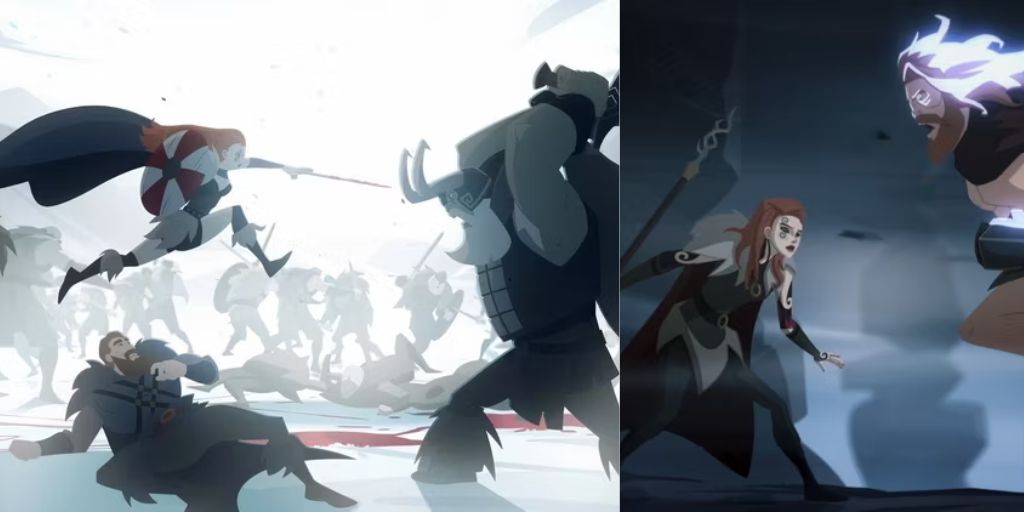
Still from Twilight of the Gods (Credit: Netflix)
His desire for revenge is not just personal; it is also a reaction to the systemic oppression he and his children face. After he and Leif escape, the Vanir honor their deal and join Sigrid’s warriors as they prepare to storm the walls of Asgard.
‘Twilight of the Gods’ Ends With a Bloody Battle – and the Advent of Ragnarök
Leif and Loki’s actions lead to a bloody battle. The warriors face great challenges as they fight against Thor and his forces. The battle scenes are filled with action and drama, showcasing the animators’ skills in creating visually stunning sequences.
This climactic confrontation sets in motion the events of Ragnarök, where the fate of the gods hangs in the balance. The series beautifully combines elements of action, drama, and mythology, showcasing the struggles and triumphs of its characters.
As the story unfolds, viewers see themes of revenge, sacrifice, and the quest for power. The characters confront their pasts and make choices that will determine their futures.
This scheme of character motivations and conflicts is what makes Twilight of the Gods compelling. It goes beyond surface-level action to examine the deeper themes at play in Norse mythology.
The end of Twilight of the Gods leaves fans excited about the future and wondering if there might be more stories to tell in this vibrant universe.
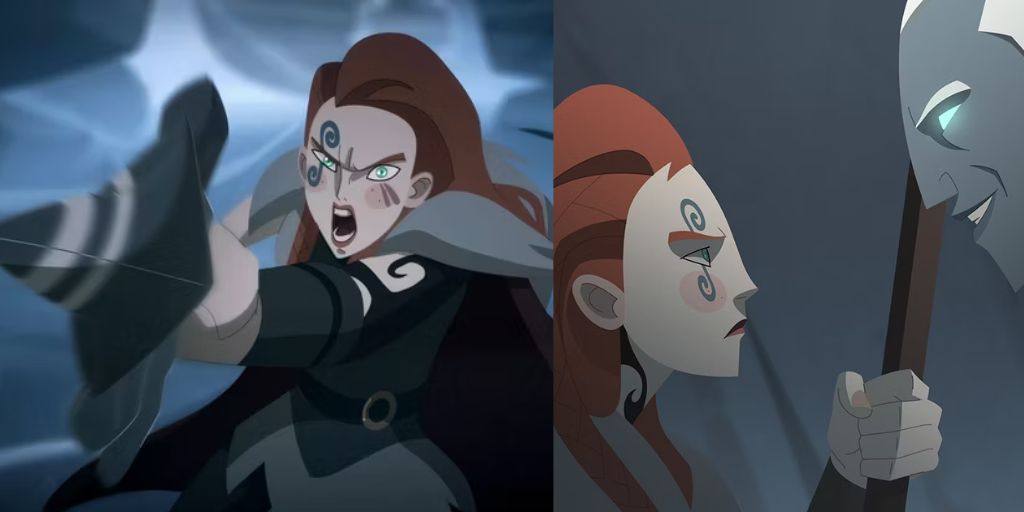
Still from Twilight of the Gods (Credit: Netflix)
The series captures the essence of Norse mythology while presenting it in a new and visually stunning way. Fans of the genre will appreciate the attention to detail and the rich storytelling that unfolds throughout the series.
Twilight of the Gods not only reimagines Norse mythology but also engages with timeless themes of love, loss, and the consequences of revenge. The characters’ journeys resonate deeply, and the stunning animation enhances the full experience.
This series is a testament to the power of storytelling and the enduring appeal of mythological tales. As viewers are drawn into this world, they are left with a sense of anticipation for what comes next in this epic saga.
