Some of the best romantic films do not have happy endings or fairytale romances. Movies like The Umbrellas of Cherbourg, La La Land, and Casablanca show that sometimes the best stories come from relationships that almost work out.
Even with strong feelings, things just do not go as planned. It might be the wrong time or place, or maybe fate gets in the way. Sometimes, the problems are inside the people involved. They might not be right for each other or not ready for a relationship at that time. In the end, they have to move on when the moment is lost.
The film On Chesil Beach, made in 2017, shows this kind of relationship. The movie is based on a bestselling book by Ian McEwan and directed by Dominic Cook. It stars Saoirse Ronan and Billy Howle as Florence and Edward, two young lovers who just got married.
They are on their honeymoon at Chesil Beach, which is on the south coast of England. Everyone expects them to consummate their marriage in their nice seaside hotel. Edward’s family loves Florence, but Florence’s family just tolerates Edward. They come from different social classes and have difficult family lives, but they made it to their wedding day.
However, things feel awkward the moment they enter their hotel room. Their strong romantic connection falls apart when they reach the wedding bed. It quickly becomes clear that Florence does not want to have sex.
The audience sees this relationship through their eyes as they think about their past.
Edward is a working-class man who takes care of his sick mother. He has struggled with his temper and has been in fights before.
Edward wants attention and care, but he hides his anger because he feels he should stay strong. This leads to problems in his relationship with Florence.

Still from the movie (Apple TV+)
Florence’s journey is different and not often shown in stories. She does not feel comfortable with intimacy while in a relationship.
There are many reasons someone might not want to be intimate. For some, it may be because of how they feel or because they need a strong connection first.
In Florence’s case, her discomfort comes from deep, unspoken trauma. It is the 1960s, and while society pressures her to stay pure, she is expected to suddenly be intimate with her husband after marriage
. She tries to read books and talk to others, but discussing sex before marriage was seen as wrong back then. Even today, the topic of asexuality is not widely talked about.
Florence does not have the words to explain her feelings, but she faces these challenges with Edward. She tries to avoid the subject, but when they talk about sex, her anxiety rises.
She even considers asking Edward to see other women to satisfy his needs. Though she loves Edward deeply, she worries she may never be enough for him. This is something many people who identify as asexual experience—wanting a partner who understands their feelings.
What makes On Chesil Beach special is how it shows sex in a realistic way. We often see funny or awkward sex scenes in movies, but this film presents a deeply uncomfortable experience. Edward and Florence are both young and inexperienced.
They fumble with their clothes, and Florence keeps stopping, while Edward feels frustrated and insecure. The scenes are drawn out and silent, creating an intense and uncomfortable experience for viewers. Eventually, everything falls apart, leaving the couple confused, frustrated, and defeated.
This movie highlights that many people say the first time is often the worst, even though movies usually show sex as a beautiful expression of love.
In reality, sex can be awkward, vulnerable, and uncomfortable. The pressure Edward and Florence feel does not help their situation.

Still from the movie (Apple TV+)
They realize their marriage is not meeting the expectations set by society and their families. When Florence runs to the beach, neither of them can talk about the problem.
Edward cannot control his temper, and Florence cannot share her trauma. In one painful conversation, their marriage ends.
In On Chesil Beach, Edward and Florence never see each other again. Life goes on, and Florence eventually marries someone else and has a daughter.
We do not learn how that situation works out for her. The final part of the film focuses on Edward, who lives with his regret about that night with Florence.
Both of them think about the conversation that ended their marriage and wonder if anything could have saved it.
They were happy enough together, even with their issues, but they did not understand how their relationship could fail until they were emotionally and literally exposed. This vulnerability in intimacy makes On Chesil Beach a heartbreaking story.
On Chesil Beach presents a powerful narrative about love and the complexities of intimacy. The film challenges traditional romantic ideals by showing that not all relationships follow a straightforward path.
Edward and Florence’s journey reveals how deep-rooted issues can affect a couple’s ability to connect. Their struggles with communication and intimacy highlight the importance of understanding one another’s needs in a relationship.
Florence’s asexuality and trauma make it difficult for her to engage in physical intimacy, which Edward does not fully grasp.
This lack of understanding leads to a breakdown in their relationship, showing that love alone is not enough to overcome significant barriers. The film encourages viewers to reflect on the importance of open dialogue and emotional support in relationships.
It emphasizes that intimacy is not just about physical connection but also about emotional understanding.
Ultimately, On Chesil Beach reminds us that love can be complicated and that sometimes, despite strong feelings, two people may not be meant to be together.
The film serves as a poignant reminder that acknowledging and addressing personal struggles is vital for a successful partnership.
Both Edward and Florence learn valuable lessons about themselves and the nature of love as they navigate their separate paths.
Many modern Lovecraftian movies reveal their cosmic horror slowly. The 2020 film Underwater, directed by William Eubank, takes this idea to a new level. It starts as a thriller, but Underwater ultimately turns into a classic nightmare. The feeling of being trapped adds to the fear, and Cthulhu himself makes an appearance.
Kristen Stewart stars as Norah Price, who is an underwater engineer. She works at a secret drilling compound deep underwater. When the compound faces a terrible disaster caused by an unseen force, Norah gathers the survivors.
They must find escape pods to survive. Although Underwater did not get a lot of attention, it deserves more praise for its innovative take on classic Lovecraftian themes.
Cosmic horror usually focuses on fear from the vast and unknown ocean or space. However, Underwater takes a different approach by trapping both the characters and the audience in close, tense situations. There are parts of the movie that feel more like the film The Descent than the story of Call of Cthulhu.
One intense scene shows Norah trying to find the escape pods while moving through the destroyed tunnels of the compound. As she squeezes and crawls through the wreckage and broken wires, viewers hold their breath with her.
The low light in these scenes helps show how restricted Norah’s situation is. Just as she struggles to move, the audience cannot see everything clearly. While Eubank cannot physically squeeze his viewers into a tight space, he creates a similar feeling through other senses.
The entire film plays with the feeling of being trapped. Setting Underwater in a deep-sea compound adds to the feeling of pressure. When things go wrong, the characters have nowhere to escape. This tension rises as the alarm announces each deck’s failure.

Still from the movie (Disney+)
Stewart shows how her character reacts to each deck being sealed off. Her face tightens, her eyes dart around, and her mouth forms a hard line. As Norah searches for an escape pod, Eubank uses tight lighting and camera angles to emphasize how trapped she is.
For much of the viewing experience, audiences might think they are watching an underwater version of Alien. The film introduces a strange creature that biologist Emily Haversham, played by Jessica Henwick, mistakenly thinks is a new species.
It is not until the last part of the film that Underwater fully embraces its Lovecraftian influences. This film is one of the few that shows Cthulhu entirely. The character design for Cthulhu is so terrifying that most movies choose to show hints of Cthulhu, like death cults or parts of the Necronomicon, instead of depicting the creature fully.
Even though there are signs that Norah’s company has bad intentions, the presence of Cthulhu serves as a critique of harmful environmental practices. Earlier in the film, Emily Haversham whispers to herself that they should never have drilled into the ocean floor. Now, her anxious words reflect two truths: the harm done to the environment and the awakening of Cthulhu.
Kristen Stewart delivers a restrained performance as Norah, grappling with a blend of incomprehensible fears and everyday horrors in Underwater. The film distinguishes itself by portraying Cthulhu in its entirety, establishing a high benchmark for itself.
The realistic and gritty design of the creatures grounds the film, similar to the goal of Lovecraft’s work. There is a sense that these creatures could be hiding on the ocean floor, lying quiet unless disturbed.
The setting of Underwater plays a big role in building tension and fear. The film shows the dark, cramped tunnels that create a sense of entrapment. This feeling is heightened by the underwater environment, which is both beautiful and terrifying.
Viewers experience a sense of isolation, surrounded by the vastness of the ocean. This setting amplifies the existential dread that permeates the film.
The characters’ struggles with fear and panic make their journey even more relatable. They must face their fears and find strength in each other. As Norah leads the group, her determination shines through. She becomes a symbol of hope in a situation that seems hopeless. Her leadership is important in guiding the survivors through their dangerous environment.
Each character brings a unique perspective to the story. They each react differently to the horror around them. For example, some characters become paralyzed by fear, while others try to take charge. This variety adds depth to the narrative and makes the viewer think about how people respond to extreme situations.
Her concerns about the drilling show the movie’s underlying message about respecting nature. This message connects to Lovecraft’s themes of the unknown and the dangers of human interference with nature.
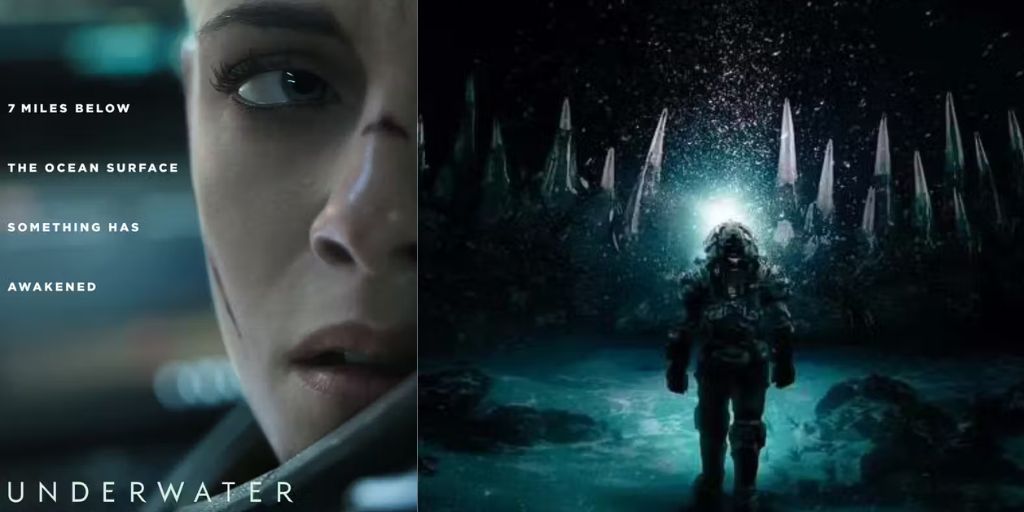
Still from the movie (Disney+)
The film also covers the idea of teamwork in crisis situations. As the characters face various challenges, they must rely on each other for survival. Their interactions reveal their fears, hopes, and desires. This teamwork theme adds an emotional layer to the story and emphasizes the importance of human connection during difficult times.
As the story progresses, the tension continues to build. Each new challenge puts the characters’ lives at risk, and viewers feel the weight of their struggles. The suspense keeps audiences engaged as they wonder whether Norah and her friends will find a way to escape.
The film’s pacing adds to the sense of urgency. It moves quickly from one tense moment to the next, leaving little time for the characters to catch their breath. This fast pace reflects the chaotic nature of their situation, drawing viewers deeper into the story.
By the end of the film, viewers are left with a lasting impression. Underwater serves as a reminder of the dangers lurking beneath the surface of the ocean. The combination of suspense, horror, and environmental themes creates a rich and engaging experience.
The film’s conclusion leaves audiences pondering its themes long after the credits roll. It challenges viewers to think about humanity’s relationship with nature and the consequences of our actions. The haunting imagery of Cthulhu and the terrifying creatures serve as a powerful reminder of the unknown forces that exist in the world.
Underwater is a remarkable film that combines Lovecraftian horror with a thrilling story. Its unique take on cosmic horror and the portrayal of claustrophobia make it a standout film. Kristen Stewart’s performance and the realistic design of the creatures add to its effectiveness.
This film encourages viewers to reflect on their connection to the environment and the consequences of human actions. Underwater is more than just a horror film; it is a thought-provoking dealing of fear, survival, and the unknown. Ultimately, it reminds us that while we may be small in the grand scheme of things, our actions can awaken forces far beyond our control.
