It Ends With Us stands as a poignant and emotional adaptation of Colleen Hoover’s best-selling novel, charming audiences with its powerful themes of love, abuse, and self-empowerment. While the film has generated much attention due to its behind-the-scenes drama and critiques surrounding its marketing, it has also achieved box-office success. The adaptation follows the complex love story of Lily Bloom, played by Blake Lively, as she grapples with her feelings for Ryle Kincaid (Justin Baldoni) and Atlas Corrigan (Brandon Sklenar). However, the film’s final moments offer a crucial resolution to Lily’s journey, which warrants a detailed analysis of her choices and the ultimate question: Does Lily end up with Atlas or Ryle?
It Ends with Us Ending Explained
It Ends With Us centers around Lily Bloom, a young woman who moves to Boston with the dream of opening her own flower shop. There, she crosses paths with Ryle, a neurosurgeon whose charm quickly sweeps her off her feet. However, their love story is not straightforward, as the film alternates between Lily’s present-day relationship with Ryle and flashbacks to her teenage years with Atlas, her first love. These flashbacks introduce another layer of tension, as Lily’s father’s abusive behavior toward her mother lingers in her memory. Ryle’s own dark tendencies begin to surface, echoing the trauma Lily experienced as a child, which becomes more apparent as the film progresses.

Lily Bloom and Ryle Kincaid (Image via Getty)
Amidst this, Lily reconnects with Atlas, now an adult, and it’s clear that their past love has never truly faded. While Lily and Ryle eventually marry, she begins to confront the painful reality that Ryle’s actions might not be accidental, but rather a deeper, more troubling pattern of behavior. As the story unfolds, Lily finds herself at a crossroads, torn between her tumultuous marriage to Ryle and the rekindled flame with Atlas. Ultimately, she makes a brave decision to leave Ryle, seeking refuge with Atlas as she begins the process of healing.
Lily’s Decision: Breaking Free from Ryle’s Abuse
Before Lily and Ryle marry, Atlas provides Lily with his phone number in case she ever needs his support, especially after a disturbing confrontation where Ryle accuses her of still being involved with Atlas. This tension escalates when Ryle discovers the number and a violent argument ensues. The situation takes a dark turn when Lily falls down the stairs, a moment that is left ambiguous for the audience but is clearly a result of Ryle’s actions. Although he claims it was an accident, the truth is undeniable to the viewers: Ryle pushed her.
Lily is forced to accept Ryle’s version of events, but this incident marks a pivotal moment in her awakening. As Lily starts to gain clarity, she feels the weight of her realization that Ryle’s past behavior was never accidental. The situation grows more complicated when Lily finds herself in a violent encounter with Ryle. In a particularly disturbing moment, Ryle assaults her after discovering the relationship between Lily and Atlas. This attack forces Lily to see the truth of Ryle’s abusive tendencies, and she begins to take steps toward breaking free from him, bolstered by Atlas’s support.
Lily’s Journey to Reclaiming Her Power
After a traumatic encounter with Ryle, Lily learns she is pregnant with his child. Seeking support from Atlas, they reflect on their past, and he reassures her she’ll be an amazing mother. Lily also learns from Allysa, Ryle’s sister, about his traumatic past—he accidentally killed his brother, Emerson—which helps her understand his behavior but strengthens her resolve to protect herself and her future child.

Lily Bloom (Image via Getty)
Allysa advises Lily to distance herself from Ryle, which sparks a turning point in Lily’s journey toward reclaiming control. Despite the challenges of pregnancy, Lily prepares for motherhood, creating a safe space for her baby. Ryle later attempts to reconcile, begging for another chance and promising to seek help. Lily, however, rejects him, standing firm in her decision to sever ties for good.
A Fresh Start: Lily’s Resolution
After giving birth, Lily is confronted by Ryle, who wants to be part of their daughter’s life. Lily, however, stands firm, naming their daughter after his late brother, Emerson, and insisting on a divorce. She asks Ryle a powerful question: “What if one day she said ‘My boyfriend hit me,’ what would you say to her?” This prompts Ryle to realize the pain he caused.
Ryle leaves and Lily embraces her new life with her daughter. She whispers, “It stops right here, with you and me. It ends with us,” ending the cycle of abuse for good.
The Film’s Conclusion: A Shift from the Book’s Ending
The film concludes with a flash-forward where Lily, her mother, and daughter visit Lily’s father’s grave. In a symbolic moment, Lily introduces her father to his granddaughter, leaving a blank eulogy page on his tombstone, signifying peace with her past and readiness to move forward.
Later, Lily and her daughter encounter Atlas at a farmer’s market. Their interaction is filled with lingering emotions, and while their connection remains evident, the film ends ambiguously. Lily confirms her independence from Ryle, and Atlas reveals he is single, hinting at a potential reconciliation.
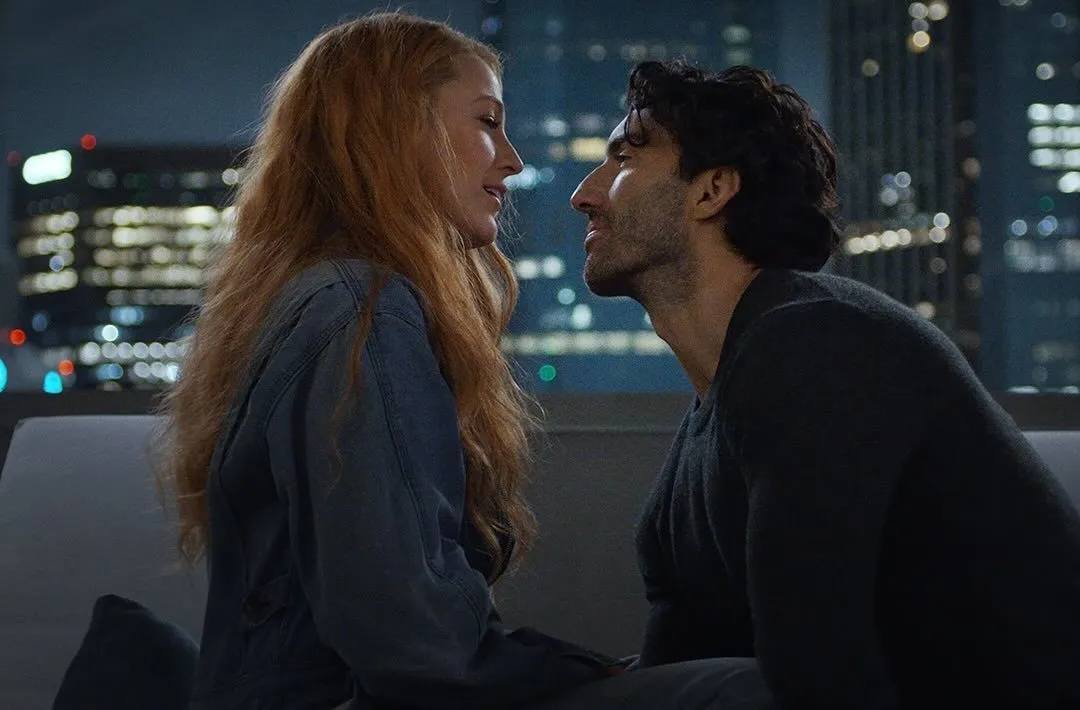
Lily Bloom and Ryle Kincaid (Image via Getty)
Unlike the book, where Lily and Atlas’s romantic reunion is explicit, the film opts for subtlety, likely to build intrigue for a sequel. This shift centers the story on Lily’s personal growth and her decision to break the cycle of abuse, prioritizing empowerment over romance.
Final Thoughts: A Story of Empowerment and Healing
In the end, It Ends With Us is not just about the question of who Lily chooses romantically, but rather about her journey toward healing and empowerment. Lily’s ability to walk away from an abusive relationship, her decision to raise her daughter independently, and her commitment to breaking the cycle of violence all contribute to a narrative that is both inspiring and heart-wrenching. While the film leaves some questions about Lily’s future with Atlas unanswered, it firmly establishes her as a woman who is in control of her own destiny.
In 2016, South Korean director Na Hong-jin released “The Wailing,” a gripping film that blends black comedy with chilling horror. Combining elements of zombie thrillers, psychological terror, and occult horror, the film earned its place as one of the most underappreciated Korean horror films. The complex narrative and surprising twists have left audiences fascinated with many trying to unravel the meaning behind its mysterious conclusion.
“The Wailing” revolves around Jong-goo (played by Kwak Do-won), a police officer, husband, and father. In the small, isolated village of Gokseong, strange and violent murders begin to unfold. Ordinary villagers are inexplicably turning into savage killers, leaving everyone puzzled. However, when these events coincide with the arrival of a mysterious Japanese man (Jun Kunimura), the village starts to suspect that something supernatural might be happening.
The Wailing Ending Explained
Despite the terrifying murders, Jong-goo remains initially skeptical about supernatural causes. His doubts begin to fade when his young daughter, Hyo-jin (Hwan-hee Kim), begins showing bizarre symptoms, such as violent behavior and a mysterious skin condition. In an attempt to find answers, Jong-goo consults with a local deacon, Yang Yi-sam (Do-yoon Kim), and confronts the Japanese man, who insists he knows nothing of the murders. Despite his suspicions, Jong-goo pressures the Japanese man to leave.
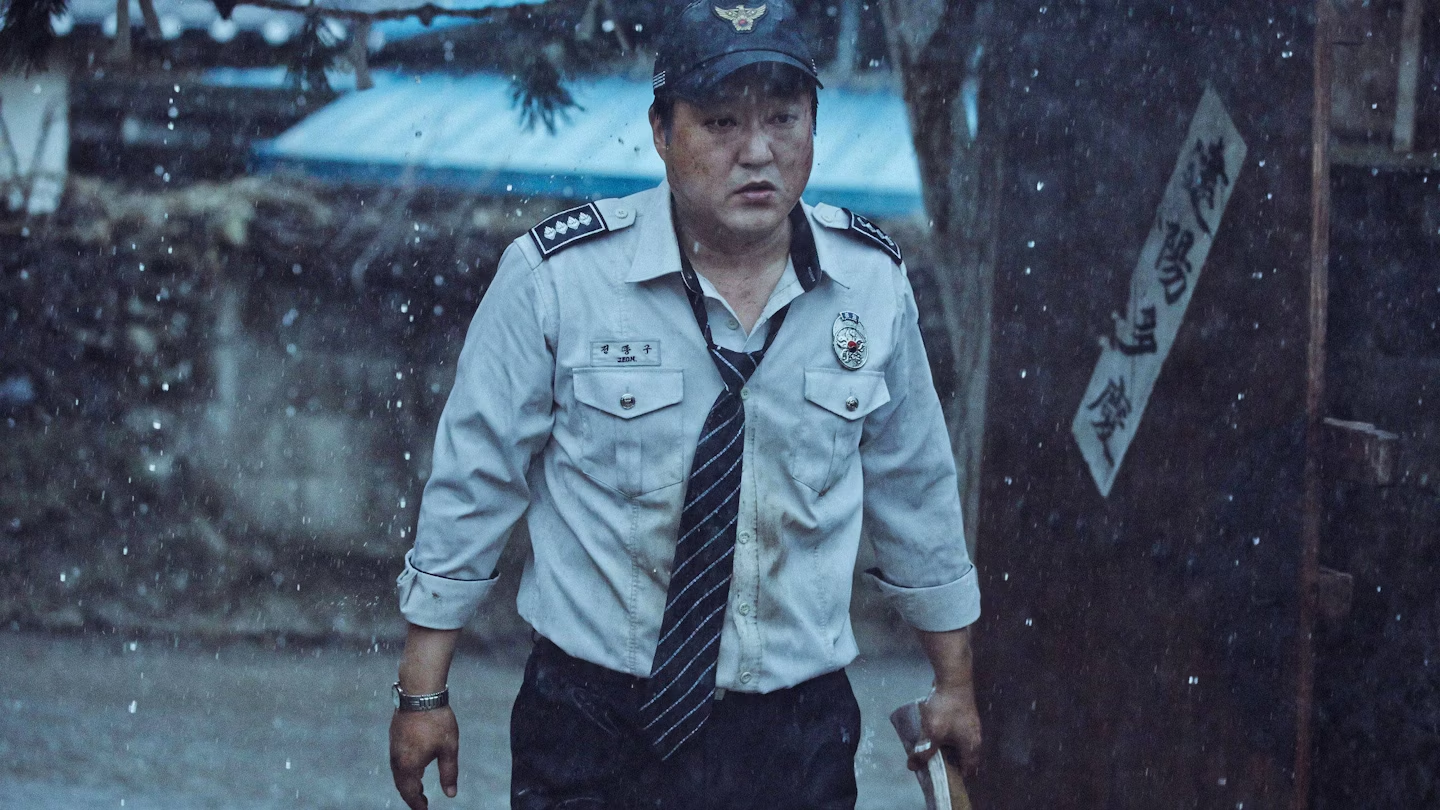
Jong-goo (Image via Getty)
Jong-goo’s Investigation Deepens
As the violence intensifies, Jong-goo finds himself increasingly caught in a personal battle. Even after a chilling encounter with a strange apparition and disturbing nightmares, he remains unconvinced that a spirit or demon is behind the chaos. His world is turned upside down when he finds a disturbing photo of the Japanese man with images of past murderers and victims. This discovery intensifies his desperation, and he warns the Japanese man to leave, or face deadly consequences.
Desperate for help, Jong-goo’s mother-in-law calls upon Il-gwang (Hwang Jung-min), a well-known shaman specializing in possession and demonic exorcism. Il-gwang reveals a terrifying theory: the Japanese man is not an ordinary human but a demon in disguise, whose presence in the village has corrupted the people. Jong-goo, still doubtful of the supernatural, is reluctantly forced to accept the shaman’s assistance when his daughter’s condition worsens.
The Climax: Unraveling the Truth
After sabotaging the exorcism, Jong-goo returns home to discover that his daughter has vanished. Il-gwang then reveals a surprising twist : the true demon is not the Japanese man but Moo-myeong (Chun Woo-hee), the mysterious woman who has been lurking around the village. The Japanese man, in truth, is a shaman who has followed the demon to Gokseong with hopes of ending its reign of terror.
In a tense confrontation with Moo-myeong, Jong-goo is torn between two choices. Moo-myeong claims to be the only one who can save Hyo-jin, and she urges Jong-goo to wait for her trap to catch the demon. The alternative is to trust the warnings of the shaman and rush back home to prevent further violence. Ultimately, Jong-goo opts to rush home, only to find that his daughter has killed his entire family, now fully possessed by the demon.
The Final Moment
In the heartbreaking conclusion, Jong-goo, overcome with grief, promises to protect his now-possessed daughter. The film ends ambiguously, leaving viewers to question the true nature of the demon and what it truly wanted. Was the demon targeting the village for its sins, or was there a deeper, more personal reason for its destructive path?
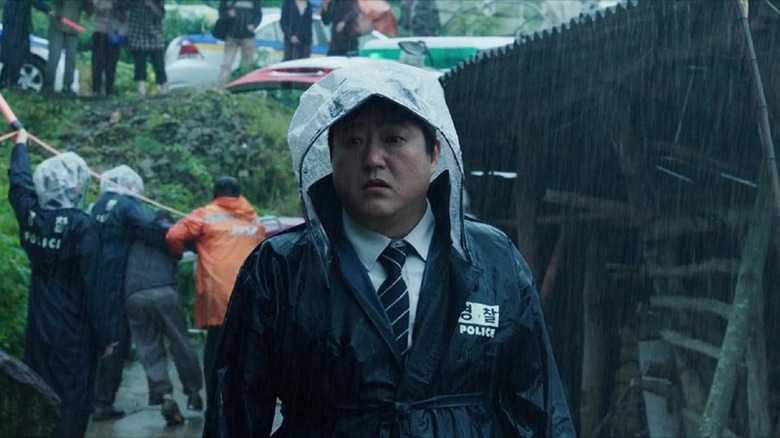
Jong-goo (Image via Getty)
Unraveling the Demon’s Identity
In the film’s final moments, the mystery surrounding the demon begins to unfold. The Japanese man, who had been believed to be the demon, is revealed to be a ghost — a demonic entity that has taken the form of a human. In an unsettling transformation, the Japanese man sheds his human disguise, revealing his true form as a monstrous, twisted creature with red eyes and grotesque features.
The identity of Moo-myeong remains unclear, though it is suggested that she may have been the true shaman, attempting to stop the demon’s destruction. However, her efforts were ultimately unsuccessful. Meanwhile, Il-gwang, once considered an ally, is revealed to have been corrupted by the demon, helping it to kill the villagers. In a chilling final scene, Il-gwang takes photos of Jong-goo and his possessed daughter, seemingly to add to the demon’s collection of souls.
Interpreting the Ending
The ending of “The Wailing” is deliberately ambiguous, leaving audiences with more questions than answers. While it’s clear that the demon has succeeded in overtaking Hyo-jin, the true reason for its arrival remains elusive. One interpretation suggests that the demon was drawn to the town because of its inhabitants’ collective sins, as implied by Moo-myeong. This theory aligns with the idea that the evil in Gokseong is not just supernatural but also tied to human wrongdoing.
Possible Alternative Explanations
The film’s ambiguity has spurred various interpretations, with some viewers suggesting that the supernatural elements are a red herring. One popular theory posits that the violence in the village is the result of a poisonous mushroom epidemic, which causes hallucinations and madness. This theory suggests that the demonic presence in the film is simply a hallucination induced by the mushrooms, with the violence being a natural consequence of the epidemic.
While the film’s themes of religion and family are central, there is an undercurrent of xenophobia in the portrayal of the Japanese man. The village’s immediate suspicion of the foreigner and the derogatory language used to describe him reflect an unintentional subtext of fear and mistrust toward outsiders. Director Na Hong-jin has explained that he did not intend to focus on xenophobia but instead wanted to highlight the mystery and fear that arise from the presence of an unknown threat.
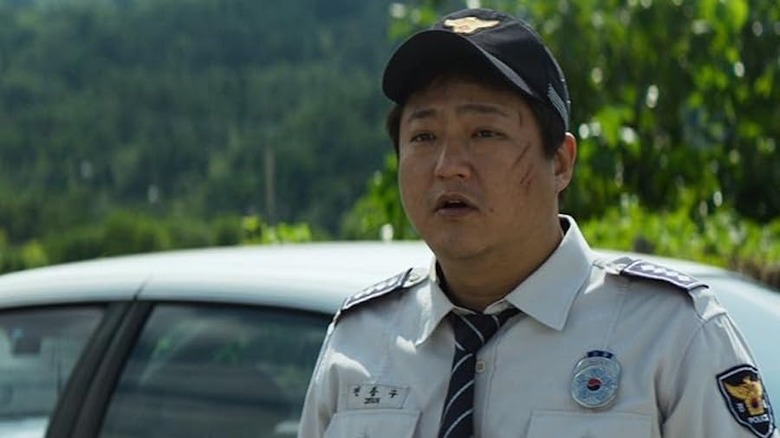
Jong-goo (Image via Getty)
Na Hong-jin’s Approach to the Ending
Director Na Hong-jin crafted the film’s ending to allow for multiple interpretations, aiming to satisfy a wide range of audiences. In interviews, he discussed how he deliberately left the conclusion open-ended, allowing viewers to come up with their own interpretations. This approach paid off, as the film’s ambiguity sparked intense discussions and theories from fans around the world.
Critical Reception of the Ending
While “The Wailing” received widespread critical acclaim, the ending itself generated mixed reactions. Some critics, such as those from Empire, praised the film’s stunning conclusion, while others felt that the twists were clumsily executed. Audiences, too, were divided, with some embracing the ambiguity and others seeking more concrete answers.
