Saturday Night gives an insightful look into the intense, high-energy atmosphere of Saturday Night Live (SNL), showing how its quick humor, unpredictable cast, and behind-the-scenes drama have led to over fifty years of groundbreaking television. The movie, directed by Jason Reitman, opens with one of SNL founder Lorne Michaels’ famous quotes: “The show doesn’t go on because it’s ready; it goes on because it’s 11:30.”
These words capture the essence of SNL, a show that combines rapid production with a comedic edge, aiming to entertain viewers each week no matter the challenges or risks involved. In this time frame, the team crafts episodes that can leave a lasting impression on pop culture or, at times, reflect the fast-paced demands of weekly broadcast television.
Critics who occasionally argue that SNL isn’t as relevant or funny as it once was might not fully appreciate that SNL has always been a mix of remarkable highlights and challenging moments.
With Saturday Night, Reitman, who co-wrote the script alongside Gil Kenan, known for Ghostbusters, set out to capture not only the story behind the show’s first live episode but also the unfiltered energy of bringing the show to life.
Rather than delivering precise impressions of comedy legends or creating a strictly factual retelling of the events leading up to SNL’s debut episode, Reitman instead focuses on the chaotic, rushed, and often humorous spirit behind producing a show that must go on air, ready or not, at 11:30 P.M. This intense preparation can feel less like organized rehearsal and more like organized chaos.
Through this lens, Saturday Night seeks to celebrate SNL’s unique work environment and the commitment of the people behind it, which has made the show a cultural phenomenon for nearly half a century.
The story centers around Gabriel LaBelle, known for The Fabelmans, as he takes on the role of a young Lorne Michaels. Michaels in this portrayal is a driven, young comedy producer who must prove to NBC that his concept for a live, variety-style comedy show—complete with musical guests, short films, and even Muppets—is a strong one worth supporting.
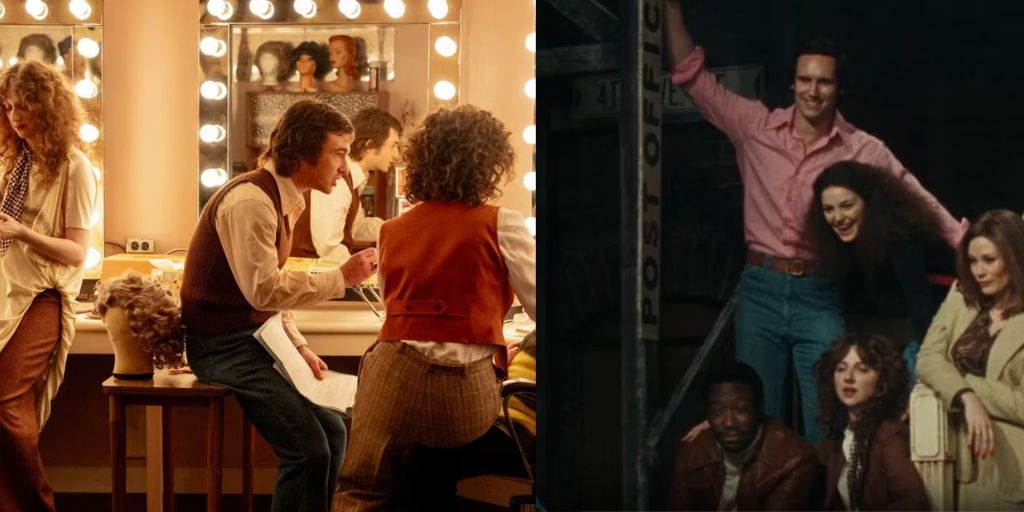
Still from Saturday Night (Columbia Pictures)
With just 90 minutes left before showtime, the odds seem stacked against the team. Network executives are demanding quick results and have their eyes on Michaels. Meanwhile, critical parts of the production are still missing: John Belushi (played by Matt Wood) hasn’t signed his contract, essential lighting crew members haven’t shown up, bricks are being laid in the studio as time ticks away, and the show’s content hasn’t yet been finalized or timed down to fit its allotted airspace.
With each passing moment, it looks less likely that Saturday Night will make it to air to test itself, regardless of the approaching 11:30 deadline. The film’s opening scene handles character introductions gracefully, showing who is playing each iconic SNL figure without disrupting the pace of the story. Instead of pausing to formally introduce each actor and the characters they portray, Saturday Night uses these first moments to naturally familiarize viewers with the ensemble of actors recreating SNL’s original cast.
This efficient introduction helps the audience keep track of the many moving parts within the story, each individual adding to the broader picture of the film’s setting. The casting choices Reitman made bring personality and energy to the film’s characters, even if they aren’t strict impersonations.
Dylan O’Brien, who plays Dan Aykroyd, delivers a performance that might seem unusual at first, but he quickly captures the essence of Aykroyd through his subtle mannerisms rather than exact imitation. Lamorne Morris as Garrett Morris, Cory Michael Smith as Chevy Chase, and others show the spirit of the original SNL cast while allowing each actor to bring something original to the role.
Reitman’s film, however, doesn’t just focus on SNL’s male cast members. The movie also takes care to showcase the three women in SNL’s first cast lineup: Gilda Radner (Ella Hunt), Jane Curtin (Kim Matula), and Laraine Newman (Emily Fairn). These actresses capture the drive, humor, and sometimes frustration of being a woman in an industry often dominated by men.
Their camaraderie and shared ambition help them stand out in a show that could easily have been a “boys’ club.” These characters, while finding their way through a male-centered comedy world, find ways to make their names known, each adding her own flair and humor to SNL’s legacy. Another central female figure in the story is Rosie Shuster (Rachel Sennott), Michaels’ estranged wife, whose contributions to SNL are undeniable.
As the movie demonstrates, Shuster brought critical support and creative insight that helped Michaels and the show succeed. Shuster and Michaels’ partnership was essential, showing that while Michaels often receives the recognition, Shuster’s influence was a key factor in SNL’s early success. This storyline emphasizes that SNL’s foundation wasn’t built by one person alone but by the collaboration of numerous voices, perspectives, and ideas.
Saturday Night features a massive cast, with each actor bringing unique characters into the storyline. Tommy Dewey stars as Michael O’Donoghue, a figure known for his dark and daring sense of humor, which acts as both a strength and a challenge within the team.
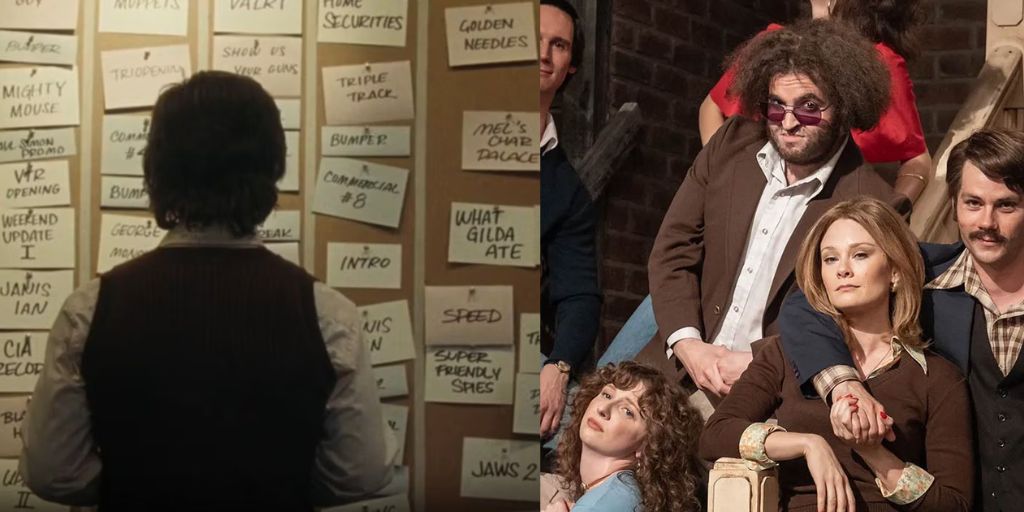
Still from Saturday Night (Columbia Pictures)
Matthew Rhys appears as George Carlin, who served as the first guest host for SNL, adding an additional layer of tension and excitement to the show’s debut. Nicholas Braun portrays both Jim Henson and Andy Kaufman, bringing a lighthearted touch to these influential figures. J.K. Simmons takes on the role of Milton Berle, while Andrew Barth Feldman portrays a newcomer struggling to adapt to the SNL world.
Each actor gets only a few minutes of screen time, yet each character contributes something meaningful to Michaels’ chaotic journey. The wide-ranging ensemble shows the many personalities involved in the show’s creation, adding a sense of lively chaos to the story.
At the film’s center, LaBelle brings Michaels’ energy and ambition to life, showing the pressure he felt to make the show successful. LaBelle’s portrayal of Michaels transforms from a hopeful and enthusiastic figure to a visibly exhausted producer struggling to hold everything together.
By the time the film reaches its climax, LaBelle’s character is visibly drained, with red eyes and disheveled clothes showing the physical toll of trying to meet SNL’s high demands. This exhaustion mirrors the high-stress world of live television, where every decision matters and every second counts.
Despite the pressure, LaBelle captures Michaels’ unwavering commitment to his vision. His portrayal serves as a reminder of the immense dedication that goes into creating something new and unpredictable, especially in the fast-paced world of comedy.
Reitman and Kenan’s script is based on real events surrounding the premiere of SNL, but the film does not attempt to be a precise recreation of those events. Instead, Saturday Night uses artistic liberties to create a heightened version of what likely happened during this high-pressure period.
For example, scenes like Michaels’ conversation with network executive David Tebet (played by Willem Dafoe) or a surreal moment where Belushi goes ice skating in a bee costume are fictionalized but add to the film’s structure and pacing.
These scenes may not be historically accurate, but they help build a clear narrative. In the context of the film, these moments highlight Michaels’ struggle to bring his vision to life despite countless obstacles.
Saturday Night also marks Reitman’s return to his best directorial style since films like Tully in 2018 and Young Adult in 2011. The movie skillfully builds tension through a series of escalating issues that Michaels and his team must overcome.
Jon Batiste’s musical score, centered around a steady drumbeat, amplifies the film’s pacing, adding suspense to each scene. The rhythm matches the story’s pacing and adds to the sense of urgency that permeates the film, similar to the music used in Birdman.
Reitman’s love for SNL is evident in the way he directs, creating a sense of excitement as he captures the world of Studio 8H, where SNL is filmed. His directorial style, which includes long takes, quick cuts, and constant camera movement, brings the setting to life in a way that reflects his admiration for SNL and its cultural impact.
However, the film’s deep connection to SNL’s history might feel overwhelming for audiences less familiar with the show. Reitman and Kenan’s script seems to assume that viewers have prior knowledge of SNL’s culture, traditions, and history.
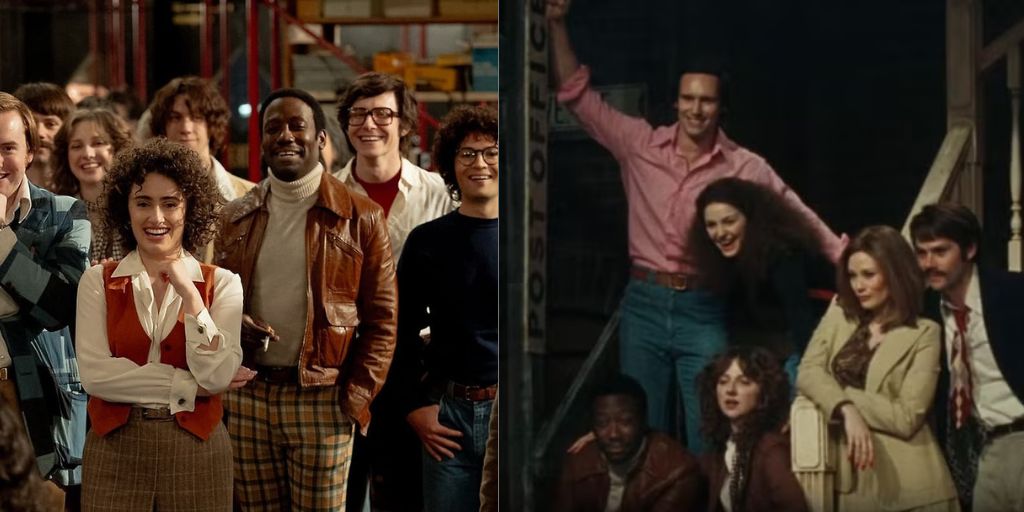
Still from the movie (Columbia Pictures)
But for others, they might lack significance. Although Saturday Night is deeply rooted in Reitman and Kenan’s knowledge of and love for SNL, viewers without similar familiarity may miss some of the nuances and historical context woven into the film.
Despite these specific references, Saturday Night still offers an exciting and engaging story that anyone can appreciate. It shows how SNL, through the dedication and resilience of its cast and crew, managed to revolutionize comedy and create a unique space within television.
Reitman’s film captures the intense teamwork and creativity needed to bring SNL to life, highlighting the challenges and breakthroughs that made the show what it is today. This movie doesn’t just look at SNL’s past but also recognizes its lasting influence on comedy, pop culture, and television.
By focusing on the creation of the show’s first episode, Saturday Night reminds viewers of the dedication, chaos, and collaboration involved in bringing a live comedy show to air.
Despite its niche references, Saturday Night offers a story that can engage a wide range of audiences, even those less familiar with SNL. By capturing the intense teamwork and creativity essential to the show’s debut, Reitman provides a window into the labor, dedication, and improvisation that shaped this groundbreaking series.
Through its dynamic storytelling, Saturday Night does more than recall the past; it reminds viewers of the tenacity required to produce a live comedy show that would later become an essential part of American culture. With SNL, Michaels and his team created a new language in comedy, one that wasn’t just about making people laugh but about pushing boundaries, addressing societal issues, and challenging conventional ideas of television entertainment.
Saturday Night demonstrates that SNL wasn’t just born out of talent or clever writing but out of an environment that welcomed risk and resilience. Reitman’s film shows that the live format forced everyone to adapt on the fly, working under pressure with no room for mistakes, and building something unique week after week.
In portraying this, Saturday Night offers a fresh appreciation for the obstacles that SNL has continually overcome and the legacy it has carved out in television. The depiction of Michaels and his team’s chaotic preparation also highlights an essential truth of live comedy: the audience sees only the polished outcome, while the countless hours of mistakes, trials, and breakthroughs remain hidden backstage.
Saturday Night resonates beyond SNL, speaking to anyone who has ever believed in a creative vision, struggled to bring it to life, or worked tirelessly toward a goal despite the odds. The story becomes not just about a single night in television history but about the universal drive to create, innovate, and persist.
Reitman’s emphasis on collaboration and resilience as driving forces behind the show’s success serves as a reminder that behind every successful venture lies a group of dedicated individuals, each playing a vital role in the finished product.
Michaels may have held the vision for SNL, but it was the combined efforts of writers, actors, producers, and crew members that made the show a reality. Saturday Night honors these contributions, showing how each person’s unique talents and hard work came together to shape the chaotic, humorous world of SNL.
In many ways, Saturday Night reaffirms that creativity and ambition, despite the inherent difficulties, can create something remarkable. It inspires viewers to see the worth in every struggle and obstacle in the creative process.
By highlighting the intensity and unpredictability behind SNL’s first episode, Reitman allows the audience to appreciate the human effort that keeps the show running week after week, decade after decade. For those who love SNL, and even for those new to its legacy, Saturday Night offers an entertaining and heartfelt tribute to a world where humor, grit, and determination collide to bring laughter to millions.
J.R.R. Tolkien’s The Lord of the Rings has held a special place in readers’ hearts for decades, offering a world of deep characters, complex histories, and profound moral questions. Among the most iconic characters is Gandalf, played by Ian McKellen in the films. Gandalf is not only a powerful wizard but also a key figure in the struggle against Sauron, the dark lord of Middle-earth.
However, Gandalf stands out as more than just a typical sorcerer. As a Maia, he belongs to a unique category of beings called the Ainur, who existed before the world was even formed. Unlike typical mortals, Gandalf is an immortal spirit with powers and insights that go far beyond human understanding.
Yet despite his otherworldly origins, he relies on a simple wooden staff to channel his magic. This brings up a curious question: why would someone as powerful as Gandalf need a staff?
The answer goes beyond just Gandalf’s abilities as a Maia. It ties into his mission and the restrictions imposed on him by the higher beings called the Valar when he was sent to Middle-earth. Gandalf’s staff is much more than a magical instrument; it is a symbol of his authority, a guide for his mission, and a tool for controlling his powers within the limits he must respect.
This restraint reflects how Tolkien designed his world, combining strength with responsibility. Gandalf’s staff not only serves as a tool for magic but represents the balance he must keep between his powers and his duties. By examining Gandalf’s background, mission, and the role of his staff, we can see why he must rely on it in his interactions with the world of Middle-earth.
Gandalf’s Role in the Istari and the Staff’s Symbolic Power
Gandalf’s background as a Maia sets him apart from typical wizards in fantasy. As a Maia, Gandalf is a lesser Ainu, a type of divine being created by Eru Ilúvatar, the god figure in Tolkien’s legendarium. Among these beings, the most powerful are the Valar, who shape and guide the world, while the Maiar serve them as helpers and messengers. Gandalf is one of these Maiar, which places him in a unique role.
He is both powerful and deeply aware of the responsibilities that come with such strength. When the Valar chose to send a group of Maiar to Middle-earth to counter the growing threat of Sauron, they created the order of the Istari or wizards.
The Valar selected five Maiar to take on physical forms, including Gandalf. Unlike Sauron, who sought control and dominance, Gandalf’s mission was to guide and inspire hope in the people of Middle-earth.
The Istari came to Middle-earth not as conquerors but as wise counselors, entrusted with helping the free peoples resist Sauron’s influence. However, they were given strict rules. Tolkien’s The Silmarillion describes how the Valar instructed the Istari to avoid displays of overwhelming power, which could intimidate or control the very beings they were meant to guide.
Instead, they were meant to influence through wisdom, encouraging people to stand up to Sauron on their own terms. This approach set the Istari apart from Sauron, whose power was rooted in manipulation and domination. Gandalf, then, embodies the spirit of gentle guidance, focusing on the freedom of choice for Middle-earth’s inhabitants. His staff plays an important role in allowing him to fulfill this role without resorting to force.
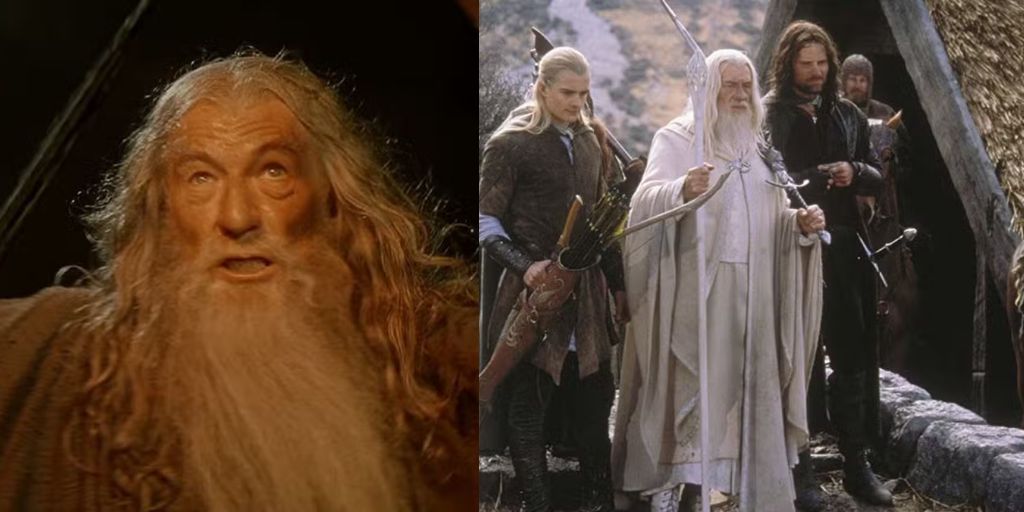
Still from the series (Max)
Gandalf’s Staff as a Channel for Limited Power
While Gandalf has significant power, he cannot wield it in the same way he could before taking on a mortal form. His staff helps him channel his abilities within the limitations set by the Valar. Rather than unleashing his full power, which might disrupt the world or instill fear, Gandalf’s staff allows him to use his magic in more measured, focused ways.
In his physical form, Gandalf faces the same challenges and vulnerabilities as other mortals, and the staff aids him in maintaining control over his magic without overwhelming the world. Gandalf’s staff is essential for creating the balance between his divine powers and the physical limits he must adhere to.
In Tolkien’s world, magic comes with its own risks and responsibilities. Power must be used thoughtfully, with respect for the well-being and freedom of others. Gandalf’s staff represents this careful approach to magic, helping him work within the world’s natural limits rather than overpowering it.
Tolkien’s fascination with mythology and the archetype of the wise, restrained wizard influenced his portrayal of Gandalf and his staff. Wizards in ancient folklore often carry staffs as symbols of their wisdom and authority, and Gandalf is no different. His staff is both a tool and a part of who he is, shaping how he interacts with Middle-earth.
The Staff’s Role in Gandalf’s Character Transformation
As Gandalf grows and takes on greater responsibilities, his staff remains a constant, symbolizing his authority and purpose. When Gandalf transforms from “Gandalf the Grey” to “Gandalf the White,” he returns to Middle-earth with even greater power and a renewed mission.
After defeating the Balrog and experiencing a kind of resurrection, Gandalf’s powers are amplified, but so are his responsibilities. In his new role as Gandalf the White, he becomes the leader of the Istari, taking over from Saruman, who had succumbed to corruption.
This transformation is visually represented in the films when Gandalf breaks Saruman’s staff at Isengard, symbolizing his rise in authority. Breaking Saruman’s staff is a pivotal moment, both in the story and for Gandalf’s character. It signals his new role as head of the Istari and marks his shift from a guide to a more direct protector of Middle-earth.
Gandalf’s transformation is not only about gaining power but about embracing a new level of responsibility. As Gandalf the White, he becomes more assertive in his mission, using his staff to confront Saruman and protect Middle-earth more actively. His return as Gandalf the White underscores the importance of his staff as a tool for guidance and balance, not simply a weapon.
Without his staff, Gandalf would be incomplete—not because he lacks power, but because the staff is essential for expressing his authority and fulfilling his role. Tolkien’s concept of magic in Middle-earth is not one of unchecked power but of carefully balanced responsibility.

Still from the series (Max)
Gandalf’s Staff in the Context of Middle-earth’s Power System
Magic in Tolkien’s world is a unique force that reflects the values and limitations of its user. Rather than an unlimited source of energy, magic in Middle-earth is tied to the user’s wisdom, intent, and moral compass. Gandalf’s staff reflects this view of magic as something that should be used carefully and with respect for others.
Gandalf’s staff is not only a symbol of his authority but also an instrument that allows him to balance his power with the needs of the world around him. His staff acts as a channel for his abilities, helping him focus his magic and maintain control without overwhelming others.
In Middle-earth, many characters have objects that symbolize their roles, from Aragorn’s sword Andúril to the One Ring. These items reflect their users’ unique responsibilities and place in the world, and Gandalf’s staff is no exception.
Tolkien’s portrayal of Gandalf’s staff aligns with his broader philosophy of magic and power. In Middle-earth, strength is not just about raw force but about the responsibility to use power wisely. Gandalf’s staff is a reminder that even the most powerful beings have limits and must act with respect for the world and its inhabitants.
This theme of balanced power runs through many of Tolkien’s works, reflecting his view of authority as something that should be exercised with restraint and wisdom.
Gandalf’s Journey in The Rings of Power
As he gradually regains his sense of self, he discovers his powers and begins to understand his purpose. In season 2, The Stranger goes on a journey to find a staff, recognizing that he needs it to control his abilities more effectively. Without it, he struggles to manage his magic, sometimes endangering his friends, the Harfoots Nori and Poppy.
This storyline gives insight into Gandalf’s development and the importance of his staff in his journey. It shows that the staff is more than just a tool for magic; it’s an essential part of his identity and role as a guide.
As The Stranger searches for a staff, viewers get a look into Gandalf’s transformation into the wise, powerful figure he will become. The search for the staff symbolizes his need to balance his powers and understand his role in Middle-earth, reinforcing Tolkien’s theme of magic as a force that must be used with care.
The Symbolic Meaning of Gandalf’s Staff in Tolkien’s World
Gandalf’s staff embodies his mission and values, reflecting Tolkien’s approach to magic and power. In Middle-earth, magic is not a tool for domination but a way to promote balance and harmony. Gandalf’s staff is a symbol of his commitment to this philosophy, helping him channel his abilities within the limits he must respect.
In a world where power can easily corrupt, Gandalf’s staff reminds him of his duty to guide, not control. This focus on balanced power is a core aspect of Tolkien’s work, reflecting his belief that authority should be tempered with responsibility.
Through Gandalf’s journey, Tolkien reveals the idea that true strength comes from restraint, compassion, and respect for others. Gandalf’s staff serves as a reminder that power is not an end in itself but a tool for fulfilling one’s responsibilities.
In The Lord of the Rings, Gandalf’s staff represents the balance he must maintain as both a powerful being and a guide. It is a symbol of his mission to protect Middle-earth while respecting the freedom of its inhabitants. Gandalf’s story is one of growth, humility, and dedication, and his staff is a vital part of that journey.
