What might be the most iconic part of 1988’s Beetlejuice isn’t the stop-motion or the dark fantasy weirdness, but the casting. It’s a career highlight for Michael Keaton, it lets Catherine O’Hara’s comedic brilliance shine, and it’s a star-making turn for Winona Ryder.
While all these performers deliver brilliant performances, one cast member stands out as the best side character. In Tim Burton’s quirky mix of mortals and ghosts, including L.L. Bean hater Otho (Glenn Shadix) and the green-skinned Miss Argentina (Patrice Martinez), we have the cranky but hilarious afterlife caseworker Juno, played by the underrated Hollywood actress, Sylvia Sidney.
Beetlejuice was one of Sidney’s last film roles, and she wasn’t sure if she wanted to do it. Burton had to help her understand his vision. Her casting gave Beetlejuice fans a grumpy, chain-smoking short queen, who was essential in balancing the film’s horror and comedy.
With Beetlejuice Beetlejuice (2024) now out, the legacy sequel shows what happens without a character like Juno in the afterlife’s gothic world. Adam (Alec Baldwin) and Barbara (Geena Davis) Maitland die in a car accident and become ghosts in their home.
After their house is sold to the Deetz family, who are not ideal for the ghosts, the Maitlands try to haunt them. But these ghosts are too nice to scare anyone. A supernatural book left behind for them, the “Handbook for the Recently Deceased,” doesn’t help, nor does a trip to the afterlife for an unscheduled meeting with their caseworker.
Adam and Barbara meet the impatient and grumpy Juno, who tells them, “I evaluate individual cases and determine if help is needed, deserved, and available.” When Adam asks if she is available, Juno bluntly says, “No.” Sylvia Sidney’s role as the overworked Juno is darkly funny, bringing a sense of reality to the fantastical setting with her husky voice and tough personality.
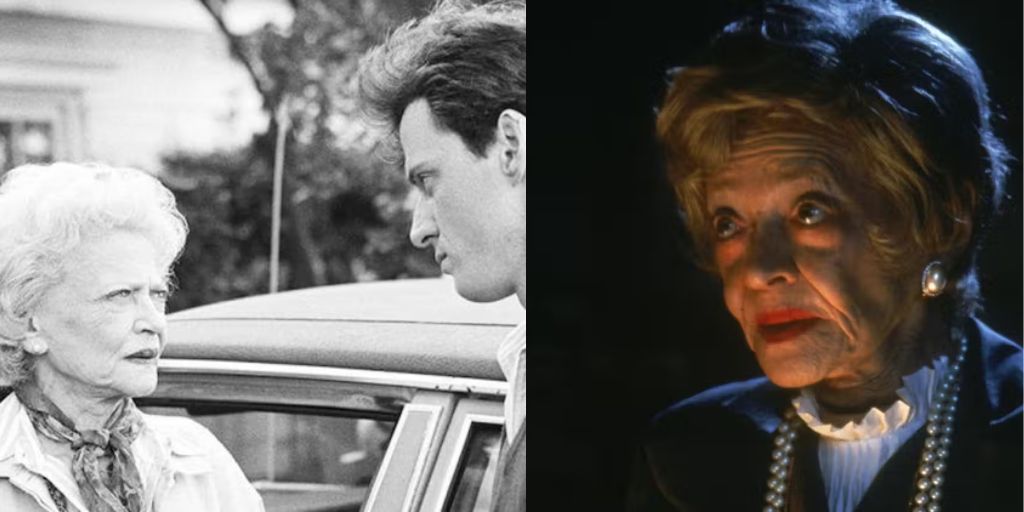
Still from the movie (Max)
She plays the film’s best side character, and Beetlejuice fans might not know that Sidney had a legendary career before joining Tim Burton’s version of the Netherworld. A 1990 LA Times interview with Sidney reviewed her esteemed career. She appeared in films by influential directors, including Alfred Hitchcock’s Sabotage and Fritz Lang’s Fury, both from 1936.
She received an Oscar nomination in 1973 for her supporting role in Summer Wishes, Winter Dreams. In 1985, she gave a memorable Golden Globe-winning performance in the TV movie An Early Frost, about a man dealing with an AIDS diagnosis. Beetlejuice introduced her to new generations, but she initially hesitated to join the cast. “I turned it down so many times because I couldn’t understand the script,” she said in the same LA Times interview.
Sidney mentioned, “I finally had a long conversation with them, and they said, ‘Read the script again.’ I said you’ll have to send another one because I threw the other one away.” It took a long meeting with Tim Burton for Sidney to appreciate his “sensitivity” and accept the role.
Beetlejuice’s German Expressionism, with slanted hallways and crooked doorways, may not be recognizable to many viewers. However, everyone has met their version of Juno before, whether at the DMV, the bank, or the doctor’s office. Juno is not a villain but is not particularly helpful to the spirits either.
Juno’s advice for the Maitlands on how to get rid of the Deetzes is vague: “Do what you know, use your talents, practice!” This advice leads the couple to create the best dinner party scene in a comedy, with Adam’s love of Harry Belafonte music having the opposite effect of driving the Deetzes away.
Sidney’s deadpan, tired line delivery makes her irritation at the Maitlands and other ghosts funny rather than mean-spirited (pun intended). Surrounded by recently deceased football players, she’s tiny, but her brash voice makes her stand out as she yells, “I’m not your coach! He survived.”
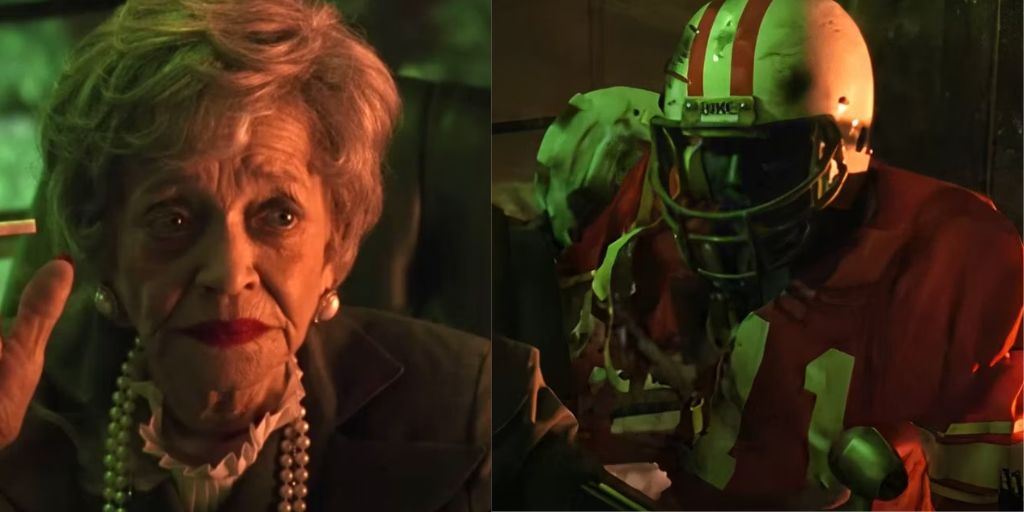
Scene from the movie (Max)
Juno’s character design doesn’t immediately stand out until she takes a drag from her cigarette, and smoke escapes from her slit throat. It’s as distinct as the other waiting room ghosts without being as outrageous as a hunter with a shrunken head or a woman split in half. This helps viewers take her seriously, unlike Otho’s foolishness or Miss Argentina’s colorful appearance.
Juno’s role in the story is more important than just explaining the “Ghost with the Most” or making viewers laugh at her constant annoyance, and it’s something missing from Beetlejuice Beetlejuice. While the sequel is mostly successful, the return of Betelgeuse and Lydia (Ryder) slips into zaniness compared to the original’s balance with the mundane.
Willem Dafoe’s Wolf Jackson was an action movie star who did his own stunts when he was alive but now works as a hard-boiled detective in the afterlife. He constantly confuses these two parts of himself. As the new ghostly authority figure, Wolf Jackson is not as serious as Juno.
Instead, he matches the sequel’s campy energy. Dafoe is enjoying himself, but his character doesn’t fit into the main story as well as Juno does. Juno’s no-nonsense attitude is a major reason why the original’s balance is maintained.
In the afterlife, the Maitlands deal with frustrations similar to their life. If not for the spooky office layout or slit throat, Juno could belong in an ordinary workplace. She doesn’t have time for catchphrases like Wolf Jackson — she has a lot of paperwork to handle!
After over 30 years, it makes sense why Beetlejuice Beetlejuice embraces the supernatural chaos, keeping it distinct from the original to avoid becoming a complete copy. But Sylvia Sidney remains an underrated highlight from the 1988 classic.
She was seen in Tim Burton’s 1996 alien invasion movie Mars Attacks!, her final film role before she passed away in 1999. However, her best work with Burton was in Beetlejuice. Sylvia Sidney’s performance as Juno represents the peak of supernatural comedy, making rewatching it enjoyable and fresh.
Lisa McGee’s popular show Derry Girls, which first aired on Channel 4 and later came to Netflix, tells the story of Northern Irish teenagers Erin Quinn (Saoirse-Monica Jackson), Orla McCool (Louisa Harland), Claire Devlin (Nicola Coughlan), Michelle Malon (Jamie-Lee O’Donnell), and their English friend James Maguire (Dylan Llewellyn).
The show follows their teenage years in Derry during the time of the Troubles. In its final season, Derry Girls featured several notable guest stars, including Fatboy Slim, Conleth Hill from Game of Thrones, and Chelsea Clinton. But the biggest surprise came in the first episode of Season 3 when Liam Neeson appeared as a Royal Ulster Constabulary officer, leaving viewers shocked.
Neeson also appeared briefly in the final episode of Derry Girls, but this time his character took on a much more serious tone compared to the humorous interrogation scene in the episode “The Night Before.” In the finale, Neeson’s character was shown voting on the Good Friday Agreement. His emotional expression left viewers wondering about the importance of his return and what it meant for the story.
Who Does Liam Neeson Play in Derry Girls?
In the episode “The Night Before,” Neeson plays Chief Inspector Byers, a Royal Ulster Constabulary officer. He interrogates the group of girls after they accidentally break into their school while searching for their GSCE results.
According to The Guardian, Neeson was nervous about filming his scene, and his appearance was kept secret by referring to him on set as “the big fella.”
During the interrogation, Byers is worn down by Uncle Colm (played by Kevin McAleer), whose long, boring stories cause both him and his partner to grow frustrated. Eventually, they release the girls after realizing they aren’t responsible for the burglary.
Though the scene is funny, it takes a more serious turn when Erin accuses the officers of discriminating against them because they are Catholic.
Neeson’s character responds that this is a serious accusation. He also reveals that the RUC only has three Catholic officers, showing the discrimination in the police force at the time. This moment ties the scene to the larger context of the Troubles, which affected everyone in Northern Ireland, including these teenage girls.
Neeson’s Return in the Derry Girls Finale
In the last episode of Derry Girls, titled “The Agreement,” Neeson’s character returns during a crucial time in Northern Ireland’s history — the Good Friday Agreement. This agreement, introduced in 1998, aimed to end the violence of the Troubles.
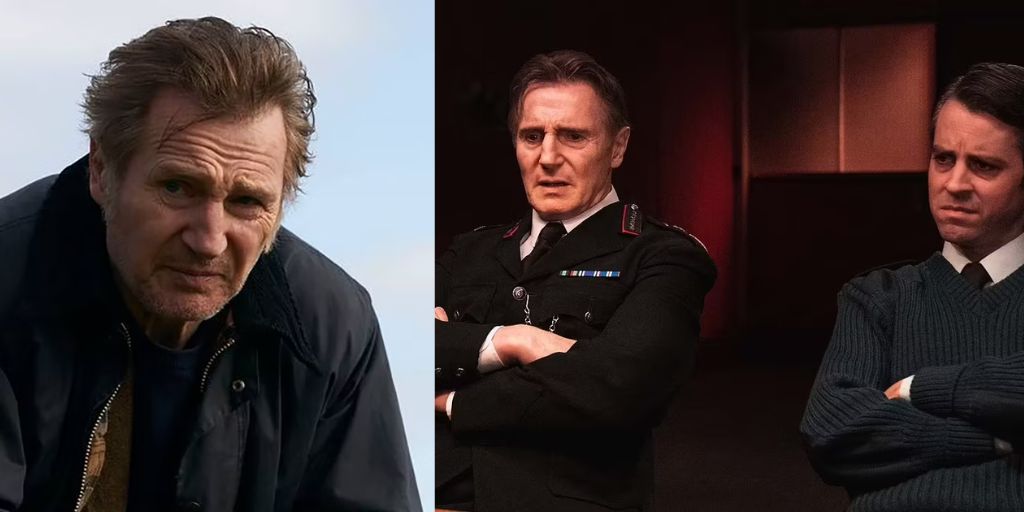
Still from Derry Girls (Credit: Netflix)
It focused on police reform, the disbanding of paramilitary groups, and the return of self-government to Northern Ireland. As the characters in Derry Girls debate the moral implications of the agreement, they are shown casting their votes in a public referendum.
One of the most memorable moments in the finale is when Neeson’s character, Chief Inspector Byers, is seen voting.
The scene is set to the song “Dreams” by The Cranberries and is intertwined with footage of historical moments, including UK Prime Minister David Cameron’s apology for the Bloody Sunday massacre of 1972, where 26 unarmed Catholic protestors were killed by British soldiers.
Byers is shown removing his RUC officer’s hat before he votes, a subtle but powerful gesture that carries deep significance.
Why Does Neeson’s Character Remove His Hat?
To understand the importance of this moment, it’s essential to know about the Troubles, a conflict that began in the late 1960s and ended with the Good Friday Agreement in 1998.
It was a violent conflict between unionists, mostly Protestants who wanted Northern Ireland to remain part of the UK, and nationalists, mostly Catholics who wanted to join the Republic of Ireland.
Over 3,800 people died during the Troubles, and Catholics faced significant discrimination, especially from the RUC, which was often accused of siding with unionist paramilitary groups against Catholics.
Neeson’s character appears conflicted as he votes. Part of this inner struggle could stem from the fact that, during the Troubles, around 300-400 RUC officers were killed.
The Good Friday Agreement allowed for the release of some prisoners responsible for these deaths, which might have been weighing on Chief Inspector Byers’ mind. By removing his hat, he could be acknowledging the many lives lost and choosing to vote not as an RUC officer, but as a person affected by the violence of the Troubles.
The removal of his hat could also symbolize the burden of his role in the RUC. Neeson’s character might have been voting with the weight of the institution on his shoulders. By taking off the hat, he may have been freeing himself from that responsibility to vote based on his conscience.
Neeson’s Connection to His Role
Though Neeson plays a Protestant RUC officer in Derry Girls, he is a Catholic who grew up in Ballymena, Northern Ireland, during the Troubles. He has spoken openly about Ireland’s unification and has praised the Good Friday Agreement.
Neeson’s role in the show likely held deep personal significance for him, and his emotional performance in the final scene may reflect his feelings about the conflict and the peace process.
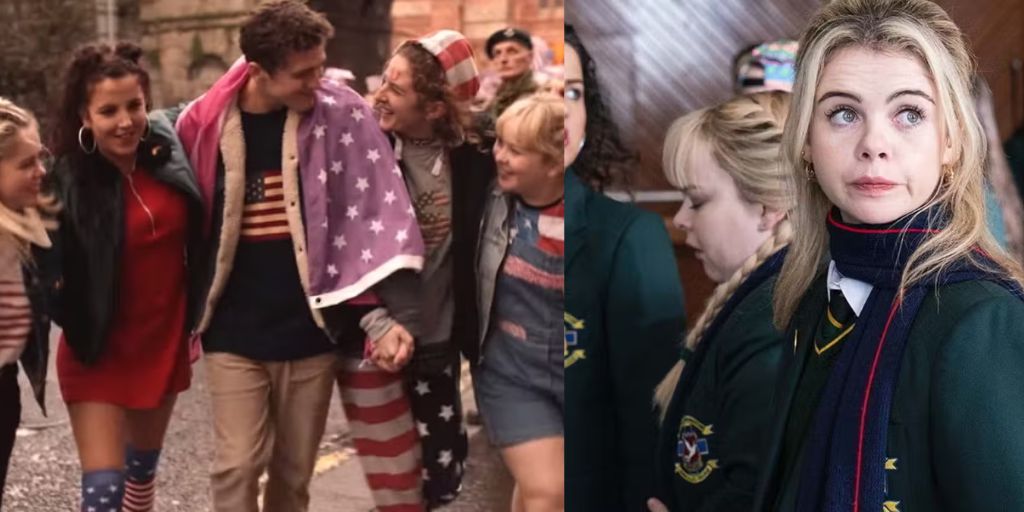
Still from Derry Girls (Credit: Netflix)
Derry Girls has been praised for its authentic portrayal of mid-1990s Northern Ireland, and Neeson’s silent but impactful performance in the finale served to highlight the lasting effects of the Good Friday Agreement.
Liam Neeson plays a Royal Ulster Constabulary officer in Derry Girls, first appearing in a humorous scene and returning for a serious moment in the finale. His character’s emotional vote on the Good Friday Agreement reflects the internal conflict tied to Northern Ireland’s Troubles, a theme deeply personal to Neeson himself.
Derry Girls is currently available to stream on Netflix in the U.S.
