We have all encountered self-centered bosses, but none compare to Kier Eagan (played by Marc Geller) in Severance. At Lumon Industries, Kier is treated as a near-divine figure. His words are revered by employees, almost as if they are sacred texts.
To outsiders, it may seem like Kier is the current CEO due to the strong emphasis on his presence, but he is actually the company’s long-deceased founder. Though Kier passed away decades ago, his influence still looms over Lumon’s operations.
The company’s history is deeply intertwined with his life, leading to some unusual and unsettling practices. But what makes Kier Eagan so influential, and why does he inspire such unwavering devotion?
The Legacy of Kier Eagan at Lumon
A statue of Kier Eagan prominently stands in the Perpetuity Wing of Lumon, a place where his legacy is immortalized. Most of what is known about his life is detailed in the Compliance Manual, which every department keeps under his portrait. His story begins with a unique and challenging childhood.
Kier’s parents were described as having a “close biological relationship,” hinting that they were likely related. This resulted in Kier being a sickly child, and he even battled tuberculosis at a young age.
At just 12 years old, Kier started working for a harsh furniture tycoon who was infamous for mistreating his employees. These early experiences shaped Kier’s belief that a boss should genuinely love their work and view employees as part of a larger family. This philosophy would later become the foundation of his approach to leadership at Lumon.
As a young man, Kier worked at an ether factory, where he met Imogene Eagan, who later became his wife. Interestingly, Kier chose to take her last name, a decision that likely carried symbolic meaning for their shared ambitions.
During his early twenties, Kier also served as a doctor in a war, most likely the American Civil War. Witnessing the suffering of soldiers deeply impacted him, pushing him to create something meaningful.
In 1865, at the age of 24, Kier founded Lumon Industries, starting as a small pharmaceutical company. He became its first CEO and held the position for an astonishing 74 years until his death in 1939. Under his leadership, Lumon grew into a pioneer in bioengineering, far surpassing its humble origins.
Since then, leadership at Lumon has remained within the Eagan family, with Kier’s descendants continuing his legacy. Today, the company is led by Jame Eagan (Michael Siberry), the eighth Eagan to serve as CEO.
Kier’s Philosophy: Work as the Ultimate Purpose
At Lumon, employees are encouraged to study Kier’s life and adopt his teachings. Over time, this often leads to a sense of worship.
For instance, Irving B. (played by John Turturro) frequently reads Kier’s writings in the Compliance Manual, finding purpose in his words. This reflects the company’s goal of fostering loyalty and creating a shared sense of belonging.
Kier’s philosophy revolves around making work the central focus of an employee’s life. It is structured around three key components:
- The Nine Core Principles: Employees are expected to embody these values—Vision, Verve, Wit, Cheer, Humility, Benevolence, Nimbleness, Probity, and Wiles.
- The Four Tempers: Kier identified four human traits that must be controlled—Woe, Frolic, Dread, and Malice.
- Corporate Affection: This idea emphasizes the importance of serving the community through work. However, Kier’s twist on this concept suggests that love for work and the company should outlast love for life and personal relationships.
These principles and ideas are displayed throughout Lumon’s headquarters in the form of paintings, quotes, and other symbolic representations.
One notable feature is the Perpetuity Wing, a museum dedicated to the Eagan family and, more prominently, to Kier himself. This wing even includes a full-scale replica of Kier’s house, where top-performing employees are invited to participate in rituals that honor his legacy.
Theories About Kier’s Influence in Severance
Kier Eagan’s lasting influence at Lumon has sparked numerous fan theories about his role in the series. Many viewers speculate that Kier may still be controlling the company in some way.
One theory suggests that Kier’s legacy is preserved through the severance chips implanted in employees. Since Kier was the child of closely related parents, the Eagan family may have developed a way to transfer his consciousness into the minds of his descendants, ensuring that only an Eagan can lead Lumon.
The work done in the Macrodata Refining department might involve perfecting this process, allowing Kier to maintain his influence indefinitely.
Another theory proposes that Kier never actually died and is instead operating as the enigmatic figure known as “the Board,” secretly directing Lumon’s activities.
These theories are supported by the fact that nearly everything in the town surrounding Lumon headquarters bears Kier’s name, including the local newspaper. His overwhelming presence in both the company and the community raises questions about the true extent of his power.
Kier’s Influence in Severance
Kier Eagan’s role in Severance is both fascinating and unsettling. His teachings and legacy are central to the company’s culture, shaping the lives of employees in profound ways. From the Compliance Manual to the Perpetuity Wing, Kier’s presence is felt everywhere.
Even though he has not physically appeared in the series, Kier’s character adds an air of mystery and complexity to the narrative. His philosophy, which blurs the lines between work and personal life, highlights the dangers of corporate indoctrination.

A sci‑fi psychological thriller set in a dystopian biotech office at Lumon Industries. Employees undergo a “severance” procedure that separates their work and personal memories, creating distinct “innies” and “outies.” Mark Scout, a severed worker in the Macrodata Refinement department, begins to uncover Lumon’s dark secrets and confront existential questions about identity and autonomy. Season 2 deepens the mystery with the innies awakening in their outie bodies and going through deeper conspiracies.
No Country For Old Men has earned its place as a modern classic, with its unforgettable characters, tension-filled moments, and a plot that keeps viewers on the edge of their seats. However, its ending has sparked considerable debate. The film is a faithful adaptation of Cormac McCarthy’s novel, following Llewelyn Moss (Josh Brolin) who steals a bag of drug money and finds himself pursued by the relentless hitman Anton Chigurh (Javier Bardem). At the same time, Sheriff Bell (Tommy Lee Jones) tries to intervene, hoping to save Moss and stop Chigurh’s reign of terror.
The Coen Brothers’ movie, much like McCarthy’s book, begins as a gripping genre piece, only to reveal deeper philosophical themes by the end. The No Country For Old Men finale, especially its final moments, left audiences expecting a more traditional climax, only to find themselves presented with an ambiguous conclusion. A decade after its release, discussions surrounding the ending continue to unfold, with a closer analysis revealing the nuanced intentions behind the Coen Brothers’ vision.
No Country For Old Men Ending Explained: The Surprising Conclusion of No Country For Old Men
The story’s suspense mainly revolves around Moss trying to stay ahead of Chigurh. However, in an unexpected turn, Moss is killed off-screen by a group of assassins. Chigurh recovers the stolen money, and true to his earlier threat, he visits Moss’ wife, Carla Jean, with a grim decision. Chigurh offers her a coin toss to decide her fate, and she refuses to play along, leaving the choice to him. It’s implied that he kills her.
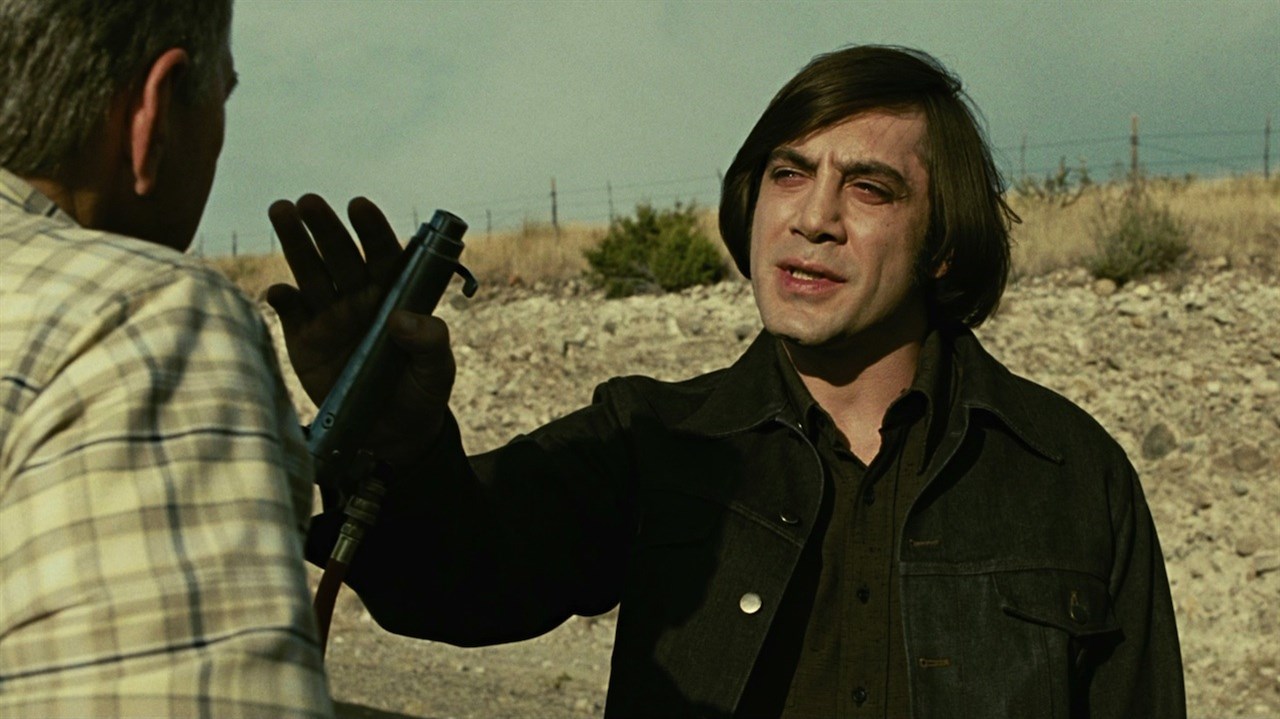
Anton Chigurh (Image via Getty)
Soon after, Chigurh is involved in a traffic accident, but despite his injuries, he walks away from the destruction he’s caused. The focus then shifts to Sheriff Bell, who is grappling with the fallout of his failure to save Moss or stop the chaos. In his retirement, Bell reflects on two dreams he had the night before. The first involves meeting his father, who gives him money, and the second features them riding together through a snowy mountain pass. Bell’s recounting of these dreams ends with him acknowledging that he woke up, marking a symbolic end to the film.
The Symbolism Behind Sheriff Bell’s Dreams
Bell’s two dreams are central to understanding the deeper meaning of No Country For Old Men. From the beginning, it’s clear that Bell feels disconnected from the world around him, yearning for a time when good and evil were easily distinguishable. His first dream highlights this sense of guilt, as he was entrusted with a mission to protect Moss and failed to do so. The dream is a subconscious reflection of Bell’s lingering sense of responsibility and regret, which he struggles to articulate.
The second dream features Bell and his father riding through a cold, snowy, and it represents Bell’s internal conflict. He notes that he is now 20 years older than his father ever was, signifying that he has become the old man in his visions. This moment is more than just nostalgia; it’s an acknowledgment of the passing of time and the death of a simpler, more hopeful worldview. The fire Bell’s father lights in the dream symbolizes the hope that values from the past could carry on into an uncertain future. However, Bell’s abrupt awakening suggests that not only have these values faded, but they may never have existed as he remembers them.
Why No Country For Old Men’s Ending Was Controversial
On the surface, No Country For Old Men may seem like a typical Western thriller. In a conventional storyline, Moss would have faced off against Chigurh, and after a dramatic showdown, he would have survived, escaping with his wife and the stolen money. Instead, Moss is found dead in a rundown motel room, and his wife’s life is taken shortly afterward. The audience’s expectations are shattered further when Sheriff Bell, who has largely been a passive observer, does not bring about a traditional resolution.
The final scenes defy the expected hero-villain confrontation, leaving Chigurh to escape with the money, his actions unpunished. Bell’s failure to catch Chigurh or recover the money is jarring, and the film concludes with a sense of unresolved tension. Some viewers found this anti-climactic, feeling that the film lacked closure. However, the Coen Brothers’ refusal to conform to genre conventions points to the deeper thematic exploration of fate and mortality that runs throughout the film.
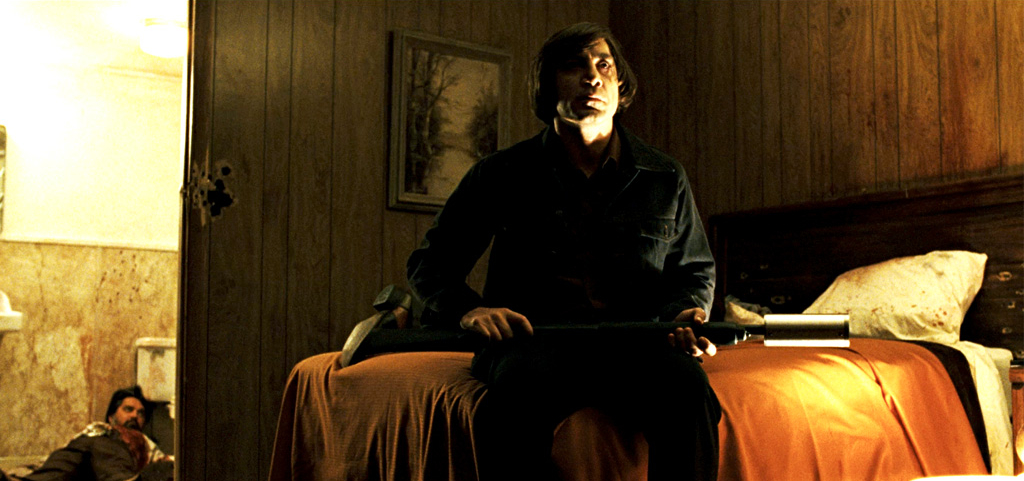
Anton Chigurh (Image via Getty)
Why No Country For Old Men’s Ending is Perfect
Despite initial reactions, No Country For Old Men’s ending is a fitting conclusion to the film’s overarching narrative. While Moss’ actions and Chigurh’s terrifying presence might seem to dominate the story, it’s clear on further analysis that Sheriff Bell is the true protagonist. His journey isn’t about hunting down criminals but about coming to terms with his own aging, his struggle to understand a violent and chaotic world, and his acceptance of the inevitability of death.
Chigurh, often perceived as a symbol of death, represents the inescapable nature of fate. Moss, despite his skills and military experience, cannot outrun the consequences of his choices. In this way, the film suggests that death is an unyielding force, one that will eventually claim everyone, regardless of their actions. Bell’s retirement is a decision to withdraw from a world that no longer makes sense to him, and his inability to confront Chigurh signifies his recognition of a world beyond his control.
How The Ballad of Buster Scruggs Continues No Country’s Themes
The Coen Brothers’ The Ballad of Buster Scruggs, another Western anthology film, delves further into themes introduced in No Country For Old Men. One of the recurring elements in both films is the inevitability of death and the futility of trying to escape it. Each chapter of The Ballad of Buster Scruggs portrays characters attempting to outrun death, only to meet tragic ends. The stories share a dark, nihilistic worldview, where death is an inescapable reality.
While No Country For Old Men focuses on Sheriff Bell’s struggle with the modern world, The Ballad of Buster Scruggs presents death as an omnipresent force that shapes the lives of its characters. The films are linked by their shared exploration of mortality and the futility of trying to control one’s fate, making The Ballad of Buster Scruggs a thematic continuation of the ideas that No Country For Old Men grapples with.
How The Coen Brothers Explain No Country For Old Men’s Ending
The Coen Brothers have discussed their intentions behind the unconventional ending of No Country For Old Men, emphasizing that the film’s conclusion was always meant to be ambiguous. The ending’s lack of closure was not a mistake or oversight; rather, it was a deliberate choice to avoid the conventional “hero vs villain” resolution. The filmmakers have stated that they wanted to stay true to Cormac McCarthy’s novel, which explores a world in chaos, where old systems of understanding no longer hold.
The Coen Brothers acknowledged that they were drawn to McCarthy’s story because of its complexity and its resistance to traditional storytelling. In an interview, they explained that they didn’t want to make a “Hollywoodized” version of the story and were committed to presenting a more realistic, albeit unsettling, portrayal of life’s uncertainty and randomness. This anti-Hollywood approach was essential to capturing the novel’s essence and contributing to the film’s lasting impact.
The Meaning Behind the No Country For Old Men Ending
The ending of No Country For Old Men encapsulates the film’s central themes. While it may appear to focus on the cat-and-mouse pursuit between Moss and Chigurh, the true story is Bell’s. His journey is one of aging, grappling with a world that no longer makes sense, and coming to terms with his own mortality. Bell’s final reflection on the past, alongside his acceptance of the inevitability of death, highlights the emotional core of the film.
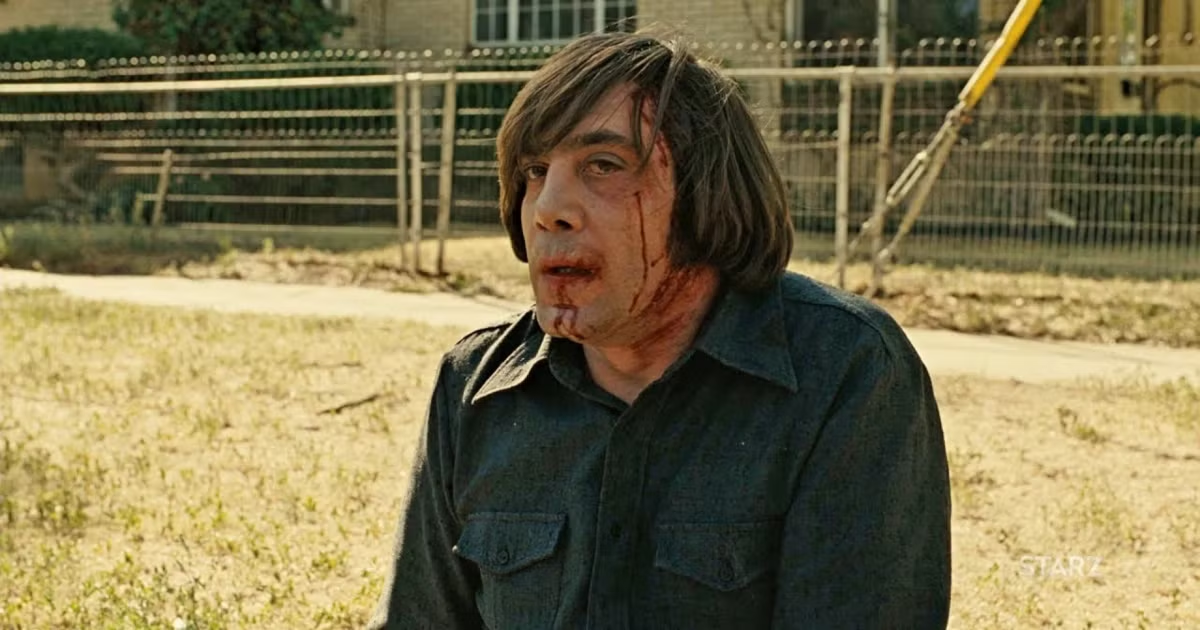
Anton Chigurh (Image via Getty)
Before the final scene, Bell visits his uncle Ellis, who shares a story about death that further emphasizes the film’s themes. Ellis recounts how his uncle was killed for no reason, a stark reminder that death is unpredictable and beyond anyone’s control. Bell’s acceptance of the future, as unrelenting and unavoidable as Chigurh’s presence, marks his realization that he cannot hold onto the past. In this way, the ending reflects both personal and universal truths about aging and mortality.
How the No Country For Old Men Ending Was Received
Critical reception to No Country For Old Men was overwhelmingly positive, with the film holding a high score on Rotten Tomatoes and Metacritic. Many saw it as one of the best films of the year, and it received several Oscar nominations. However, the ending remained a point of contention. Some viewers found the abrupt nature of the finale unsatisfying, questioning whether the film was simply unfinished or intentionally inconclusive.
The division in opinion continues, with some praising the film for its deep philosophical exploration of mortality and fate, while others felt let down by the lack of a clear resolution. Even years after its release, discussions around the ending continue to highlight the film’s complexity and the bold choices made by the Coen Brothers.
Why No Country For Old Men Has the Coen Brothers’ Best Ending
No Country For Old Men stands out in the Coen Brothers’ filmography for its refusal to offer the audience a comforting conclusion. Many of their other films, like Fargo and Raising Arizona , end on a more hopeful note, with characters finding peace or redemption. However, No Country For Old Men challenges this convention by leaving viewers with a bleak, unresolved ending that highlights the inescapability of death and the futility of trying to outrun it.
This stark, dark ending makes the film feel more profound, reinforcing the themes of inevitability and mortality. While the Coen Brothers have often balanced their grim stories with a sense of hope, No Country For Old Men rejects that notion, delivering a closing message that is unsettling but true to the story’s core message.
