In the of Naruto world, few characters have left as profound a mark as Minato Namikaze, the Fourth Hokage.
Known for his speed and sharp intellect, Minato was more than just a powerful shinobi; he was a tactical genius and a deeply dedicated protector of the Hidden Leaf Village.
His iconic confrontation with Obito Uchiha during the Nine-Tails attack on Konoha exemplifies his skills, his strength, and his unbreakable resolve to defend his village and loved ones.
More than a fight, it was a clash that showcased the depth of Minato’s character, blending action with strategy, sacrifice, and the responsibilities of a true Hokage.
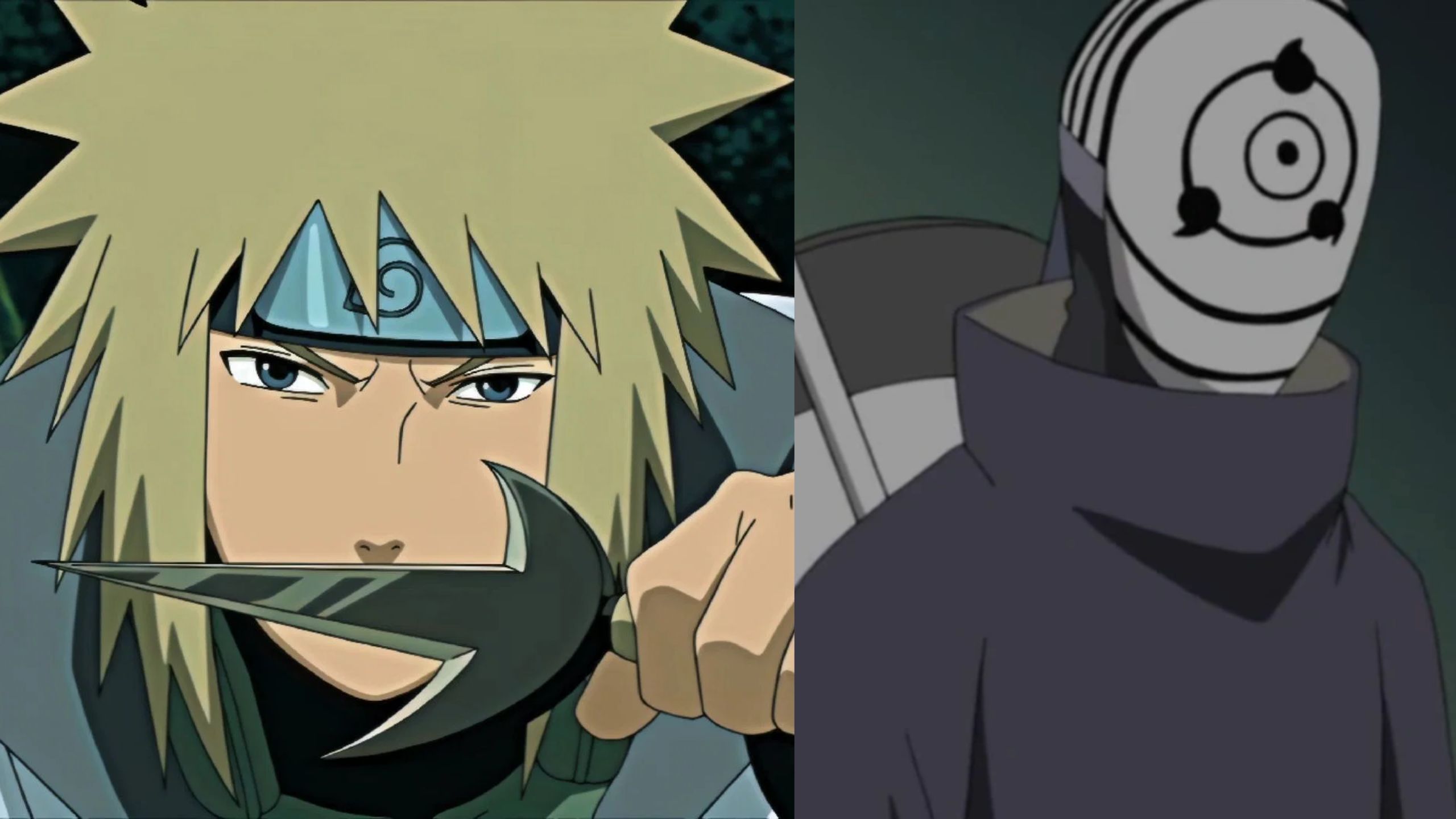
Minato Namikaze And Obito Uchiha From Naruto (Studio Pierrot)
For fans of the Naruto series, the battle between Minato and Obito is not merely a showcase of power.
Instead, it highlights Minato’s understanding of the Shinobi Way, where intelligence, quick thinking, and selflessness weigh more than brute force.
The legendary battle not only defines Minato’s character but sets a foundation for Naruto, his son, who eventually carries forward his legacy.
The Nine-Tails incident is one of the most tragic moments in Naruto’s backstory, illustrating Minato’s profound love for his village and his son, even as he faced insurmountable odds.
A Grim Night for Konoha and the Arrival of a New Threat
The story takes us back to the night Naruto was born. Unbeknownst to the villagers, this joyous occasion was about to be overshadowed by a tragic series of events.
Just after Naruto’s birth, a mysterious masked man infiltrated the hidden location where Minato and his wife Kushina were with their newborn son.
As Naruto’s mother and a jinchūriki (someone with a tailed beast sealed within them), Kushina had always lived with the threat of someone attempting to exploit her powers.
On that fateful night, this threat materialized in the form of Obito, who would later reveal himself as one of the most dangerous enemies of Konoha.
Obito’s appearance was a shocking twist. Disguised and armed with the power of the Sharingan, he was able to infiltrate the safe space where Kushina was in labor.
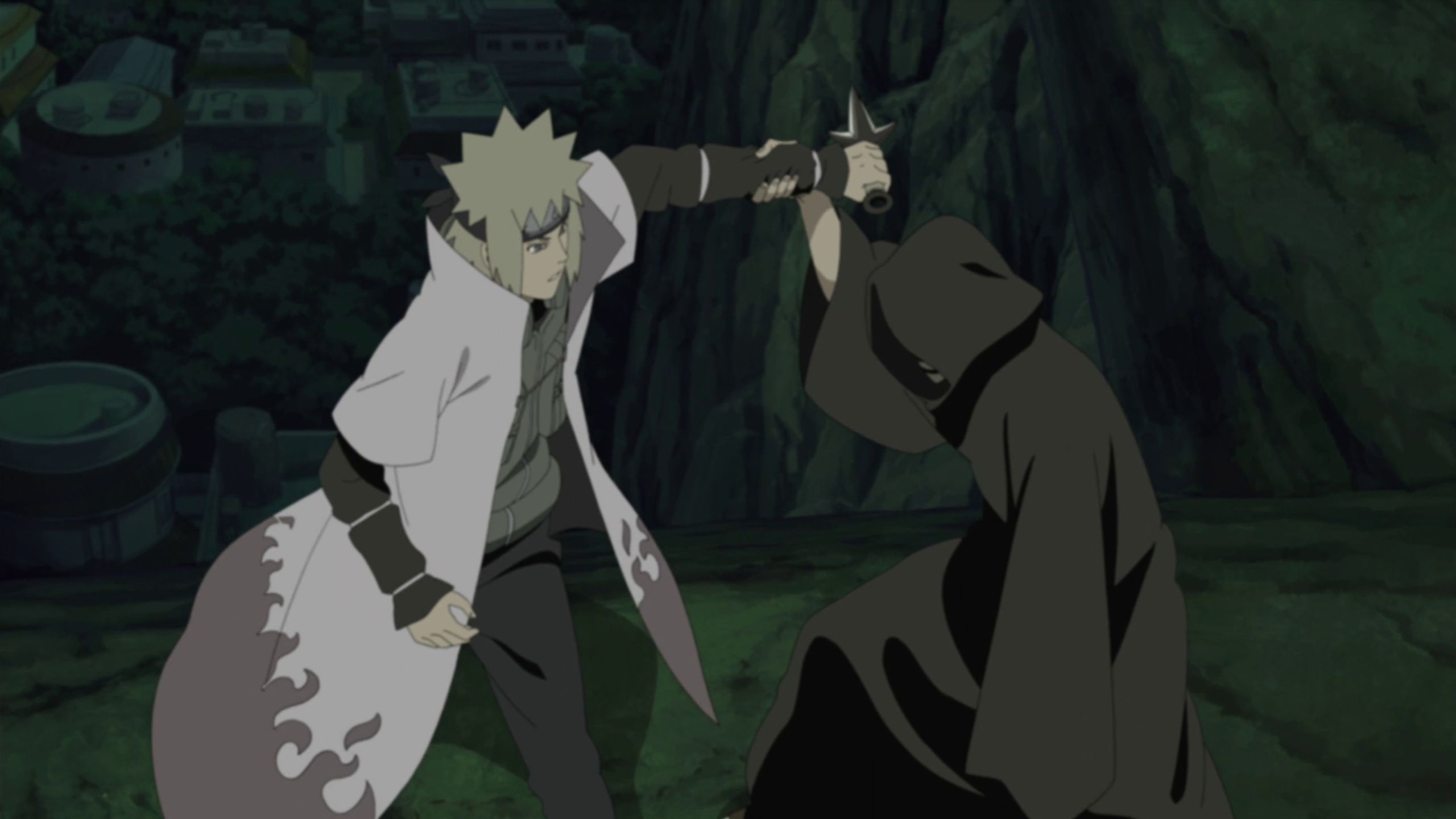
Minato Vs Obito (Studio Pierrot)
Without hesitation, he held Naruto hostage, using the newborn as leverage against Minato and Kushina.
The masked man’s ruthless tactics became clear: he would do anything to separate Minato from Kushina, allowing him to proceed with his true goal unleashing the Nine-Tails on Konoha.
Minato, torn between his duties as a Hokage and his love as a father, was forced to make split-second decisions to protect both his son and the village.
In a swift maneuver, he managed to save Naruto from Obito’s clutches, a move that showcased his speed and his remarkable instinct under pressure.
However, this victory was short-lived. Before Minato could regroup, Obito succeeded in freeing the Nine-Tails, ripping apart Kushina’s weakened seal and releasing the beast that had long been held in check within her.
This devastating act sent shockwaves through the village, initiating the disastrous attack that would claim countless lives.
The Nine-Tails Unleashed and Minato’s Resolve
As Obito unleashed the full fury of the Nine-Tails upon Konoha, Minato’s priorities shifted to protecting his village.
He knew the destruction that a single bijū (tailed beast) could cause, and his quick response demonstrated his commitment to the Hokage title.
Leaving Naruto and Kushina in a safer location, he returned to the village with a resolute mind, understanding that he might have to sacrifice everything to stop the destruction.
This was no ordinary battle. As Hokage, Minato was responsible for the safety of every villager, and this weight was not lost on him.
While other powerful shinobi like Jiraiya or the Third Hokage may have chosen brute force to subdue the Nine-Tails, Minato’s approach was one of strategy and precision.
He could not afford to engage the beast recklessly. By quickly assessing the situation, Minato was able to devise a plan that would neutralize both the Nine-Tails and the masked intruder.
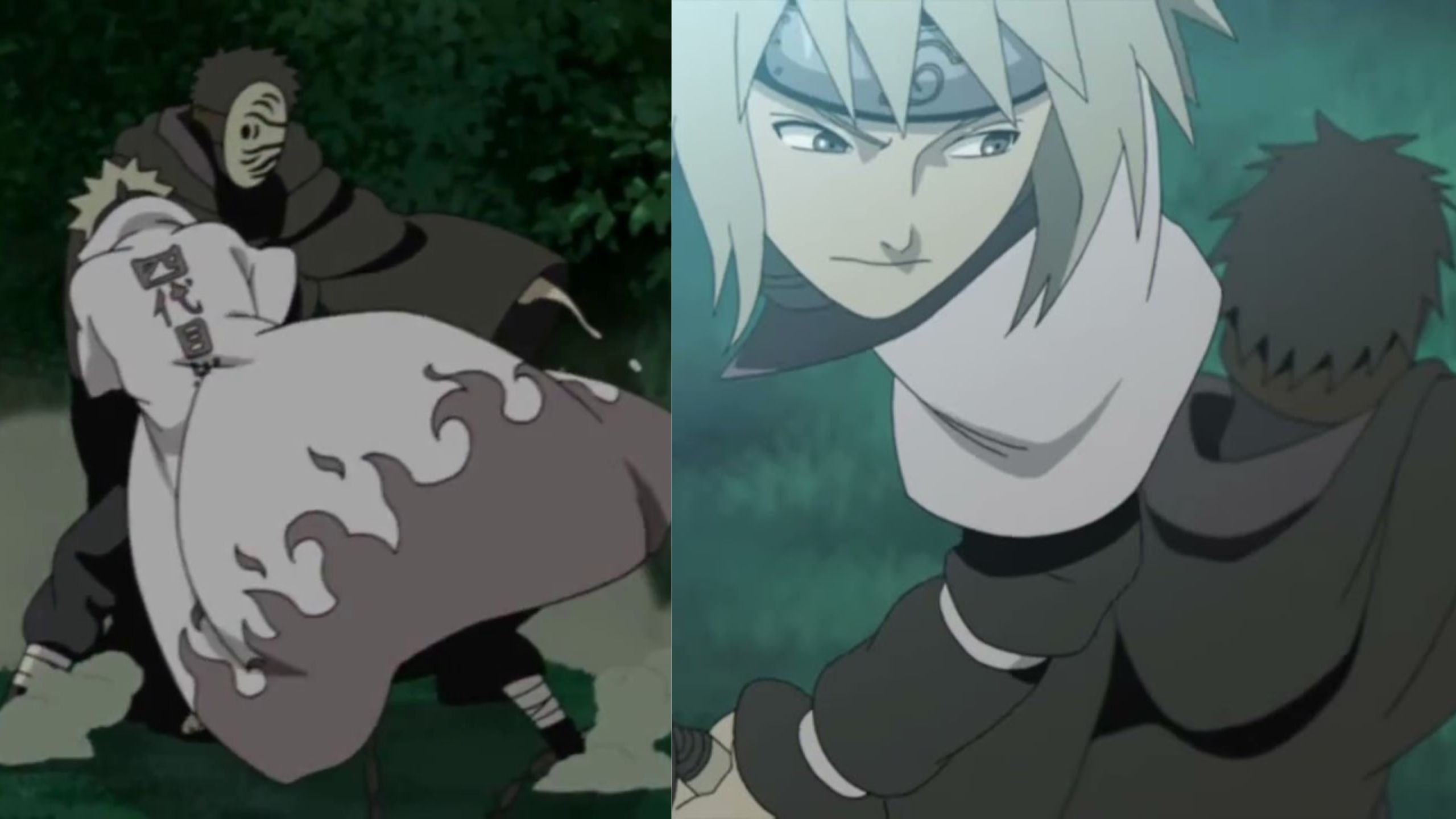
Obito Uchiha Vs Minato Namikaze In Naruto (Studio Pierrot)
The clash between Minato and the Nine-Tails revealed much about the Fourth Hokage’s strength.
Minato’s reputation as the “Yellow Flash” was already legendary, and it was during this battle that his signature speed and reflexes were most prominently displayed.
Using the Flying Raijin Jutsu a complex teleportation technique that allowed him to appear instantly wherever he had placed a special seal Minato was able to outmaneuver the colossal Nine-Tails and prevent it from causing even greater destruction. However, the true challenge lay not with the beast but with the mastermind controlling it.
The Genius of Minato’s Strategy in Facing Obito
When Minato finally confronted Obito directly, it became clear that this was no ordinary shinobi.
Obito possessed the Sharingan, which granted him the ability to make his body intangible, allowing any physical attack to pass through him without effect.
Minato quickly recognized that Obito’s powers were unlike any he had encountered before.
The Sharingan’s capabilities had been long feared in the shinobi world, but Obito’s intangibility, combined with his ability to manipulate space, presented a unique challenge.
Minato, however, was not one to be easily daunted. As he engaged in combat with Obito, he observed his opponent’s movements and quickly deduced that Obito’s powers had a limitation there was a brief moment when Obito became tangible, a vulnerability in his otherwise perfect defense.
Exploiting this weakness required impeccable timing and flawless execution, something only Minato’s level of expertise could accomplish.
This battle was as much a contest of intellect as it was of strength. Minato knew he had only a small window to strike.
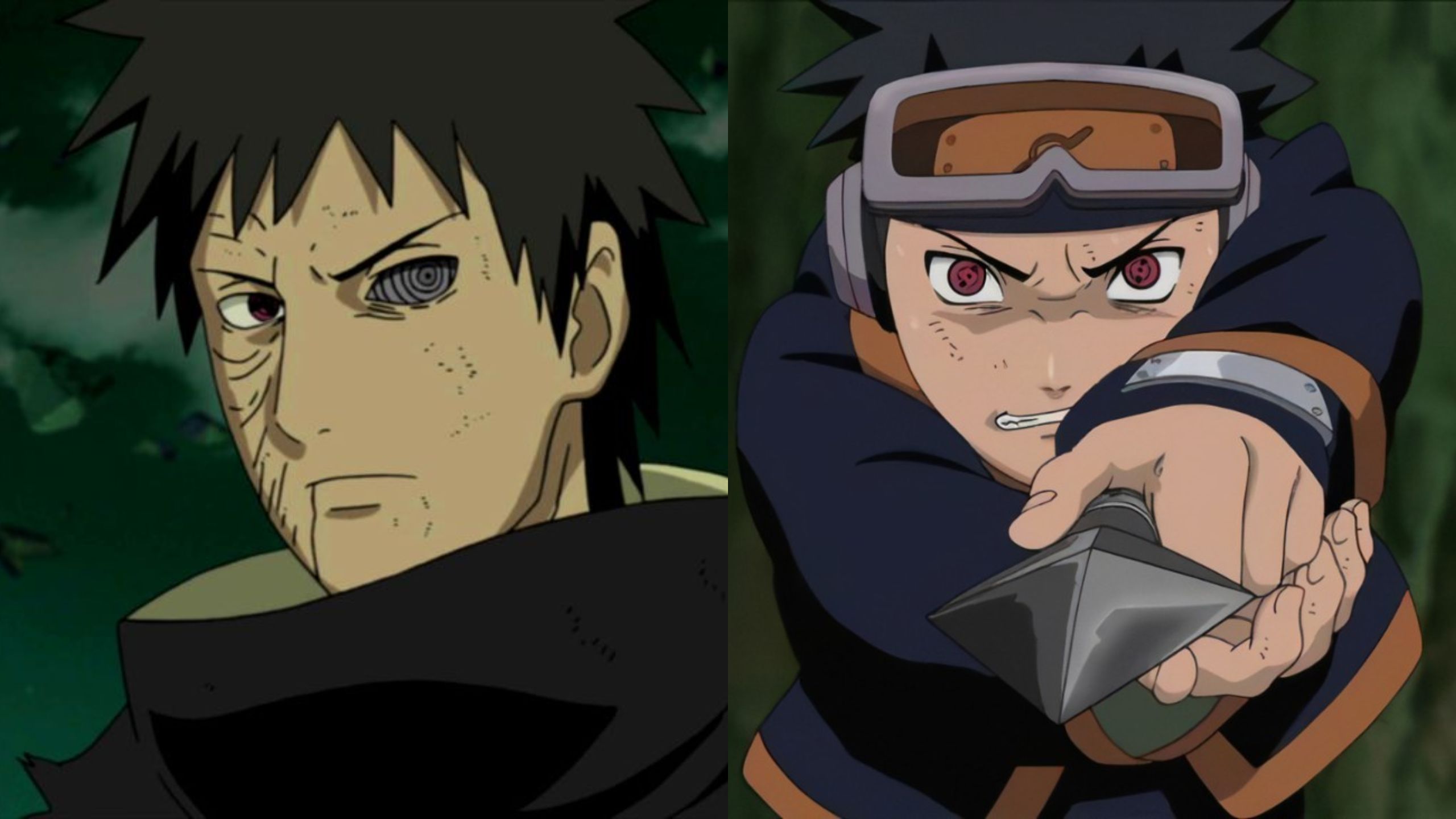
Obito Uchiha From Naruto (Studio Pierrot)
His strategic thinking, combined with his mastery of the Flying Raijin, allowed him to time his attacks to perfection.
He threw one of his kunai imbued with his teleportation seal at Obito, tricking him into activating his intangibility to dodge the weapon.
At that precise moment, Minato teleported to the kunai’s position, landing a powerful Rasengan on Obito.
This technique, known for its destructive power, dealt a decisive blow, temporarily incapacitating Obito and ending his direct control over the Nine-Tails.
This victory was not just a testament to Minato’s strength but to his intellect and his ability to think on his feet.
He had managed to defeat an enemy who was younger, powerful, and armed with one of the most dangerous dojutsu (eye techniques) in existence.
By outsmarting Obito, Minato not only saved his village but also set a high standard for the Hokage title, one that would resonate with future generations.
Minato’s Sacrifice and the Sealing of the Nine-Tails
With Obito temporarily out of the way, Minato’s attention returned to the rampaging Nine-Tails. Despite his victory over Obito, the beast was still a formidable threat to the village.
Minato understood that subduing the Nine-Tails was only a temporary solution; to truly protect Konoha, he needed to ensure that the beast could never again be used as a weapon.
This led him to make one of the most difficult decisions of his life a decision that would alter the future of his family and Konoha itself.
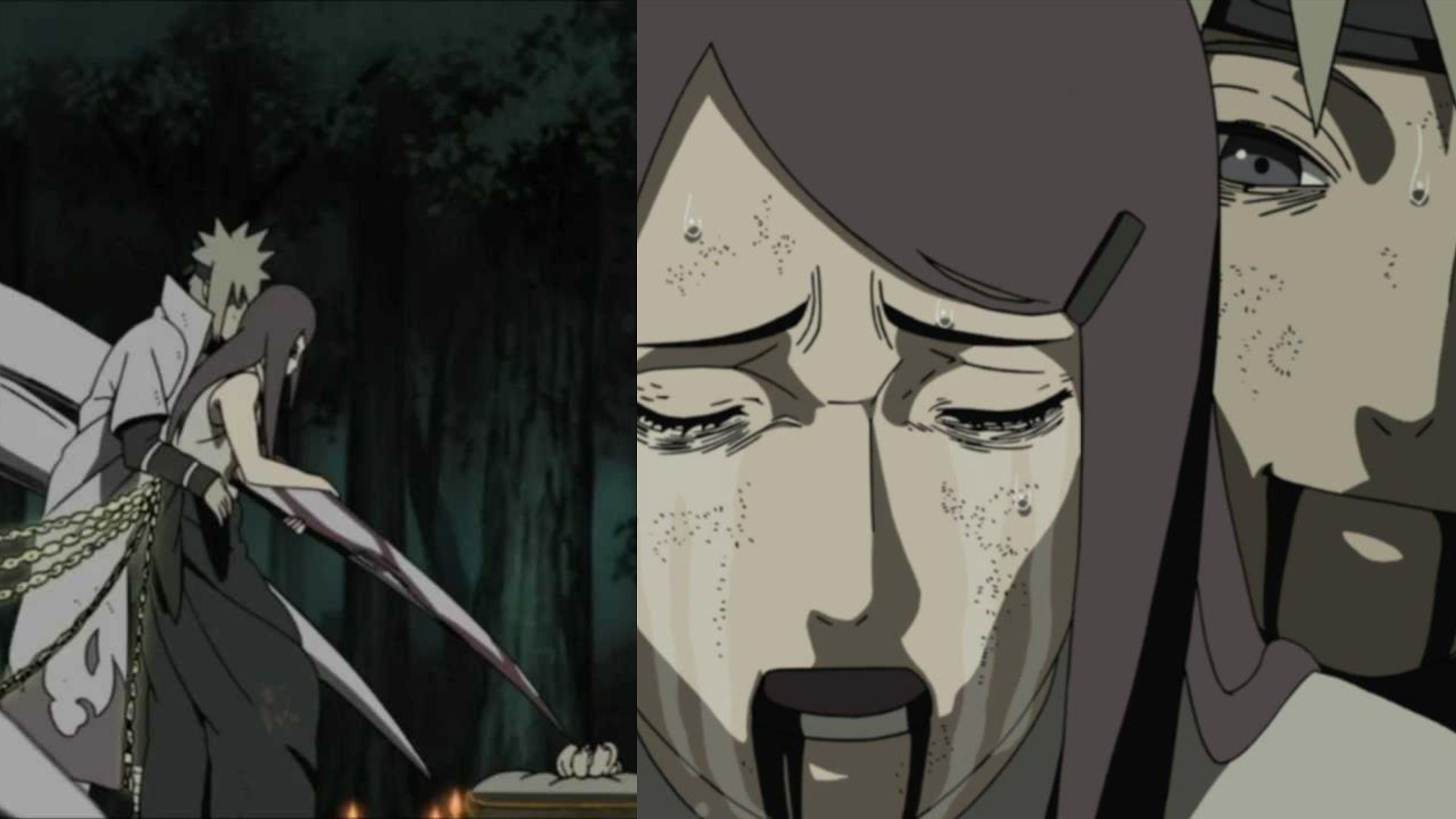
Kushina Uzumaki And Minato Namikaze Saving Naruto From Nine Tails From Naruto (Studio Pierrot)
Minato knew that the only way to prevent the Nine-Tails from wreaking further havoc was to seal it. He could have sealed the beast entirely within himself, taking its power with him to the grave.
However, he chose a different path. Believing in the future, he made the painful decision to split the Nine-Tails’ chakra into two parts, sealing half within himself and half within his newborn son, Naruto.
This act was both a sacrifice and a gift. By sealing half of the Nine-Tails within Naruto, Minato ensured that his son would have access to a power that could protect him in the future.
However, he also condemned Naruto to a life of hardship, as a Jinchūriki often faces fear and ostracism.
Despite the pain this decision caused, Minato had faith that Naruto would grow into a strong shinobi who could bear the burden and harness the power of the Nine-Tails to protect Konoha.
Burden of the Hokage and Minato’s Last Words to Naruto
As the sealing process began, Minato prepared to say his final goodbyes to his son and his wife.
In those last moments, he imparted a message of hope and resilience to Naruto, a message that would echo through the series and shape Naruto’s journey.
Minato’s parting words were a mix of love and guidance, as he encouraged Naruto to forge his own path and to value the bonds he would form with others.
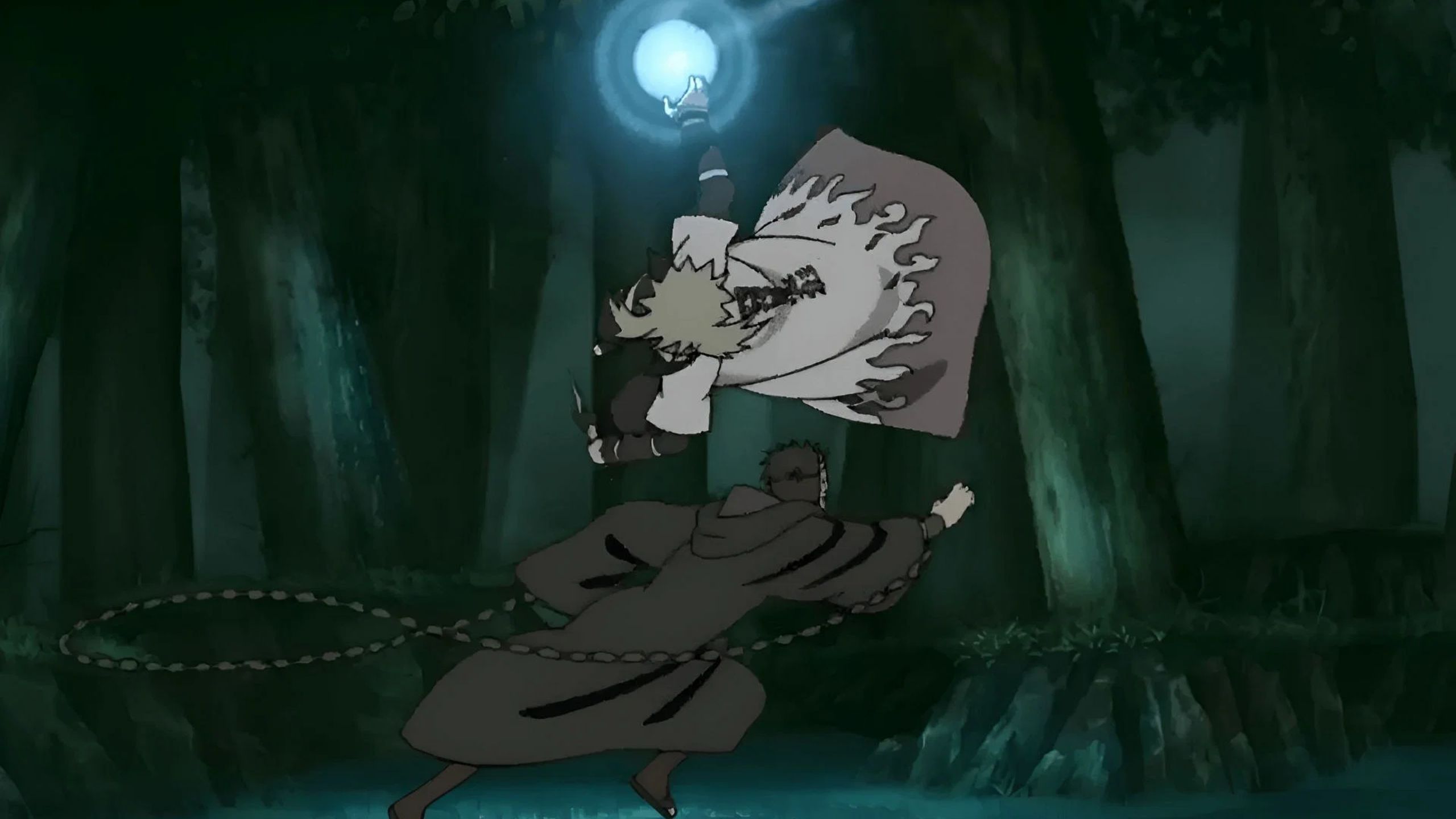
Minato Vs Obito (Studio Pierrot)
This emotional farewell highlighted Minato’s wisdom as both a father and a Hokage. He knew that Naruto’s path would be difficult, but he also trusted in his son’s potential to overcome the odds.
Kushina, too, shared a moment with her son, imparting her own wisdom and love. Together, Minato and Kushina left behind a legacy of strength, courage, and unwavering love.
For Naruto, these final words became a source of inspiration, a reminder of the sacrifices his parents made for him and the village.
Minato’s parting gift to Naruto was not just the power of the Nine-Tails but the values that would guide him in his life as a shinobi and eventually, as the Seventh Hokage.
Impact of Minato’s Legacy on Naruto and Konoha
Minato’s influence on the series goes beyond his actions on the battlefield. His legacy becomes a guiding force for Naruto, who spends much of his life striving to live up to the ideals of his father.
Growing up as the son of the Fourth Hokage, Naruto had a powerful example to follow.
Although he never had the chance to know his father, the stories of Minato’s bravery and wisdom served as a source of inspiration.
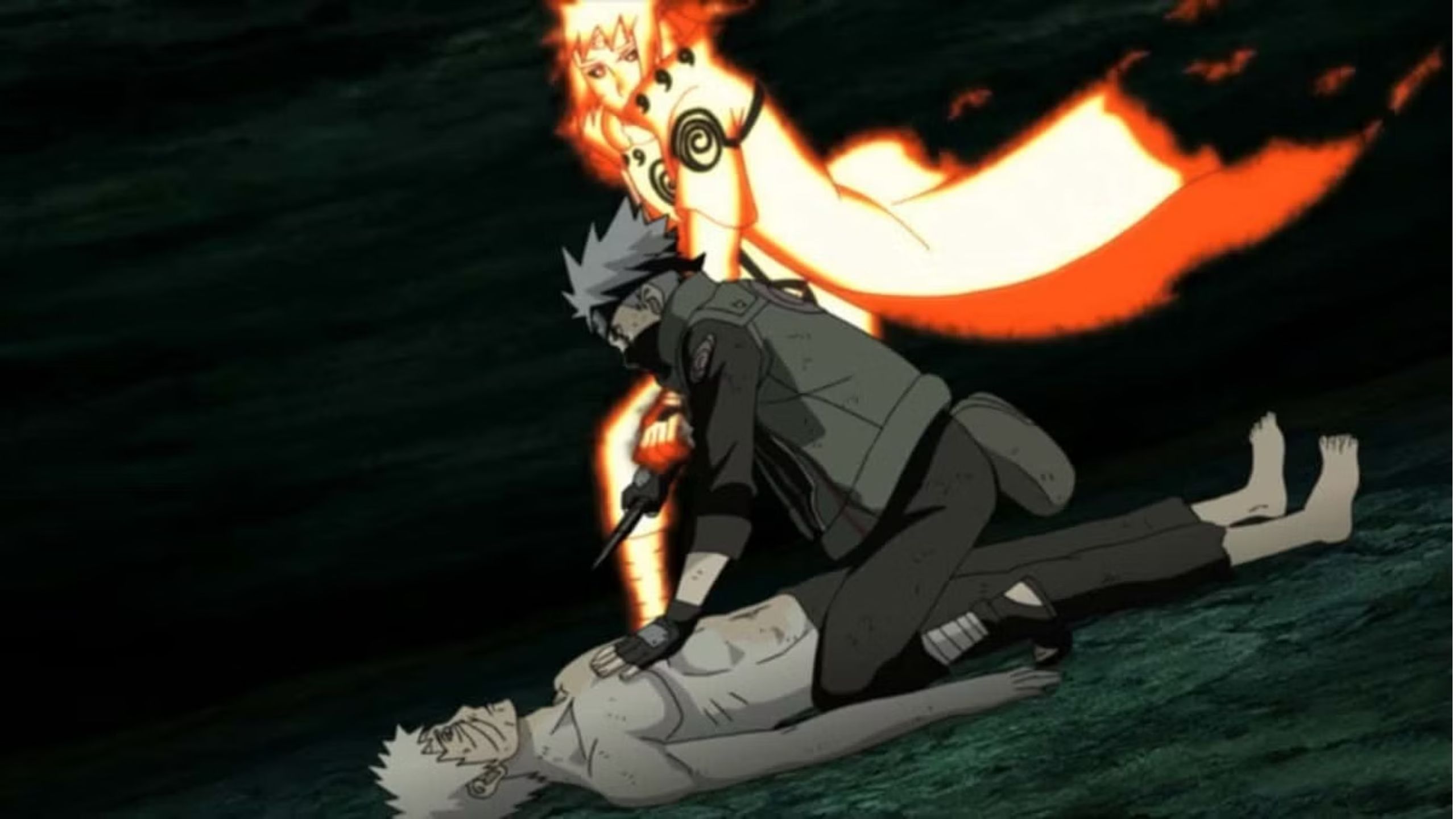
Obito Uchiha Vs Kakashi Hatake And Minato Namikaze In Naruto Shippuden (Studio Pierrot)
Naruto’s dream of becoming Hokage was not only driven by his desire to be recognized but also by a wish to honor his father’s memory.
Throughout his journey, Naruto faces trials that echo Minato’s struggles. Just as Minato confronted powerful foes to protect the village, Naruto must also overcome seemingly insurmountable obstacles, including the power of the Nine-Tails within him.
Each battle, each struggle, is a testament to the resilience and strength that Minato passed down to his son.
By the time Naruto becomes Hokage, he has not only proven himself worthy of the title but has also fulfilled his father’s vision for a strong, united Konoha.
Minato’s Legacy and His Role as a Symbol of Hope
In the end, Minato Namikaze’s legacy lives on through the lives he touched and the village he saved.
His legacy as a Hokage is marked by his intelligence, his compassion, and his willingness to sacrifice everything for the greater good.
For Konoha, he remains a symbol of hope, an example of what it means to be a protector, a strategist, and a hero.
His actions during the Nine-Tails incident cemented his place as one of Konoha’s greatest heroes, a legacy that would inspire future generations of shinobi.
Even years after his death, Minato’s influence continues to shape Konoha. The village he sacrificed so much to protect stands as a testament to his dedication, and his spirit lives on in Naruto, who embodies his father’s ideals with pride and honor.
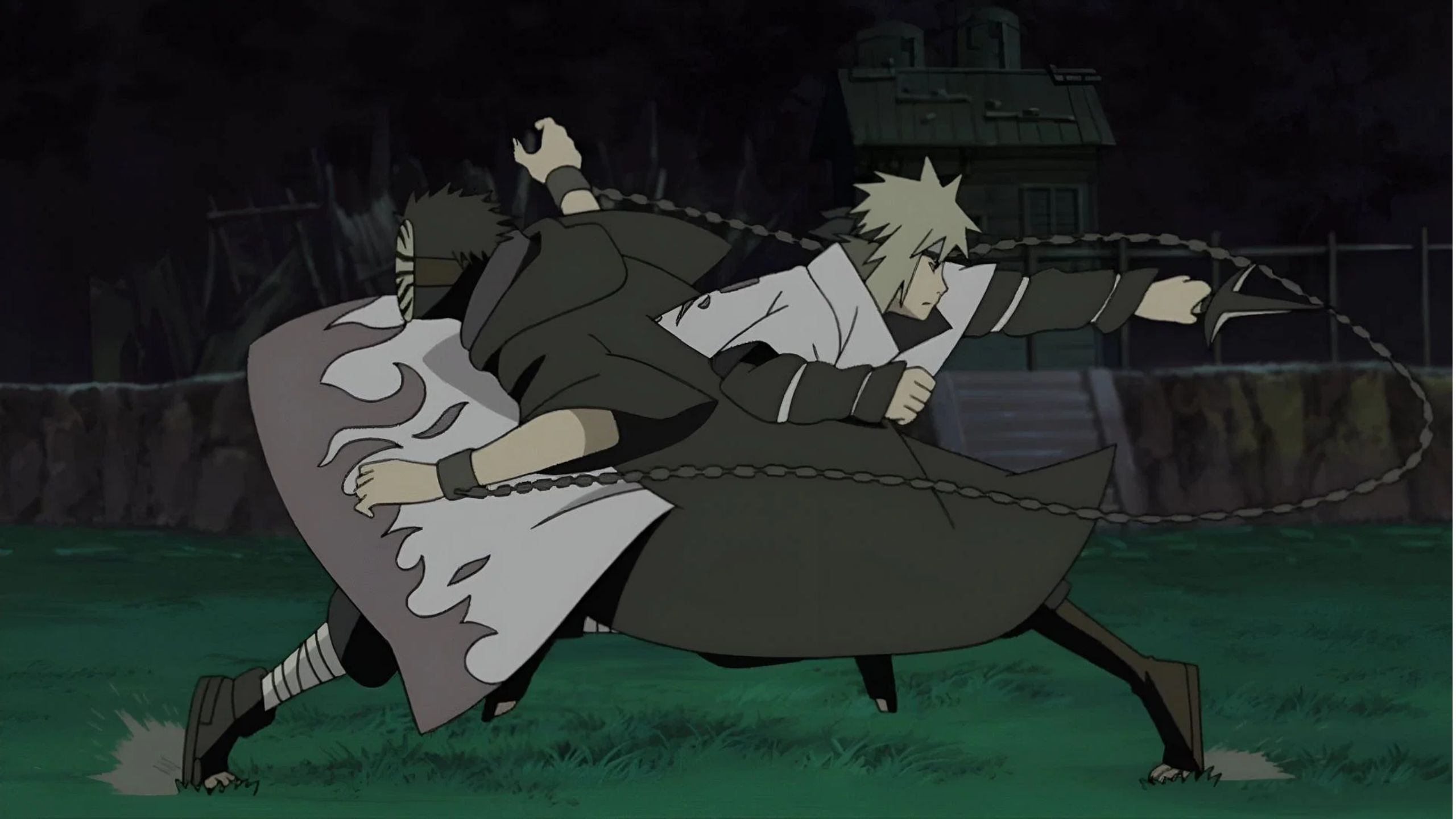
Minato Vs Obito From Naruto (Studio Pierrot)
Through his actions and his sacrifices, Minato Namikaze has left an indelible mark on the world of Naruto, a world forever changed by the legacy of the Yellow Flash.
Minato’s confrontation with Obito was more than a battle; it was a defining moment in the history of Konoha and the Naruto series.
Through his intelligence, strategy, and sacrifice, Minato exemplified what it meant to be Hokage.
His story is one of strength, love, and unwavering dedication a story that continues to inspire Naruto and fans alike.
Minato’s legacy is one of hope and resilience, a legacy that endures in the hearts of those who seek to protect the village he loved so dearly.
Netflix’s latest release, Time Cut, is a film that mixes horror, time travel, and heartfelt family moments, but it has drawn some comparisons to Prime Video’s Totally Killer.
Last year’s Totally Killer follows a young woman (played by Kiernan Shipka) who time-travels to the 1980s to prevent a masked killer from targeting her mom’s friends.
Similarly, Time Cut centers around Madison Bailey (from Outer Banks) in the role of Lucy, who also travels back in time to prevent a tragic event in her family’s past. The two films have some similarities, both using time-travel to add excitement and suspense to the storyline.
However, while Totally Killer leans into the horror, Time Cut focuses more on family and the emotional connection between two sisters.
The origins of Time Cut set it apart, as the movie was filmed during the COVID-19 pandemic, facing delays before its release this year.
Directed by Hannah MacPherson, the film goes beyond the typical horror approach, instead diving into the story of two siblings who connect across time.
While Time Cut is indeed a slasher film, it has a strong emotional core that places family ties front and center, with horror elements becoming secondary.
This combination makes it unique among recent horror releases, as it delivers moments of fear while also offering heartwarming interactions between the two main characters.
The plot centers on Lucy Field, a young and talented scientist excited to pursue a career in space exploration. Her dream takes a huge leap forward when she’s offered an internship at NASA. This opportunity is everything she has worked for, and Lucy is overjoyed.
However, when she shares the news with her parents, she is met with an unexpected reaction—they look worried rather than excited. Instead of supporting her, her parents start listing reasons why they’d rather have her stay home.
Their reaction is influenced by an event that changed their lives forever: the tragic death of their oldest daughter, Summer, in 2003. Summer’s murder at the hands of a masked killer left scars that still affect how her parents view the world, and the grief they carry now affects Lucy’s life.
This sense of loss and lingering grief sets up the movie’s main storyline. On the anniversary of her sister’s death, Lucy visits Summer’s grave.
While she’s there, she discovers a strange machine that turns out to be a time-travel device, accidentally sending her back to 2003, days before Summer’s tragic death. Lucy finds herself in her hometown, where she encounters her sister alive and well.
This time-travel accident gives Lucy the unique chance to meet and spend time with her sister—a person she’s only ever known through family stories and photographs.
At first, she’s simply excited to be with Summer, but soon her determination grows. She is set on preventing her sister’s death, even though changing the past could have major effects on her own existence.
Lucy knows that if she succeeds in saving Summer, her own life might be at risk, as her parents may never have had a second child if they hadn’t lost their first. This twist adds complexity to Lucy’s mission, making her journey both heartwarming and risky.
While Time Cut involves horror, the film is surprisingly tender and focuses on the bond between Lucy and Summer.
Madison Bailey and Antonia Gentry, who plays Summer, share an on-screen connection that makes their sibling bond believable and relatable. Their interactions are heartfelt, showing Lucy and Summer as sisters who truly care for one another, even though they are just meeting.
For example, one scene captures a lighthearted moment when Lucy tries on Summer’s clothes in her bedroom, putting on heart-shaped sunglasses and low-rise jeans—a popular style in the early 2000s.
This makeover scene serves as a warm, nostalgic nod to classic early 2000s films, where such sequences were common and celebrated, highlighting Lucy and Summer’s growing connection.
The film’s dedication to recreating the early 2000s is apparent in nearly every scene. The costumes, music, and set designs pull viewers back to 2003, complete with the fashion trends of that time.
Lucy, now in her sister’s world, walks through a high school filled with students wearing Juicy Couture tracksuits, colorful hair clips, and tennis shoes with squeaky wheels.
One memorable scene features Lucy spotting Summer in the school hallway while Hilary Duff’s song “So Yesterday” plays in the background. This is a joyful moment for fans of early 2000s pop culture, bringing back memories of an era marked by flip phones, specific fashion trends, and the carefree spirit of the time.
For those who grew up in that period, the movie’s accurate portrayal of the early 2000s captures a wave of nostalgia, creating a comforting, familiar setting.
Although the movie brings a sense of nostalgia and family warmth, Time Cut is still, at its core, a slasher film. Lucy realizes she’s returned to a time when a killer is on the loose, targeting a group of four students, including her sister.
Determined to save them, Lucy teams up with a school outcast, played by Griffin Gluck, to try and prevent the murders. Yet, even with this horror element, the film doesn’t emphasize the intense gore or suspense typical of the slasher genre.
Viewers expecting a more traditional horror experience might be surprised that the film leans away from intense scare scenes and focuses more on the characters’ emotional journeys.
This approach to horror is especially notable given the involvement of Michael Kennedy, known for his work on horror-comedy films like Freaky and It’s A Wonderful Knife.
Time Cut has a few intense moments, like a dramatic mall scene, but it avoids the typical horror staples of high-pitched screams, fast-paced chases, or startling twists.
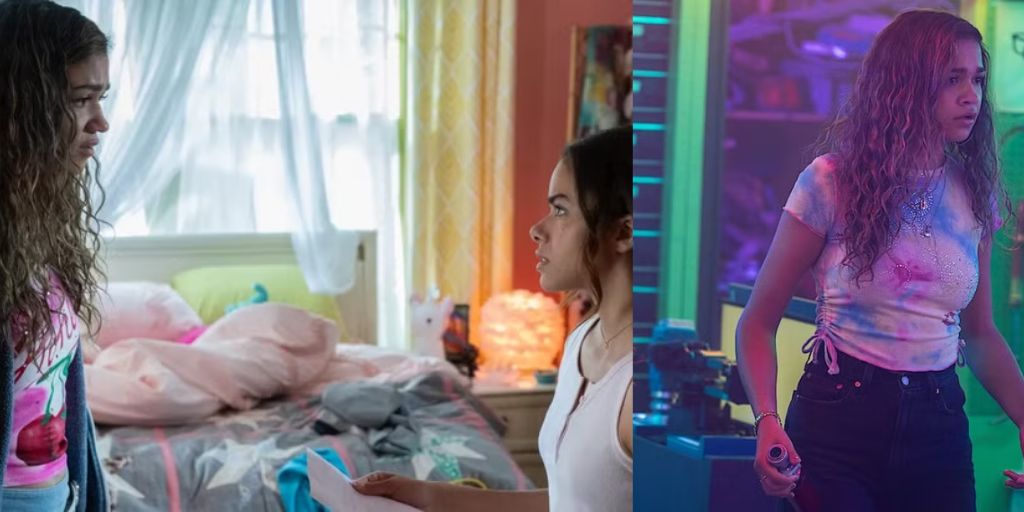
Still from the movie (Netflix)
Instead, it opts for a milder, more character-driven take on horror, using suspense sparingly. The horror in Time Cut is present but is not the central feature of the film; instead, it complements the main focus on Lucy’s journey and her connection with Summer.
For viewers hoping for a full-on horror experience, this toned-down approach might feel lacking. However, Time Cut sets itself apart by prioritizing the emotional storyline over typical horror. The film explores how grief, love, and the desire to protect family can cross the boundaries of time.
This makes the movie feel more relatable and adds an emotional depth that’s uncommon in slasher films. The few frightening moments add tension, but they’re not the main focus, allowing viewers to see the characters’ relationships as central to the plot.
The heart of Time Cut lies in the idea that family connections can overcome fear, and this theme drives the story more than any horror aspect.
Time Cut is best seen as a time-travel tale with a heartwarming twist, rather than a straightforward slasher film. Its unique combination of horror and family makes it different from most films in the genre.
By blending early 2000s nostalgia with themes of love and sacrifice, Time Cut captures a feeling of warmth and connection rarely seen in horror movies.
The sibling bond between Lucy and Summer creates a storyline that goes beyond scares, leaving viewers with a story of hope, family, and second chances.
Time Cut won’t deliver intense horror, but for viewers who want a lighter, sentimental experience, it could be a great choice. It offers a warm, cozy look at early 2000s culture, reminding us of the fashion, music, and energy of the time.
Although it doesn’t fully deliver on gore, it gives a refreshing take on the slasher genre, inviting viewers to see horror through a softer lens. This makes Time Cut a unique Halloween choice, providing a comforting movie night experience filled with nostalgia and family moments.
Time Cut stands out as a unique take on the horror genre, blending nostalgia, family bonds, and time travel into a story that defies typical slasher conventions.

Still from the show (Netflix)
While many horror films rely heavily on gore and suspense to capture viewers’ attention, Time Cut takes a different path by focusing on the heartwarming relationship between Lucy and Summer, two sisters separated by tragedy but reunited by a twist of fate.
Their bond brings a fresh perspective to the genre, as the film ultimately conveys a message of family love and the lengths one would go to protect loved ones, even if it risks altering their own existence.
The film’s nostalgic early-2000s setting further enhances its charm, providing viewers with a comforting trip back in time through music, fashion, and cultural references.
This thoughtful recreation of the era adds another layer to Lucy’s journey, creating a sense of warmth that contrasts with the horror elements.
Although Time Cut may not satisfy die-hard fans of intense horror, it successfully appeals to those looking for a lighter, more heartfelt experience within the genre. For Halloween or any movie night, Time Cut offers something different: a blend of nostalgia, sentiment, and suspense.
By balancing horror with heart, Time Cut delivers a film that is as touching as it is thrilling, making it a standout choice for anyone seeking a fresh approach to supernatural suspense.
