This thread is exclusively for spoiler pics and summaries related to One Piece Chapter 1150 . For discussions, please use the One Piece Chapter 1150 Discussion thread.
Do not post spoilers in the discussion thread.
THIS IS A LIVE-UPDATING POST -STAY TUNED
Thread Availability & Posting Rules
- The One Piece Chapter 1150 Spoiler Pics & Summaries thread may be locked until confirmed spoilers are available.
- If you find spoilers, please PM a Local Moderator , Global Moderator, or Administrator to request the thread be unlocked.
Posting Spoilers – Guidelines
- Always include the spoiler content , a link to the source , and credit the original provider when possible.
- Some spoilers may be posted anonymously.
Spoiler Pics & Translations – Rules
- No Duplicate Posts – Avoid reposting spoilers already in the thread.
- Image Posting: If posting more than three large images , use spoiler tags for mobile users. Do not post unrelated images.
- No Videos – Videos are not considered valid spoilers.
- Post Edits: Avoid major edits after replies. If new spoilers arrive, make a new post .
- No Full Chapters – Do not post or link to full official scans . (Only Viz/MangaPlus allowed.)
- Proper Formatting – Poorly formatted spoilers may be removed.
One Piece Chapter 1150 FULL SUMMARY & Spoilers On Page 2
ONE PIECE CHAPTER 1150 BRIEF SPOILERS
Chapter 1150: “Domi Reversi”
Cover story: Yamato returns Yasuie sword to the Enma Shrine in Hakumai.
Imu/Gunko unleashes a massive Conqueror’s Haki wave on Elbaph that knocks out some giants and the kids.
Dorry, Brogy and thw Giant pirates attack Imu/Gunko but Imu/Gunko uses a magic book to take out some knifes and guns. Then Imu/Gunko stabs and shoots one of Brogy’s arm
Since Elbaph has no king, Imu/Gunko says Dorry and Brogy must be the new kings. Then Imu/Gunko uses a technique called “Devil’s Contract” and transforms Dorry and Brogy into demons with great strength and immortality (in exchange for a small of their lifespan).
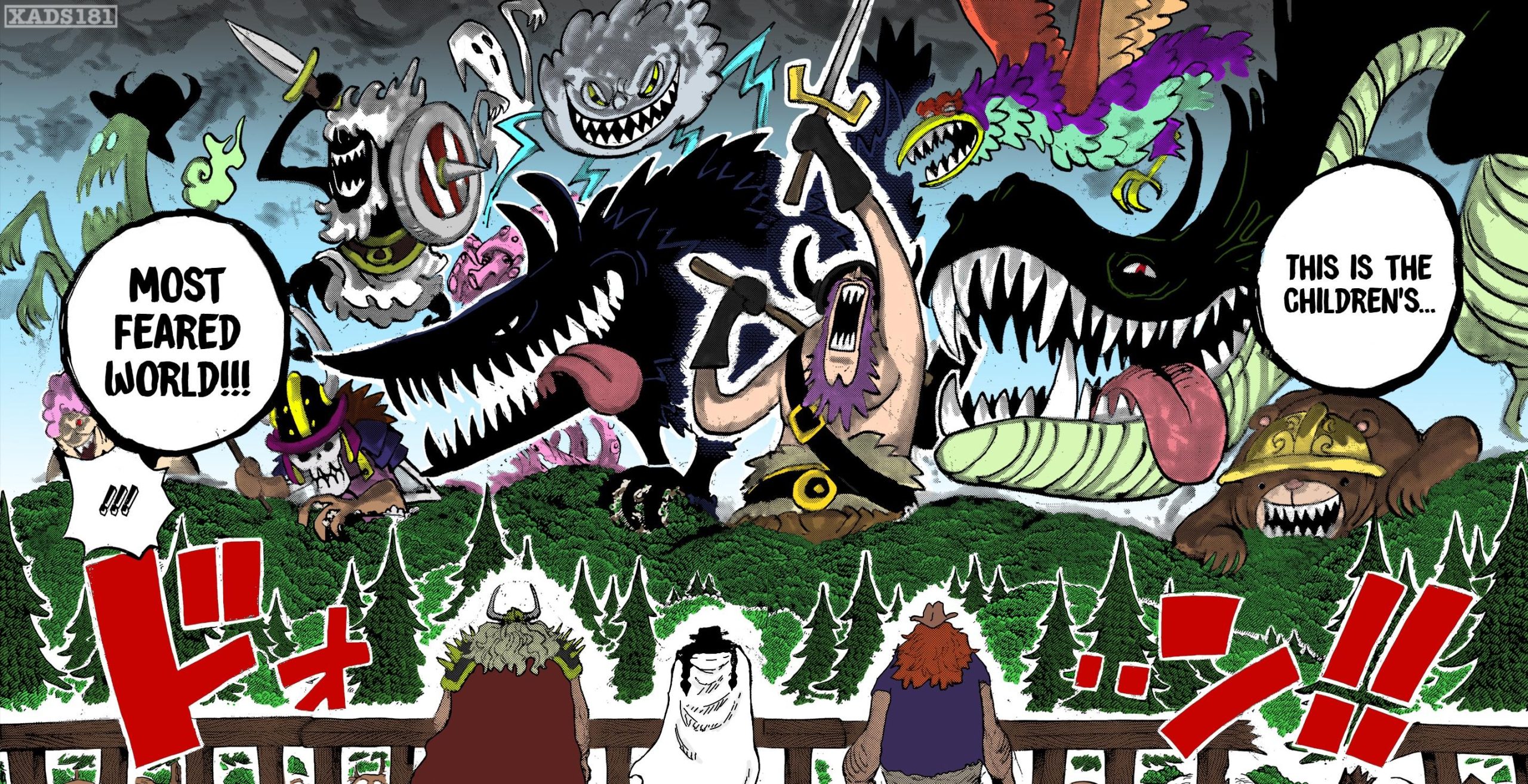
Chapter ends with Imu/Gunko commanding a demon army that have giants who have transformed into giant devils + the MMA (dream monsters) to kill of Jarul.
The Demon Giants are now about the size of Oars
No break next week.
Additional Spoilers
With his Trident, Imu creates a magic circle that flies in the air and lets a cannon blast the remaining Giants.
Imu activates “Domi Reversi,” causing Brogy’s body to twist(upside down) and transform into a demonic version of himself, larger, with fangs and bat wings and under Imu’s control.”
In Gunko’s body, Imu appears as a true demon—complete with bat wings, a trident, and a tail shaped like an arrow.
FULL SUMMARY – MORE LATER ON
Chapter 1,150: “Domi Reversi” (“ドミ・リバーシ” in japanese, kanjis (闇転支配) mean “dark reversal control”).
– Ogre Child Yamato’s Golden Harvest Surrogate Pilgrimage, Vol. 34: “Yasuie’s katana has been enshrined in the Enma Shrine in Hakumai and the surrogate pilgrimage is completed”. Yamato, Ulti and Page One are in front of the Enma Shrine (we don’t know yet if this is last part of the cover story or not).
– Nothing from Luffy’s group in this chapter. And there is no new info about Brook’s past or Mary Geoise either.
– We see Gunko/Imu devil form in an EPIC double page. Gunko’s normal body has now 2 huge and leathery black wings (resembling bat wings) and a tail with an arrow-shaped tip. Gunko/Imu also holds a large trident (much larger than Gunko’s body).
– Gunko/Imu orders Sommers to lead the line of the children (Usopp is in shock seeing that Sommers is still alive) and then talks with Killingham.
Gunko/Imu: “Killingham, is this all that thy MMAs can offer?”
Killingham: “Of course not, boss!! I left a couple “Nightmare Holes” open!! So monsters will continue to be generated from the nightmares of this island!! They are creatures of dream and have no concept of death within, they can all be revived whenever I give the signal!!”
– Gunko/Imu makes a magic book appear, and from inside the book, a dagger and a giant shotgun come out. When Brogy is about to attack, Gunko/Imu stabs Brogy’s left hand and shoots at Brogy’s wrist. The shot destroys Brogy’s wrist and separates his hand from arm.
– Then Gunko/Imu uses “Devil’s Contract” to give Brogy the “power of evil”. Brogy is swallowed by the floor and then he re-emerges (surrounded by flames) with a new devil form.
– Brogy is now much bigger than other giants (around 5-6 times bigger). Brogy has now 2 huge wings (like Gunko/Imu’s), 4 large fangs and 2 black horns. And he also holds a huge double edged axe (Brogy can use his left arm even with no wrist).
Brogy: “Gabababababa!! This sensation!! I feel like I can do anything!!!”
– Gunko/Imu then uses “Domi Reversi” to turn Dorry and some of the “Giant Warrior Pirates” into his/her subordinates. All of them have now devil forms like Brogy (they are much bigger and have wings, fangs…) and hold huge tridents (Dorry’s trident has a sword in the center prong).
– In the FUCKING EPIC last double page of the chapter we see new Gunko/Imu’s army: devil Dorry, devil Brogy and devil Giant Warrior Pirates in the front, and several dream monsters behind them. These dream monsters are much bigger than Killingham’s ones and have fangs and horns like devil giants.
Gunko/Imu: “So this is the power of “Elbaph”… Not bad at all…!!! This nation is not to be destroyed… but to be ruled by Mu. However… Let’s witness for a bit longer what kind of performance they can provide in wars…!!”
– Chapter ends with Jarul and the giants in the village. Giants ask Jarul to get away because something bad happened to “DoryBro duo” but Jarul is ready to fight…
Jarul: “You shouldn’t say that to a proud warrior…”
– End of the chapter. NO BREAK next week .
THIS IS A LIVE-UPDATING POST -STAY TUNED
Sanford I “Sandy” Weill stands out as one of America’s most influential financiers, with a net worth of approximately $1 billion. His journey from a modest upbringing in Brooklyn to leading Citigroup exemplifies ambition and strategic vision. Between 1998 and 2003, Weill was the CEO of Citigroup, the financial giant created through an unprecedented merger. He served as chairman until 2006, shaping the firm into a powerhouse of global banking.
Roots and Education: Early Foundations
Born on March 16, 1933, in Brooklyn, New York, Sandy Weill grew up as the son of Polish Jewish immigrants Max and Etta Weill. His early education took place at P.S. 200, followed by Peekskill Military Academy in upstate New York. Later, he attended Cornell University, where he studied government and joined the Alpha Epsilon Pi fraternity and Air Force ROTC. Sandy’s unusual middle initial “I” was chosen without a specific name behind it—his mother’s unique choice, symbolizing freedom for him to select a middle name later in life.

Sandy Weill (Image via Getty)
From Wall Street Runner to Brokerage Pioneer
Sandy Weill’s professional career began modestly in 1955 when he took a job as a runner at Bear Stearns on Wall Street. By 1956, he became a licensed broker but realized he was more comfortable analyzing financial statements than aggressively courting clients. Early encouragement from his future wife, Joan, helped expand his client base beyond his mother, his sole client at the time.
Weill’s ambition quickly grew. In 1960, he partnered with his neighbor Arthur L. Carter and others to launch Carter, Berlind, Potoma & Weill, a brokerage firm that underwent several name changes as it expanded. Under Weill’s leadership, the firm grew aggressively through acquisitions and became a dominant player, eventually known as Shearson Loeb Rhoades. Between 1965 and 1984, Weill steered the company through more than 15 acquisitions, making it the second-largest brokerage firm in the U.S.
A Major Sale and the Path to Corporate Leadership
In 1981, Sandy Weill sold Shearson Loeb Rhoades to American Express for about $915 million in stock, marking a pivotal moment in his career. He quickly rose within American Express, becoming president in 1983 and chairman/CEO of its insurance arm, Fireman’s Fund, by 1984. However, Weill’s tenure at American Express ended in 1985, when he left to pursue new ventures.
Building a Financial Empire: Commercial Credit and Beyond
Weill made a bold move in 1986 by investing $7 million to acquire Commercial Credit, a troubled company spun off from Control Data Corporation. Over the next several years, he strategically purchased Gulf Insurance, Primerica, and Drexel Burnham Lambert’s retail brokerage outlets. These acquisitions expanded his financial empire significantly.

Sandy Weill (Image via Getty)
One of his most notable moves was acquiring a 27% stake in Travelers Insurance for $722 million in 1992. Weill later orchestrated a merger to take control of Travelers, rebranding it as Travelers Group. He then reacquired his old brokerage, Shearson, from American Express in 1993 for $1.2 billion, bringing much of his earlier empire back under his leadership.
The Merger That Changed Banking: Citigroup’s Creation
In 1998, Travelers Group merged with Citicorp in a landmark $76 billion deal, creating Citigroup, a pioneering financial conglomerate that combined banking, insurance, and brokerage services. Sandy Weill was named CEO of the new company and remained a key figure in the financial world throughout the early 2000s. His leadership earned him CEO of the Year honors in 1998 and 2002 from “Financial World” and “Chief Executive” magazines, respectively.
Weill’s influence extended beyond corporate America. In 2001, he became a Class A director at the Federal Reserve Bank of New York, underscoring his stature in the financial sector. By 2003, Weill began stepping back, selling shares worth nearly $264 million and entering a semi-retirement phase, although he remained on Citigroup’s board until 2006.
A Life of Giving: Philanthropic Commitments
Beyond business, Sandy Weill is known for his extensive philanthropy, particularly in education, medicine, and the arts. He and his wife Joan have donated over $250 million to Cornell University, Weill’s alma mater, establishing the Weill Cornell Medical College and supporting the Weill Institute for Cell and Molecular Biology.
Weill’s philanthropic reach extends to multiple institutions. He has chaired the Weill Cornell Graduate School of Medical Sciences since 1995 and contributed generously to New York-Presbyterian Hospital and the Hospital for Special Surgery. His commitment to education led to the founding of the National Academy Foundation, aimed at creating high school academies focused on finance and business.
Sandy’s leadership roles in cultural institutions include chairmanship of Carnegie Hall’s Board of Trustees, where the Joan and Sanford I. Weill Recital Hall honors their patronage. His philanthropic accolades include the Carnegie Medal of Philanthropy in 2009 and election to the American Academy of Arts and Sciences in 2012. A major gift of $185 million in 2016 funded the Weill Institute for Neurosciences at the University of California, San Francisco.

Personal Life and Family
Sandy Weill married Joan Mosher in 1955, marking a partnership that has lasted decades. Their shared commitment to philanthropy has shaped much of their public legacy. The couple’s dedication to education and the arts reflects their deep-rooted values and desire to create a lasting societal impact.
Luxury Real Estate Investments Reflect a Life of Success
Sandy and Joan Weill have owned multiple high-profile properties, often tying their real estate ventures to philanthropic goals. In 2007, they purchased a penthouse at 15 Central Park West for $43.7 million, later selling it for a record $88 million in 2011, with proceeds pledged to charity.
Their Sonoma Valley estate, acquired in 2010 for around $31 million, features a Tuscan-style home, vineyard, and notable artworks. The Weills have supported the Green Music Center at Sonoma State University with a $12 million donation, further linking their residences to the arts.
Their Greenwich estate, listed in 2014 for $14 million, boasts six bedrooms, nine bathrooms, a home theater, a wine cellar, a pool, a spa, and a fitness room. Other properties include a 120-acre estate in New York’s Adirondacks and a villa in the Bahamas.
Legacy of Leadership and Generosity
Sandy Weill’s journey from a Wall Street runner to a billionaire financial architect embodies resilience, vision, and generosity. His ability to build and transform financial institutions reshaped the banking industry, while his philanthropic efforts continue to influence education, medicine, and the arts. Weill’s story remains a testament to how determination and a commitment to giving back can leave a lasting imprint on society.
