Pedro Páramo is a film that stands out in how it shows the boundaries between life and the afterlife. While many films use the idea of life after death in their storytelling, few do so in a way that feels as innovative and intriguing as this one.
The film uses its supernatural elements not only to tell a attractive story but also to comment on the consequences of collective wrongdoing.
It’s an ambitious narrative that tackles multiple themes while managing to keep the viewer engaged without losing the plot.
The movie is based on the 1955 novel by Mexican author Juan Rulfo, which is considered one of the most important works of Latin American literature. It tells the story of Juan Preciado, a man who travels to a desolate town in search of his father, Pedro Páramo.
What begins as a simple search for his missing father turns into a deep view into the supernatural. As Juan confronts the truths about his father, he also begins to understand his own fate, moving between the past, present, and a limbo-like afterlife.
The film’s ability to blend timelines and its handling of the afterlife, or limbo, create a unique experience that attracts viewers.
Juggling Multiple Timelines Without Confusion
One of the standout features of Pedro Páramo is how it handles multiple timelines. The film takes on the challenge of presenting not just one story but several, all unfolding in different time periods.
At first glance, it might seem difficult for a film to manage this complexity without confusing the viewer. However, director Rodrigo Prieto, making his feature film directorial debut, does so with remarkable success.
Prieto uses a narrative technique that places complete trust in the audience’s ability to understand the shifting time periods.
Instead of using obvious tools, such as color grading or heavy visual cues, to mark the different timelines, the film relies on subtle changes.
Makeup, for example, is used to show characters at different ages. The use of younger and older versions of characters allows the audience to easily recognize the passing of time without being hit over the head with it.
The film’s ability to switch between different timelines without losing clarity is impressive.
There is a fine balance here, as the audience must be able to understand where and when each scene takes place. The subtlety of these transitions ensures the viewer is never confused.
It’s easy to follow the story even as it weaves through past, present, and an afterlife world. This approach is a refreshing change from other films that often rely on color schemes or specific visual effects to distinguish different time periods.
Prieto also manages to introduce the supernatural setting of the film in a gradual way. Instead of overwhelming the audience with all the information about the afterlife and its rules at once, the film takes its time.
New elements are introduced little by little, allowing the audience to get accustomed to the world of limbo and the eerie atmosphere that comes with it. The careful pacing of this transition helps keep the story fresh and engaging.
A Genre-Bending Film
As the film moves forward, it becomes clear that Pedro Páramo is not simply a supernatural story. It blends different genres, creating a unique viewing experience.
The narrative feels like a mix of Western, drama, and horror. The film also shifts in tone, from a mystery about a man searching for his father to a more philosophical meditation on life, death, and the consequences of actions.
The transition into the afterlife, which is central to the story, is handled in such a way that it feels like a genre-bending adventure. The supernatural elements don’t overpower the film but rather add to its complexity.
The movie’s atmosphere constantly shifts between tension, mystery, and surreal horror, all while remaining deeply philosophical.
This mix of genres adds depth to the film and makes it stand out from typical supernatural films that follow a more traditional narrative structure.
The cinematography plays a huge role in this shift. The visual changes in the movie reflect the changing tone, making it clear that the afterlife is not just another setting but an essential part of the story. The eerie, dreamlike quality of the afterlife world is enhanced by Prieto’s skillful cinematography.
As a renowned cinematographer for Martin Scorsese, Prieto’s expertise in creating atmosphere through visuals is on full display here.
He and his co-cinematographer, Nico Aguilar, work together to create an unsettling, haunting look that perfectly complements the film’s themes.
Cinematography That Speaks Volumes
The cinematography of Pedro Páramo is another reason why this film feels unique. The visuals are not just there to look good but to tell the story in ways that words cannot.
The cinematography highlights the dark, ominous nature of the town and the consequences of its past. The desolate, ghostly town is not just a backdrop but a character in itself. It is a reflection of the collective sins of the people who lived there, and the visuals make this clear.
In the opening scenes, the audience is placed in the perspective of Juan Preciado. This point of view helps the audience feel as confused and disoriented as the character does.
Juan doesn’t know where he is or what is happening, and the viewer is in the same position. This technique allows the audience to experience the strange and unsettling world of Pedro Páramo through Juan’s eyes, building empathy and understanding.
As the film progresses, the town and its people begin to reveal their darker nature. The setting becomes more unsettling, and the supernatural elements take on a stronger presence.
The eerie atmosphere is created not just through the story but through the visuals, which highlight the decaying, otherworldly nature of the town.
The afterlife is depicted as a bleak, sorrowful place, where the sins of the past haunt those who are stuck there.
The cinematography works in perfect harmony with the narrative, helping to establish the themes of fate, consequence, and the lasting effects of evil actions.
A Powerful Story, With A Flawed Execution
While the film does many things well, it’s not without its flaws. One of the biggest issues with Pedro Páramo is its pacing. At times, the film feels slow, especially when it moves from one part of the story to another.
For a movie that covers so much ground, it can sometimes feel surprisingly stale, especially in scenes where the audience is trying to keep track of the many characters and events.
The film introduces several characters throughout the story, and while each one has a purpose, it can sometimes be difficult to keep track of who they are and what role they play.
The story shifts between characters and timelines, and while the transitions are handled well, the sheer number of characters and plot points can occasionally be overwhelming.
This can make it hard for the audience to stay fully engaged, as it can feel like the story is moving too slowly or jumping between too many different storylines.
Another flaw of the film is the lack of focus on the female characters. While the male characters, especially Pedro Páramo, are given depth and complexity, the women of the story are often sidelined. The film does little to show their inner lives or motivations.
In many ways, the female characters are defined by their relationships to the men in the story, and their voices are not fully heard.
This is a missed opportunity, as these characters could have added a richer layer to the story. The film often treats women as mere plot devices, and while this is reflective of the social dynamics in the story’s setting, it’s still a flaw in the storytelling.
Themes of Power and Corruption
One of the central themes of Pedro Páramo is the abuse of power, especially in religious institutions. Pedro Páramo, the central character, is a man who has a ruthless, unyielding approach to life.
He’s the product of a town that has allowed its own moral decay to define its actions. Páramo’s role as a powerful figure in the town reflects a broader theme about the corrupting nature of power.
The film also critiques the way religious leaders can manipulate their power. Padre Rentería, the priest in the town, is shown as a man who makes decisions based on his own interests while claiming to act on behalf of God.
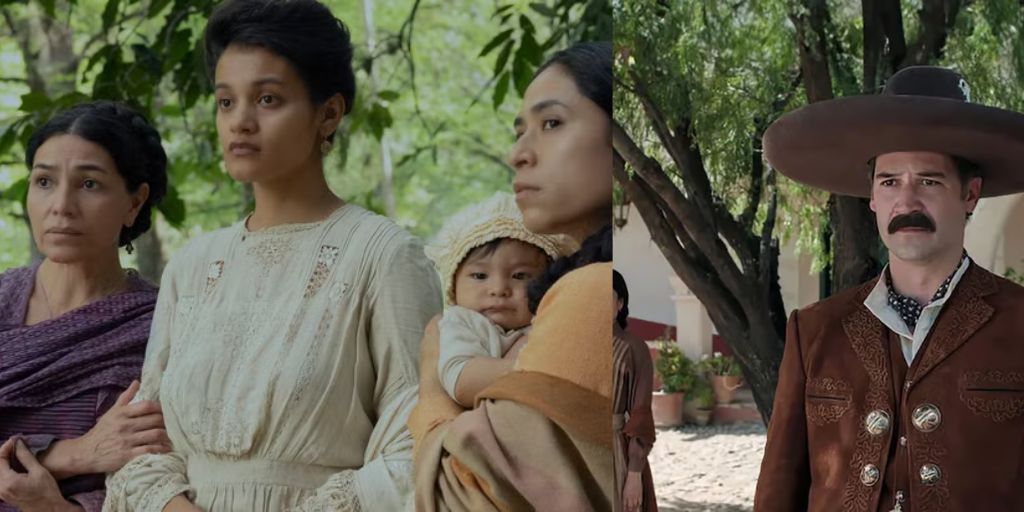
Still from Pedro Páramo (Credit: Netflix)
This character highlights the dangers of religious figures who use their influence to justify their own actions, leading to some of the most terrible consequences in the story. This theme is not unique to Pedro Páramo, but it is a key element in the narrative.
Pedro Páramo is a film that is both visually stunning and thematically rich. It tells a complex story that moves between different timelines and the afterlife while showing deep themes of power, fate, and the consequences of wrongdoing.
While the film has its flaws, such as pacing issues and the underdevelopment of its female characters, it is still a strong and engaging film.
Director Rodrigo Prieto proves that he is not only a master cinematographer but also a skilled storyteller. His work here makes us eager to see what he will do next.
Pedro Páramo is a haunting and thought-provoking film that leaves a lasting impact on its viewers.
The final Battles of The Voice Season 26 have arrived, marking a critical moment in the competition. With only a few steals remaining, the coaches must make tough decisions about who stays and who goes.
It’s a given that some exceptional talent will fall through the cracks, but this is part of the process as the coaches aim to perfect their teams before the live shows.
The battles are fierce, and the pressure is on. Artists from across the country have come to showcase their skills, but only a select few will make it to the next round. The stakes couldn’t be higher, and all eyes are on the coaches to make the right choices.
This season of The Voice has been particularly interesting as both veterans and newcomers to the show are using different strategies to secure their spots.
But one thing remains constant: it’s a tough game. While the talent on stage is undeniably impressive, the real focus is on the coaches.
They hold the power, and the contestants are simply pawns in their game. The coaches’ decisions will ultimately determine who moves forward and who gets sent home.
The Coaches’ Strategies: Steals, Decisions, and Heartfelt Moments
This season, Reba McEntire and Michael Bublé each have one steal left, while Gwen Stefani and Snoop Dogg have already used up theirs.
Despite this, the talent remains in abundance, and it’s possible that the winner of this season could be among the artists remaining in these final battles.
The battles have been filled with highs and lows, as the singers aim to shine while facing the tough decisions their coaches must make.
But when the artists are allowed to truly show their skills, The Voice reminds us why it continues to capture viewers’ attention.
The pressure on the coaches to make these tough decisions is clear. In each battle, the coaches must assess which artist has the best potential, who could win the entire competition, and who has what it takes to advance to the next stage.
While it’s always exciting to see incredible performances, the stakes are higher than ever. With the final steals at their disposal, the coaches are eager to find the next star who can make it all the way to the live shows.
Team Gwen: Country Twang and Pop Potential
The first battle of the night belongs to Team Gwen, where two young artists, Rowdy Shea and Camryn Brooks, are set to face off.
The song they perform is “I Remember Everything” by Zach Bryan featuring Kacey Musgraves, a track with a strong country vibe.
Both Shea and Brooks bring their own unique style to the stage, with Shea leaning into his modern country sound and Brooks showcasing her crossover appeal between pop and country.
The performance starts with a fun dynamic between the two artists, who seem to have a sibling-like chemistry.
However, it’s clear that their musical styles don’t blend as seamlessly as one might expect. While Brooks infuses her pop influence into the song, Shea stays true to his country roots.
The result is a performance that feels more like two separate artists singing a single song, rather than a duet. Although neither artist dominates the stage, Brooks’ full potential stands out.
She has the versatility to be successful in both the country and pop worlds. On the other hand, Shea may have a future as a country star, but he struggles to bring the emotional depth that the song requires.

Still from The Voice Season 26 (Credit: NBC)
Despite Shea’s solid performance, Gwen ultimately selects Camryn Brooks as the winner of the battle, making the difficult decision to let go of her only male country artist this season.
While this choice may have been a tough one, it’s clear that Brooks has the edge, with the potential to grow and make a mark in the music industry.
Team Snoop: Crooner vs. Soul Singer
Snoop Dogg faces a tough battle next, as he pits Michael Alexandersson against Mary McAvoy. Alexandersson, a smooth crooner, faces off against McAvoy, whose soulful voice brings a unique energy to the competition.
For this battle, Snoop selects The Flamingos’ “I Only Have Eyes For You,” a classic duet that gives both artists the chance to showcase their vocal abilities.
However, the nature of the song already gives the advantage to Alexandersson, who has a vocal style that fits the track’s smooth and romantic vibe.
McAvoy, meanwhile, must stretch beyond her typical genre to find a way to blend with Alexandersson’s intense vibrato.
When she sings solo, McAvoy proves why she’s a standout artist. She brings a powerful, soulful quality to the song, drawing comparisons to iconic vocalists like Diana Krall.
However, it’s clear that Alexandersson’s performance lacks the same emotional depth. He doesn’t go above and beyond in the way McAvoy does, and she proves herself to be the more versatile artist.
In the end, Snoop Dogg selects Mary McAvoy as the winner of this battle, recognizing that her ability to push beyond her comfort zone and connect with the song gives her the edge.
While both artists are talented, McAvoy’s performance stands out for its emotional depth and potential.
Reba McEntire: Country Powerhouse Continues to Build Her Team
Reba McEntire has a tough decision on her hands as she brings two country artists, Tanner Frick and Tate Renner, to the stage for a battle. The two men are both modern country singers with distinct styles—Frick with his radio-ready sound and Renner with his cleaner, more polished voice.
The song they perform is “Need a Favor” by Jelly Roll, a contemporary country track that gives both artists the opportunity to showcase their grit and vocal power.
During their coaching session, Reba reveals that she wants whoever she doesn’t select to be stolen by another coach, a risky move that could come back to haunt her. As the performance begins, it’s clear that both artists bring something special to the stage.
However, the battle lacks harmony, as both Frick and Renner are lead vocalists and struggle to find a balance when singing together. Frick’s raw, country-infused style contrasts with Renner’s cleaner tone, and the result is a performance that’s interesting but not perfect.
Reba ultimately selects Tate Renner as the winner of the battle, recognizing his potential to succeed in the competition.
However, her wish is granted when Michael Bublé steals Tanner Frick, adding another strong country artist to his roster. It’s a win-win for both coaches, but Frick will have to prove himself in the next rounds if he hopes to make it far in the competition.
Reba’s next battle involves Katie O and the trio 323. Katie O, a young country singer with superstar potential, faces off against the group 323, known for their tight harmonies and energetic performances.
For this battle, Reba selects “Lonesome Loser” by the Little River Band, a song that allows both Katie O and 323 to let loose and have fun on stage.
The performance is a blast, and it’s clear that Katie O shines as a solo artist, with her vocal ability and stage presence standing out. However, 323’s harmonies are so tight that they dominate the performance when they sing together.
Despite this, Reba ultimately selects Katie O as the winner of the battle, recognizing her star quality and potential for success. It’s clear that Katie O has the ability to go far in this competition, and she could very well be a contender for the finale.
Michael Bublé: The “Mad Scientist of Music” Works His Magic
Michael Bublé is proving to be the “Mad Scientist of Music” in these final battles, using his skills and experience to craft performances that stand out.
His first battle of the night pairs J. Paul with Kamila Kiehne. Kamila, a 17-year-old powerhouse, faces off against J. Paul, a seasoned artist who has the advantage of years of experience.
Michael Bublé selects Britney Spears’ “Toxic” as the song for this battle, knowing that both artists have the versatility to make it their own.
Thanks to Bublé’s guidance, both artists shine. J. Paul, with his polished vocals, is a standout performer, while Kamila Kiehne brings a fresh vibe to the song.
However, her stage presence still feels a bit raw, and she struggles to keep up with J. Paul’s commanding performance.
Despite this, Bublé selects J. Paul as the winner of the battle, acknowledging his vocal prowess and stage presence. Kamila Kiehne may have the potential to grow, but for now, J. Paul is the stronger contender.
Bublé’s next battle is another tough one, as he pairs Cameron Wright with Cassidy Lee for a “Big Bublé Battle.” Both artists are powerful and versatile, and Bublé gives them one of the most challenging songs in the Mariah Carey catalog: “Hero.”
From the moment the song is announced, it’s clear that Cameron Wright has the vocal chops to dominate this track. Cassidy Lee, on the other hand, brings a deeply emotional connection to the song, relating it to her mother after the passing of her father.
The performance is emotional and powerful, with both artists bringing something unique to the stage. In the end, Bublé selects Cameron Wright as the winner, recognizing his vocal talent and ability to handle the demanding song.
However, Reba McEntire swoops in and steals Cassidy Lee, giving her another chance to shine in the competition. This could be the pairing that helps Lee make it to the final rounds.
The Importance of the Steal: A Game-Changer in the Battle Rounds
The final steals in the Battle Rounds are a critical part of the competition. With only a few opportunities left, the coaches must make sure they use their steals wisely.
As the artists continue to battle for a spot in the live shows, the stakes are higher than ever. The steal mechanic gives hope to those who may have been eliminated, allowing them a second chance to prove themselves.

Still from The Voice Season 26 (Credit: NBC)
For the artists, the final Battle Rounds are a pivotal moment. It’s a chance to showcase their talent, take risks, and prove that they have what it takes to make it all the way to the live shows.
While some may struggle, others will shine and advance, making the decisions of the coaches all the more important.
As the season progresses, it’s clear that the final Battle Rounds are just the beginning. The competition is only going to get tougher, and the talent is only going to get stronger.
It’s anyone’s game at this point, and the final few steals may very well be the key to unlocking a path to victory. With so much talent on display, the final winner of The Voice could be anyone’s guess.
