In 1972, Jean McConville, a single mother of ten, was abducted by the Irish Republican Army (IRA) and never seen again. This tragic event altered the lives of McConville’s children, who were left searching for answers about their mother’s disappearance.
The case became a major point of interest in the United Kingdom, but it also gained a broader focus when Patrick Radden Keefe, an investigative journalist, examined it in his best-selling non-fiction book Say Nothing: A True Story of Murder and Memory in Northern Ireland.
Keefe’s investigation began after he read the obituary of Dolours Price, a woman who was the first female member of the Provisional IRA. This sparked Keefe’s interest in Price’s role in the violent IRA movement and how her life connected to McConville’s mysterious disappearance.
Keefe’s book became the basis for an adaptation by FX, titled Say Nothing. The series is an intense, nine-episode look at the lives of two women—Dolours Price and Jean McConville—and their connections to the violence of the IRA during The Troubles, a violent conflict in Northern Ireland.
The show tackles heavy themes, including morality, the justification of violence for political causes, and the personal cost of revolution. For those interested in true crime and history, Say Nothing offers a compelling narrative, bringing these complex historical events to life through its vivid storytelling.
What Is Say Nothing About?
Say Nothing opens with a chilling scene: Jean McConville (played by Judith Roddy) is captured at gunpoint by members of the IRA in front of her terrified children. This moment marks the beginning of McConville’s tragic disappearance and sets the tone for the series, which moves back and forth between McConville’s story and that of Dolours Price (Maxine Peake), a key figure in the IRA’s operations.
The show portrays Price’s transformation over time, starting with her youthful enthusiasm for the republican cause and later showing her regret and disillusionment after years of violent action.
The show opens decades after McConville’s disappearance, with an older version of Price (played by Peake) finally speaking out about her involvement in the IRA. Price reveals not only her own involvement in war crimes but also uncovers information about the killings and the mysteries surrounding McConville’s abduction.
The show’s storytelling shifts between flashbacks to Price’s younger days (with Lola Petticrew playing the role of young Dolours) and the present, where Price reflects on her actions. These flashbacks show how Dolours and her sister Marian (played by Hazel Doupe) became members of the IRA.
The Price sisters, alongside other members of the IRA, were not mere supporters—they were active fighters, taking part in bombings, sniper attacks, and other violent operations aimed at freeing Northern Ireland from British rule. They were also responsible for executing traitors within their own ranks, individuals who had betrayed the IRA to the British government.
The story of Say Nothing is not just about Dolours Price, though. As the show unfolds, we learn that McConville’s abduction and the IRA’s involvement in it are deeply connected to Price’s life. The show details how McConville was believed to have been suspected of collaborating with the British forces, a reason the IRA saw her as an enemy to be silenced.
The tragedy of McConville’s fate is wrapped up in the violence and paranoia that marked The Troubles, as both Price and the McConville family’s story become intertwined in the bloody and complex history of Northern Ireland.
A Stellar Ensemble in Say Nothing
FX’s Say Nothing is not only a story of historical events but also a powerful ensemble piece. The show presents a layered portrayal of the conflict, one that stays with the viewer long after the credits roll. It is clear that a great deal of thought was put into casting, and the actors give compelling performances that help bring the weight of these true events to life.
The first episodes of the show focus on the younger versions of the central characters, particularly Dolours Price (played by Lola Petticrew) and Marian Price (Hazel Doupe). Alongside them, the show features key characters like Gerry Adams (played by Josh Finan), the IRA leader who later became a significant political figure.
Anthony Boyle plays Brendan Hughes, a formidable IRA operator who has a major role in the series. The young cast shines in their portrayal of the characters, setting the stage for the later, more reflective moments of the series.
As the show progresses, we see these same characters as older versions of themselves, portrayed by a talented group of veteran actors. Maxine Peake’s portrayal of Dolours Price is particularly notable, capturing both the fiery spirit of the young revolutionary and the deep sense of regret that defines her later years.
The older cast members bring the full emotional range of the story to the screen, with performances that convey the complex internal struggles of individuals caught in the violent conflict of The Troubles.
The show also finds strength in how it handles each character’s story. With a large ensemble, many shows might lose focus on certain characters, but Say Nothing ensures that each of its main figures gets the time and development they deserve.
From Dolours to Gerry Adams to Brendan Hughes, the series shows the human side of these figures, making the audience both angry at their actions and sympathetic to their struggles. This balance of defiance and vulnerability is what makes Say Nothing so powerful.
The series is structured in a way that builds tension around the mystery of McConville’s disappearance. The narrative carefully places clues that suggest who might be responsible, and though the truth is eventually revealed, the discovery doesn’t feel forced or predictable.
The writers, including Joshua Zetumer, Kirsten Sheridan, and Joe Murtaugh, have done an excellent job in adapting Keefe’s book for the screen. The pacing of the story is steady and well thought-out, allowing the mystery of McConville’s abduction to develop alongside the evolving story of Dolours Price’s life.
Recreating History with Care and Precision
One of the standout features of Say Nothing is its commitment to historical accuracy. The show is based on real events, and the team behind the production has gone to great lengths to ensure that the historical context is faithfully recreated. From the wardrobe to the locations to the events themselves, Say Nothing captures the atmosphere of The Troubles with painstaking attention to detail.
The series draws on key historical moments from Northern Ireland’s history, including the 1973 Old Bailey bombing and its aftermath, where Dolours and Marian Price were arrested and sent to prison. The show doesn’t shy away from depicting these events in all their complexity, showing the painful reality of the hunger strikes that followed and the impact that these actions had on the lives of the people involved.
The story also touches on the political ramifications of the conflict, particularly the role of Gerry Adams, who would later help bring about the 1998 Good Friday Agreement, a peace agreement that aimed to end the violence in Northern Ireland.
Despite the intense focus on the IRA and the violence of the time, Say Nothing does not glorify or romanticize the acts of rebellion. Instead, the series presents a balanced view of the cost of violence, both for those who fought for a cause and for those who suffered as a result.
By focusing on Dolours Price’s journey from a young revolutionary to a disillusioned former fighter, the series presents a powerful commentary on the dangers of blind ambition and the lasting scars left by violence.
A Thought-Provoking Reflection on the Past
At its heart, Say Nothing is not just a historical recounting of The Troubles; it is a meditation on the nature of revolution, memory, and the consequences of violence. Through Dolours Price’s life, the series asks difficult questions about the cost of fighting for a cause. Is violence ever justified in the name of political change? What happens when a revolutionary cause leads to more destruction than peace?
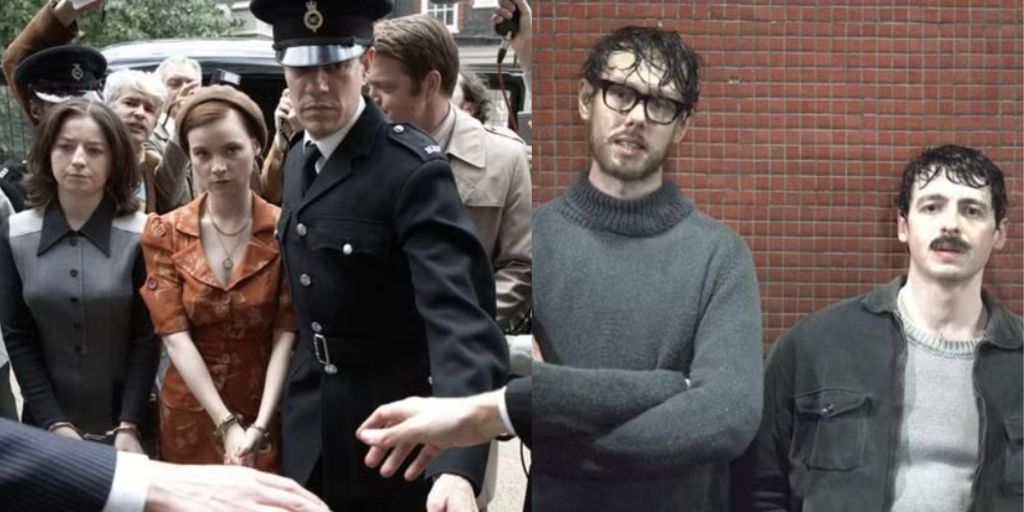
Still from Say Nothing (Credit: FX)
The show doesn’t provide easy answers to these questions. Instead, it offers a nuanced portrayal of a turbulent time and the people who lived through it. Say Nothing is not a simple true-crime drama; it is a deeply reflective work that asks viewers to reconsider the past and reflect on how history is remembered.
Final Thoughts
Say Nothing will be available for streaming on Hulu starting November 14. For those interested in true crime, history, and the complexities of political conflict, this series offers a gripping and thought-provoking experience.
With a talented ensemble cast, a well-crafted script, and a deep respect for history, Say Nothing brings the events of The Troubles to life in a way that is both powerful and unsettling. The show reminds us that history is not just about facts and dates—it is about the people who lived through it and the choices they made.
Anthony Mackie, a talented actor who has steadily risen to prominence in Hollywood, is set to make an even bigger splash with his upcoming role in Captain America: Brave New World, releasing in February.
This new project has the potential to take his career to new heights, but before fans get to see him wielding a shield, he stars in the monster thriller Elevation, directed by George Nolfi, known for his work on The Adjustment Bureau and The Banker.
Alongside Mackie is Morena Baccarin, who is no stranger to blockbuster films, particularly within the superhero genre. However, despite these two impressive leads, Elevation ultimately fails to deliver the high-stakes thrills audiences expect from a monster movie.
While many recent films in the post-apocalyptic genre have found success, Elevation does not stand out as one of them. The movie is part of a trend of thrillers following in the footsteps of A Quiet Place (2018), a movie that set the bar for monster films featuring intense survival elements.
But where A Quiet Place successfully built tension and a compelling story, Elevation struggles to find its footing. It relies heavily on familiar tropes, predictable plot points, and underdeveloped characters. As a result, the film quickly becomes forgettable, with little to offer in terms of original storytelling or lasting impact.
The Story of Elevation
Some of the best monster movies are those that come with an intriguing hook. A Quiet Place had its unique twist where making a sound could get you killed by deadly aliens with superhuman hearing. Tremors (1990) created tension by making the ground itself dangerous, with giant worms attacking anyone who moved on the earth’s surface. Elevation tries to build on this idea with a similar, albeit less interesting, premise.
The film begins three years after an apocalyptic event when giant monsters emerged from the earth and began killing humans. These creatures seem nearly unstoppable, with their armored bodies making them impervious to conventional weapons. The monsters don’t touch animals, though, and scenes show horses and buffalo thriving in the wild. This could have been a unique angle, but the film fails to show it in any meaningful way.
The monsters are revealed to have one weakness: they cannot survive at elevations higher than 8,000 feet above sea level. This discovery becomes a key element of the plot, as it provides a safe haven for those who are able to live above this height.
However, the story does little to explain the reasoning behind this weakness, leaving it as a mere plot device rather than a well-thought-out concept. It’s a missed opportunity that undermines the potential for a truly engaging story.
The main characters are based in the Rocky Mountains, just outside of Boulder, Colorado. Several refugee camps exist in the mountains, and Will (played by Anthony Mackie) lives there with his young son, Hunter (Danny Boyd Jr.).
Will’s wife died at the hands of the monsters, and Hunter suffers from a chronic lung disease that has required him to rely on a breathing machine. Living at high altitudes has helped keep Hunter alive, but his machine filters are running low, and Will has no choice but to go below the 8,000-foot mark to retrieve more supplies from a hospital in Boulder.
Going down to lower elevations is extremely risky, as the monsters roam freely in these areas, but Will is desperate to save his son. He sets off on a dangerous journey with Katie (Maddie Hasson), a close friend, and Nina (Morena Baccarin), a scientist who believes she might have a way to defeat the creatures.
Together, the three set out to find the hospital in Boulder, where the supplies are located. But as they venture into the heart of the destroyed city, the tension mounts and it becomes uncertain whether any of them will survive.
A Lackluster Story and Underdeveloped Characters
At its core, Elevation is a monster movie that struggles to provide compelling character development or an original plot. The story is filled with predictable beats that can be seen from a mile away. The heroes encounter various obstacles along their journey, including close calls with the monsters.
However, the characters’ motivations and personalities are underdeveloped, making it difficult for the audience to connect with them or care about their survival.
Unlike other monster films, such as Tremors, where the chemistry between characters is central to the enjoyment of the story, Elevation fails to create any emotional investment.
The relationship between Will and his son is the only one with any real emotional weight, but even this dynamic feels underexplored. Will is a devoted father, willing to risk everything for his son’s survival, but outside of this one motivation, there isn’t much depth to his character.
Katie, played by Maddie Hasson, is another character who lacks much development. While she’s portrayed as a supportive friend to Will, there’s little to her beyond that role.
The film gives no reason for the audience to care whether she lives or dies, other than the fact that she’s part of Will’s journey. Her personality is not fleshed out enough to make her stand out as an individual, which weakens her role in the story.
Then there’s Nina, played by Morena Baccarin. Nina is introduced as a scientist who may hold the key to defeating the monsters. However, her character feels more like a plot device than a fully realized person. She serves as the exposition machine, explaining the monsters and offering ideas on how to stop them.
But aside from her scientific knowledge, Nina’s personal backstory is barely shown until the third act, where it is shoehorned in for plot convenience. This late introduction of her background feels forced and undercuts any potential for emotional resonance.
What’s more, the lack of chemistry between Mackie and Baccarin further hinders the film. While both actors are clearly skilled in their craft, they don’t seem to have much rapport on screen. Their interactions feel stiff, and the emotional stakes in their relationship fail to land. This is a critical flaw, as the bond between the characters is meant to drive the narrative. Unfortunately, it doesn’t succeed in doing so.
Monsters That Fail to Impress
One of the most disappointing aspects of Elevation is its portrayal of the monsters. In any good monster movie, the creatures are central to the experience, whether they’re horrifying and terrifying, or simply interesting in their design. Unfortunately, the monsters in Elevation fall flat. While they aren’t outright laughable, they fail to leave any lasting impression.
At the start of the film, the monsters are kept in the shadows, heightening the suspense. But as the movie progresses, the creatures are shown more and more clearly, and they fail to live up to the expectations set by earlier films in the genre.
Unlike the terrifying creatures in A Quiet Place or the memorable Graboids in Tremors, the monsters in Elevation look uninspired. They appear to be poorly designed, with CGI that feels cheap rather than innovative. Rather than being a source of terror, they become just another element of the film that fails to excite.
The monsters’ design seems to have been rushed, as they don’t stand out in any meaningful way. At the beginning of the movie, their brief moments in the shadows suggest that they could be more frightening if kept hidden. However, as they are revealed in full view, they don’t live up to the tension built earlier. This lack of payoff makes the creatures feel like a missed opportunity.
Additionally, the film’s approach to revealing the monsters’ origins feels anticlimactic. There is an attempt to build a mystery about whether the monsters are alien in origin or something else, but when the truth is finally revealed in the final act, it lacks any real impact.
The revelation feels more like an afterthought, another piece of exposition added to the film to fill space rather than provide a meaningful twist.
A Movie That’s Easily Forgettable
Despite its promising premise, Elevation never manages to reach the heights it aims for. It isn’t a bad movie, but it’s certainly not a memorable one. If you’re looking for a way to pass the time on a rainy weekend, Elevation will do the job. It won’t insult your intelligence, but it won’t wow you either.
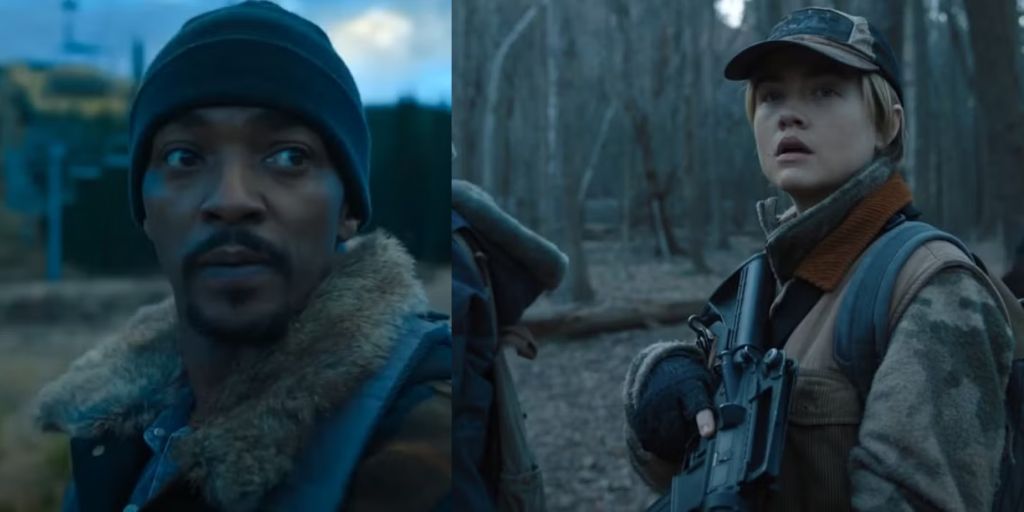
Still from Elevation (Credit: Vertical)
The film is empty, relying on clichés and predictable plot points that do little to set it apart from other movies in the same genre.
Ultimately, Elevation feels like a missed opportunity. With a stronger script, better character development, and more engaging monsters, it could have been a thrilling ride. Instead, it ends up being a forgettable movie that quickly fades from memory once the credits roll.
If you’re hoping to see Anthony Mackie at his best, you’ll have to wait for his role in Captain America: Brave New World, where he’ll have the chance to truly shine. Until then, Elevation is a monster movie that’s easy to overlook. Elevation is now playing in theaters in the U.S.
