Gwendoline Christie’s character, Lorne, in Severance Season 2 delivers a short but unforgettable line: “See? Pouchless.” This moment stands out as one of the funniest in the new season.
It happens in Episode 3, titled “Who Is Alive?”, when Mark S. (Adam Scott) and Helly R. (Britt Lower) visit a mysterious department called Mammalians Nurturable. This division of Lumon is responsible for raising goats, adding to the company’s strange atmosphere.
Mark and Helly enter the area while searching for Ms. Casey (Dichen Lachman), who has disappeared. As they look around, they find themselves surrounded by employees from Mammalians Nurturable. The situation feels tense, and it seems like it could turn bad quickly.
However, instead of becoming hostile, the goat keepers make a peculiar request—they ask Mark and Helly to lift their shirts and show their bellies. When they do, Lorne makes her cryptic statement about them being pouchless. Another employee immediately responds that this does not prove anything.
The moment is hilarious for many reasons. If viewers feel as confused as Mark and Helly, they will laugh at how absurd the situation is. The humor comes from the randomness of the request and the seriousness with which the goat keepers react.
However, this scene becomes even funnier and more intriguing for those who remember a key moment from Season 1. Lorne’s comment about the missing pouches directly connects to a bizarre first season conversation. This reference adds a deeper meaning to the joke and reveals something significant about Lumon’s treatment of its employees.
A Look Back at the Conflict Between MDR and O&D
Understanding the pouchless comment requires revisiting an earlier conflict in Severance Season 1. One of the most fascinating relationships in the show is between Irving B. (John Turturro) and Burt G. (Christopher Walken).
Their connection begins in Episode 2, where Irving admires a piece of artwork created by Lumon’s Optics and Design (O&D) department. This admiration leads him to meet Burt, the head of O&D’s corporate art division. As the two spend time together, they develop romantic feelings. However, their relationship faces two major challenges.
First, Lumon strongly discourages workplace romances. Second, the employees from Mark’s department, Macrodata Refinement (MDR), have been conditioned to distrust and dislike the people in O&D. Dylan G. (Zach Cherry), one of Mark’s closest colleagues, firmly believes that O&D once attempted a violent coup against MDR. According to Dylan, O&D employees brutally disemboweled members of the MDR team in an attempt to take over.
This gruesome event is depicted in a painting called “The Grim Barbarity of Optics and Design.” Irving finds this disturbing artwork one day, but it is not a random discovery.
Mr. Milchick (Tramell Tillman) and Ms. Cobel (Patricia Arquette), two high-ranking figures at Lumon, deliberately show him the painting to create fear and distance between him and Burt. However, their strategy does not succeed, as Irving continues to grow closer to Burt. Meanwhile, Dylan remains convinced that O&D employees are dangerous.
This long-standing distrust between the departments is challenged when Irving and Dylan visit O&D in an episode fittingly titled “The Grim Barbarity of Optics and Design.” There, they learn that Burt has been lying about the size of his department. Contrary to what MDR employees believe, O&D consists of many more workers than just Burt and his assistant, Felicia (Claudia Robinson).
Burt’s deception is meant to protect his team. He fears MDR employees because O&D has been told a completely different version of events. According to their version of history, it was MDR that staged the coup, slaughtering O&D employees in a bloody attack.
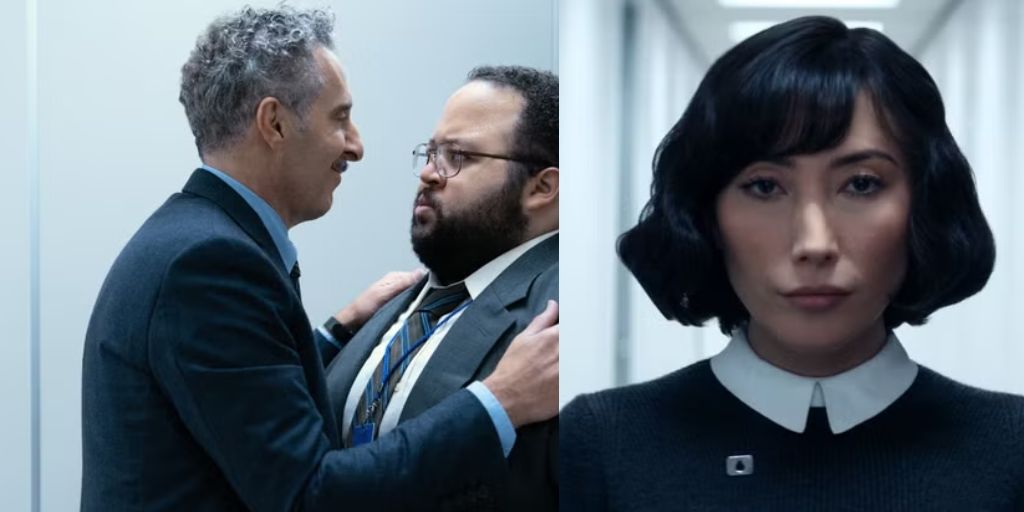
To support this claim, Burt shows Dylan and Irving a painting called “The Macrodata Refinement Calamity,” which illustrates MDR employees viciously attacking O&D personnel.
Still from Severance (Credit: Apple TV)
Even more bizarre, O&D employees have heard unsettling rumors about MDR workers. They believe that MDR employees have kangaroo-like pouches where they carry aggressive larval offspring. These legends portray MDR workers as dangerous beings who cannot be trusted.
What Does This Urban Legend Reveal About Lumon?
Lorne’s “pouchless” comment directly refers to this urban legend. Mark and Helly, unaware of this strange rumor, do not understand the significance of what the goat keepers say. They do not realize that Lumon employees have been fed different versions of history to keep them isolated from one another.
This detail reveals an important aspect of Lumon’s strategy. The company does not want its workers to unite or trust one another. By spreading misinformation, Lumon keeps employees separated, preventing them from forming alliances.
The rumor about MDR having pouches is a specific example of this tactic. It is designed to make other departments fear them. Interestingly, the same legend does not seem to exist outside of MDR. The idea of an O&D rebellion is only believed by MDR employees, while the pouch rumor exists only outside MDR.
Another crucial element to consider is MDR’s work. The department handles highly sensitive information, but its employees do not understand the full significance of their tasks.
Lumon likely wants to keep them isolated to ensure secrecy. The company’s efforts to control them make even more sense since MDR employees later rebel by sending their “outies” into the outside world.
This raises a major question: Could there be some truth to the “Macrodata Refinement Calamity”? Did a major conflict actually take place at some point? If so, is Lumon manipulating the story to make itself look like the hero? The company has a history of rewriting events, so it is possible that the so-called rebellion happened differently than either MDR or O&D believe.
At this point, there is no way to know for certain. However, one thing is clear: In the Severance universe, having or not having a pouch is not a meaningless joke. It symbolizes the deep-rooted manipulation and control that Lumon exercises over its employees.
Fans will have to keep watching to uncover more secrets behind Lumon’s twisted reality. New episodes of Severance Season 2 are released on Fridays on Apple TV+.

A sci‑fi psychological thriller set in a dystopian biotech office at Lumon Industries. Employees undergo a “severance” procedure that separates their work and personal memories, creating distinct “innies” and “outies.” Mark Scout, a severed worker in the Macrodata Refinement department, begins to uncover Lumon’s dark secrets and confront existential questions about identity and autonomy. Season 2 deepens the mystery with the innies awakening in their outie bodies and going through deeper conspiracies.
Apple TV+’s Severance has captured viewers with its unusual and complex characters. From Irving’s (John Turturro) warm yet goofy nature to Ms. Cobel’s (Patricia Arquette) piercing eyes, the show offers a mix of personalities that keep audiences engaged. At first, we believe the characters can’t get any stranger.
Then, we are introduced to Lorna, played by Gwendoline Christie in Mammalians Nurturable, who instantly assumes that Mark (Adam Scott) and Helly (Britt Lower) want to kill her just because they have arrived in her department.
Even with these eccentric figures, one character has left a lasting, unsettling effect on the audience throughout Severance’s second season: Natalie, played by Sydney Cole Alexander.
Season 1 gave us brief glimpses of Natalie, but as the show progresses into its second season, she has become a character who leaves a strong impression. In Episode 3, “Who is Alive?”, we see more of Natalie’s role, which adds a new layer to the show’s growing tension.
In this episode, Natalie delivers a “gift” from the mysterious Lumon Board to Milchick (Trammel Tillman). She also visits Devon’s (Jen Tullock) husband, Ricken (Michael Chernus), with a proposal for a new version of his book, The You You Are, aimed specifically at the “innies” in the system.
Natalie’s character is intriguing because she constantly faces a difficult relationship with the Board, which influences her every decision and action. She embodies both commitment and fear toward Lumon, making her an essential part of the series’ dramatic arc.
Sydney Cole Alexander’s Stunning Performance as Natalie
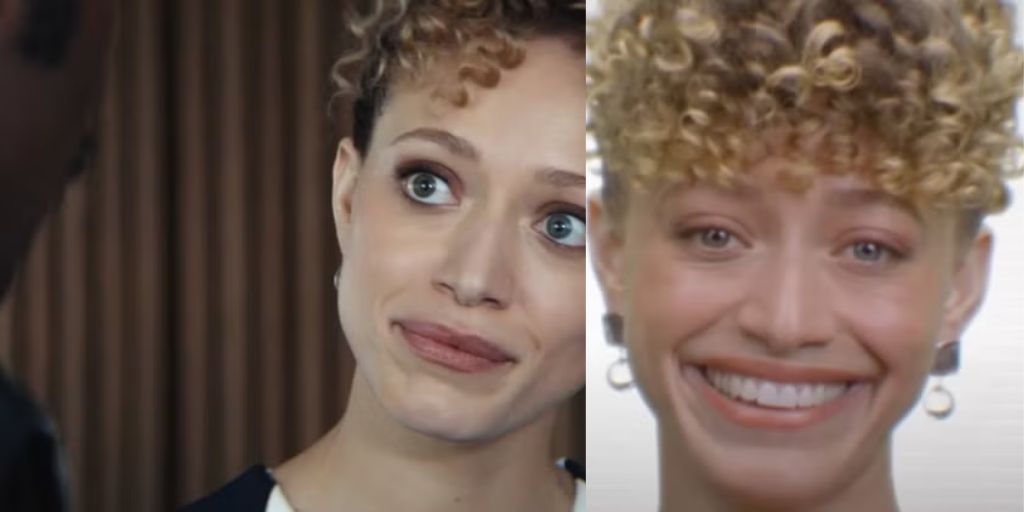
Sydney Cole Alexander’s portrayal of Natalie adds depth to the show. Her performance in Episode 3, where she interacts with Milchick and the blackface paintings from Lumon, stands out as one of her most powerful scenes. Initially, Natalie appears calm and unaffected by the Board’s “gift.”
However, her repeated blinking and strained smile suggest she may be acknowledging the uncomfortable nature of the situation. This subtle shift in her demeanor reminds us of Betty Gabriel’s performance in Get Out, where a character’s mask slips momentarily, revealing their true discomfort.
The tension between Natalie and Milchick in this scene is palpable, as they silently communicate that they are both aware the Board is always watching and listening, creating an atmosphere of constant surveillance and fear.
Natalie’s character helps to reinforce the show’s central theme: the overwhelming control that Lumon exerts over its workers. Through her, we see the fear that permeates even the most seemingly obedient employees. Despite being the closest person to the Board, Natalie remains deeply afraid of them.
This dynamic of fear, despite being in a position of relative power, is a powerful commentary on the system’s ability to control its workers without ever needing to use physical or verbal abuse. Instead, Lumon uses the threat of psychological manipulation and surveillance to maintain power, a tactic that is more terrifying because it is so subtle.
The fear that Natalie experiences, despite her role in the company, suggests that no one, no matter their position, is free from Lumon’s grasp. If only the “innies” are sent to the Break Room, one can only imagine what Natalie may have faced in the past as part of the Board’s operations.
Natalie’s Inner Conflict: The Heart of Her Struggle
While every character in Severance deals with a unique internal conflict, Natalie’s struggle seems to be the most complex. Her position requires her to carry the weight of both her loyalty to the Board and the deep fear she feels toward it. She is trapped in an emotional limbo, constantly balancing her duty and her dread.
This internal conflict is something the audience can feel in every scene she appears in. Her expressions, body language, and even her dialogues hint at the constant turmoil within her. In many ways, Natalie’s experience reflects the struggles of individuals in real-life systems of control, where people know what is happening is wrong but feel powerless to change it.
This emotional tug-of-war is similar to a statement made by Milchick in the first episode of Season 2. He shares that as a non-severed person, he must live with the guilt of knowing the harm he has done to others.
This line captures the moral tension that runs through Severance and reflects the broader question of how much individuals can be held accountable for their actions when they are part of an oppressive system.
Natalie’s internal struggle mirrors this very question: she may know that the work she does for Lumon is morally wrong, but she is stuck in a system that gives her no agency to resist.
The sense of powerlessness she feels is something that many people in real life can relate to, especially when faced with larger societal or organizational forces that feel impossible to fight.
Her constant wavering between stoicism and potential breakdowns shows just how much she is affected by the system. It mirrors how many people in our world experience similar struggles, caught between ignoring the injustices they see in order to get by, or breaking down under the weight of the truth. The emotional complexity that Natalie carries within her makes her one of the most fascinating and tragic characters on Severance.
A Shift in Perception: From Villain to Tragic Figure
When Natalie first appeared in Season 1, she was largely seen as an unlikable character. She came across as a devoted follower of Kier, deeply embedded in the company’s strange and oppressive culture.
Still from Severance (Credit: Apple TV)
Her actions and attitudes made her seem like just another cog in the machine, a character to be despised for her loyalty to the Board. However, as Season 2 progresses, this perception of her has shifted dramatically.
Through Sydney Cole Alexander’s nuanced performance, Natalie is revealed to be a far more complex figure. While she still works for Lumon, it is clear that she understands the wrongness of what she is asked to do. Her struggles with the Board show that she is not simply a mindless follower; she is a person trapped in a difficult position.
The contrast between her apparent loyalty to Lumon and her growing awareness of the system’s evils makes her one of the most sympathetic characters in the series. Natalie may be one of the most tortured souls at Lumon, caught in a moral conflict that leaves her stuck in a constant state of fear and powerlessness.
As the series moves forward, it will be interesting to see how Natalie’s character develops and whether she will find a way to break free from the system that controls her.
For now, she remains a tragic figure whose inner conflict highlights the show’s larger theme: the dehumanizing effects of a corporate system that values efficiency over individual well-being.
A sci‑fi psychological thriller set in a dystopian biotech office at Lumon Industries. Employees undergo a “severance” procedure that separates their work and personal memories, creating distinct “innies” and “outies.” Mark Scout, a severed worker in the Macrodata Refinement department, begins to uncover Lumon’s dark secrets and confront existential questions about identity and autonomy. Season 2 deepens the mystery with the innies awakening in their outie bodies and going through deeper conspiracies.
