By the end of the series, viewers are likely to find themselves questioning how they arrived at such an emotionally charged state, making it clear that the past can indeed come back to haunt those who least expect it.
The most striking aspect of Cuarón’s series, aside from its stunning visuals, is the masterful way he tells the story. Cuarón weaves together three well-crafted storylines—two set in the present and one in the past—with a level of precision that sharpens the tension and intrigue with each episode.
The series begins with Cate Blanchett’s character, Catherine Ravenscroft, at the pinnacle of her journalism career. She is being honored at a lavish ceremony, celebrating her success in uncovering hidden truths and exposing the exploitative behaviors of powerful individuals.
Catherine is not alone on this journey; she is accompanied by her supportive husband, Robert, played by Sacha Baron Cohen. Initially, Robert appears to be a loving partner, yet he often seems more like an accessory to Catherine’s opulent lifestyle than a strong presence in their relationship.
He indulges in fine wines and engages in discussions about their flavors, often while Catherine seems indifferent to his musings. His reassurances that she is a good mother to their son, Nicholas (played by Kodi Smit-McPhee), who displays a disinterested demeanor, further illustrates the disconnect in their family life.
Catherine’s seemingly perfect world is shattered when she receives a book in the mail that eerily reflects a traumatic event from her past, an event she thought she had successfully buried.
The arrival of this book acts as a catalyst, forcing Catherine to confront the haunting memories she has tried to suppress. The narrative’s complexity deepens as we witness how this revelation not only affects Catherine but also ripples through the lives of those around her.
Cuarón effectively portrays the Ravenscroft family’s wealth and privilege, emphasizing the stark contrast between their glamorous lifestyle and the heartbreaking parallel story involving Stephen (played by Kevin Kline).
Stephen is at his lowest point, drowning in grief and suffering after the loss of his wife and son. His son, Jonathan (played by Louis Partridge), died twenty years ago, leaving Stephen with a singular purpose: to seek revenge against Catherine, whom he believes is responsible for Jonathan’s tragic death.

Still from Disclaimer (Credit: Apple TV)
The events that transpired between Jonathan and Catherine in Italy years ago are gradually revealed through the book. This book serves as a tool for Stephen, as he hopes to not only inflict shame and humiliation upon Catherine but also to destroy the happy life she has built, a life he feels he was unjustly robbed of due to that fateful Italian getaway.
Cuarón’s storytelling effectively invites the viewer to go into the emotional turmoil of each character, creating a narrative that is as compelling as it is complex.
Flashbacks and narrations play a critical role in Cuarón’s narrative style, transforming what could be seen as narrative crutches into powerful storytelling devices. The storyline set in the past, detailing Jonathan’s adventurous life in Europe with his girlfriend, provides vital context.
It presents a young man filled with curiosity and a desire for life. Jonathan’s character is depicted as carefree, embodying a “nothing-can-stop-me” mindset typical of youth. He is portrayed as innocent yet easily manipulated by a young Catherine (expertly portrayed by Leila George), who uses her charm and beauty to influence him.
These flashbacks serve to shape how viewers perceive present-day Catherine. They cast a shadow over her attempts to connect with her son, Nicholas, making her efforts seem inadequate and desperate.
As she tries to rid herself of any copies of the book and frantically questions Nicholas about the woman in the story—who she suspects is her own younger self—the audience witnesses her growing panic and fear of losing the carefully crafted reputation she has worked so hard to build.
Narration provides a raw view into the characters’ thoughts and emotions, revealing their vulnerabilities and insecurities. For instance, while Robert appears to be a supportive husband, the narration unveils his inner struggles with feelings of inadequacy and fragility.
This internal conflict connects to a larger theme of the show: society’s tendency to judge others without considering the complex factors that shape their behavior. In a fast-paced world, it is easy to take people at face value without going into their deeper struggles.
By the end of the series, viewers may find themselves reflecting on their judgments of others, as well as their own motivations and actions.
His character’s journey is softened by the poignant detail that he wears his deceased wife’s favorite sweater, a symbol of his unresolved grief. Stephen becomes increasingly difficult to sympathize with as he continues down his vengeful path, but Kline’s portrayal of a man in denial adds layers to the character.
Manville’s character grapples with her own grief, exhibiting unchecked rage that threatens those around her, including her husband. The rawness of her emotional state adds another layer to the family dynamics, illustrating how grief can manifest in destructive ways.
Kodi Smit-McPhee’s character, Nicholas, appears underused for much of the series, often displaying a nonchalant attitude toward his mother’s attempts to connect with him. He seems to crave an emotional bond but consistently pushes her away.
Initially, Nicholas may come off as a typical teenager dismissing his mother, but as the series progresses, especially in Episode 5, Smit-McPhee delivers a performance that showcases his character’s emotional depth. This pivotal episode allows him to break free from his character’s confines, making his previously stifled role all the more powerful.

Still from Disclaimer (Credit: Apple TV)
Sacha Baron Cohen delivers a remarkable performance, capturing the nuances of a man whose character is defined more by his weaknesses than his strengths.
His interactions with Blanchett are particularly attractive, but it is in the quieter moments—when Robert is left alone with his racing thoughts—where Cohen’s performance truly shines. The audience is drawn into Robert’s internal struggles, which are conveyed through his subtle gestures and expressions rather than through dialogue.
Blanchett, as expected from a two-time Oscar winner, is fully immersed in her character’s complexities. Her performance becomes increasingly powerful as the walls close in around her, highlighting the emotional strain she experiences.
However, it is Leila George who truly shines in this ensemble cast. Tasked with portraying a younger version of Catherine, George captures Blanchett’s mannerisms and speech patterns while adding her own unique flair to the character. She embodies a seductive confidence that contrasts sharply with the more vulnerable Catherine of the present.
In her first encounter with Jonathan at a hotel bar, it becomes clear that George’s portrayal of Catherine is not just about charm; it reflects a deep-seated need for control. Her ability to manipulate situations and people is evident, and it raises questions about the ethics of her actions.
George’s performance reveals a woman who revels in her power over others, particularly in her interactions with Jonathan, where her intent is as much about seduction as it is about dominance.
As the series progresses, it becomes increasingly difficult to accept that loved ones can be at fault. Just when viewers think they have a solid grasp on the plot and characters, new revelations turn everything upside down.
The latter half of the series is particularly filled with twists and misdirections, though it would be unfair to reveal too much. While some might argue that certain plot points are easily resolved and key details are held back for too long, the strengths of the story far outweigh any weaknesses.
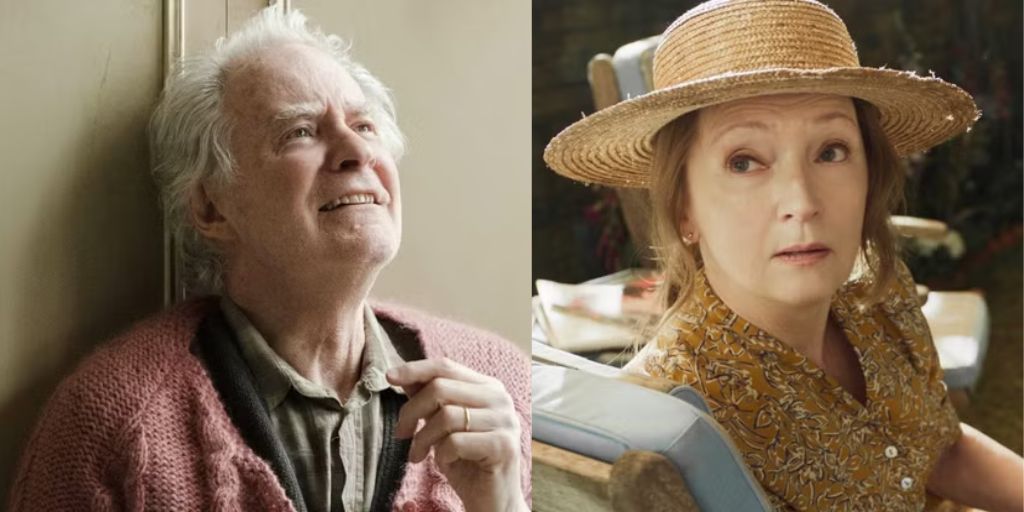
Still from Disclaimer (Credit: Apple TV)
In a galaxy with thousands of planets, a good spaceship is necessary in Star Wars. Space travel happens every day in this universe, and ships work like cars do in real life. Ships travel between planets and solar systems.
Each ship has a unique purpose, whether for carrying cargo, engaging in dogfights, or flying fast. However, none is more iconic than the Millennium Falcon.
This legendary ship is most known as Han Solo’s ship from the original trilogy but has appeared in many other movies and shows. Even though the Millennium Falcon is the most recognizable ship in Star Wars, it has flaws. Many details about the ship do not make sense, whether due to inconsistent functions or flawed logic.
The ten entries below look at details and functions about the ship that do not quite add up. While these flaws do not take away from the series’ quality, they make fans raise their eyebrows in disbelief.
Why is the Millennium Falcon the Only Ship of Its Kind?: For a standard ship, it is strange that there aren’t any more.
Even though it is called a piece of junk, the Millennium Falcon is one of a kind. Star Wars has many iconic spaceships, but many are mass-produced, and fans see them in different places. Some ships also only have one appearance, so the Millennium Falcon is not the only unique ship in the galaxy.
Its unique design is a staple of Star Wars. It is likely the real reason why there are no more ships like it. George Lucas wanted this ship to be more recognizable and special. However, while this makes sense from an outside view, it does not make sense in the Star Wars universe.
The ship is supposed to be a common freight carrier, so there should be more of them. The many exploits of the Millennium Falcon should have shown the Rebellion, bounty hunters, and the Empire that this ship is impressive. It does not make sense why fans have not seen a second Millennium Falcon with its amazing feats and original purpose.
Blaster Cannon on the Underside: This helpful feature is one-and-done.
In Star Wars Episode V: The Empire Strikes Back, a blaster pops out from the bottom of the Millennium Falcon to take down a group of snowtroopers chasing them. This blaster is an Ax-108 “Ground Buzzer,” a powerful cannon in Star Wars that works with its own power source. The cannon has different modes, such as armor-piercing and stun, making it a valuable weapon.
After it takes down a group of snowtroopers, fans would think this blaster would be useful in other scenes. They would be wrong. The Ground Buzzer never appeared before The Empire Strikes Back and does not show up after.
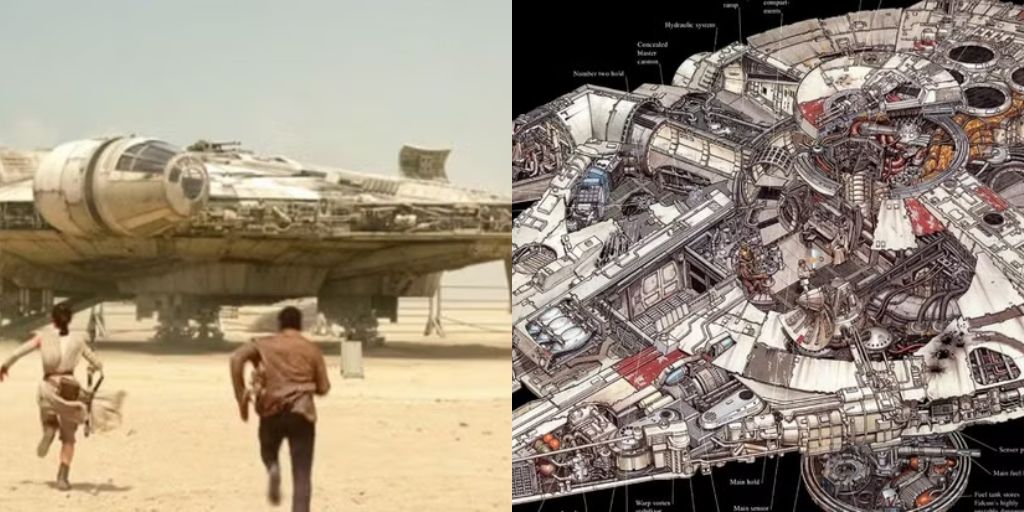
Still from Star Wars (Credit: Disney+)
There are many more times when this blaster would have been handy, so fans wonder why it was not a more prominent weapon in the many battles the Falcon fought in afterward.
The Radar Dish: No other spaceships have one of these.
The Radar Dish, known as a Rectenna, looks like a cherry on top of an ice cream sundae and completes the Millennium Falcon’s design. Beyond its nice look, a Rectenna’s purpose is to detect and target hostile threats, helping in combat. In Star Wars Episode VI: Return of the Jedi, the Rectenna breaks off after Lando uses the ship in the Battle of Endor.
While Solo has replaced the Rectenna many times after Lando broke it, it has never proven useful. When it is torn off, Lando and Nien Nunb can easily maneuver the ship and target enemies.
This makes fans think the dish does not actually have any function. Additionally, few other spaceships have a Rectenna, making its presence confusing and ultimately nonsensical.
The Mandibles: A useful feature that isn’t used.
If one were to ask what the most iconic detail about the Millennium Falcon is, many would say either the cockpit or the front mandibles. The front mandibles stand out and make the ship’s design unique. They originally served an important purpose by holding the ship’s cargo. However, in the original trilogy, Lando carries an escape pod or mini ship there.
While the Millennium Falcon does not need to carry cargo, it is strange that Han never added a replacement escape pod or ship. A small ship could fit between the mandibles, providing a quick escape if the crew ever gets into trouble. With such a useful feature, it is odd that Han never used it. This is likely because it adds to the ship’s iconic design.
The Millennium Collective: Never explained properly.
The Millennium Collective first appears in The Empire Strikes Back and is shown in Solo: A Star Wars Story. It is the central computer of the Millennium Falcon and consists of three droid brains: L3-37, V5-T, and ED-4. These three droid brains act as one identity until L3-37 helps each droid gain its own individuality.
The Millennium Collective does not make sense because no one has fully explained what it is, what it does, or how it can exist.
Fans think the droid brains work as the ship’s central computer, which helps with navigation and tracking, since each one has a specific purpose. However, this is the only instance fans have heard of something like this, leaving them with more questions than answers.
Gun Turrets: An inconsistent plot hole.
The Millennium Falcon has been part of some of the greatest battles in Star Wars history, mainly because of the two AG-2G laser cannons on the top and bottom of the ship.
Watching Han and Luke use these giant objects to blast enemy TIE fighters is always exciting. However, when fans think about it, they notice some problems with the gun turrets.
The first odd thing about the turrets is that fans can see Han and Luke moving the gun with limited range. But when shown from outside, it has a full 360-degree range of motion. Another confusing detail is the gravity inside. The top and bottom turrets are mirrors of each other, meaning one person would be upside down.
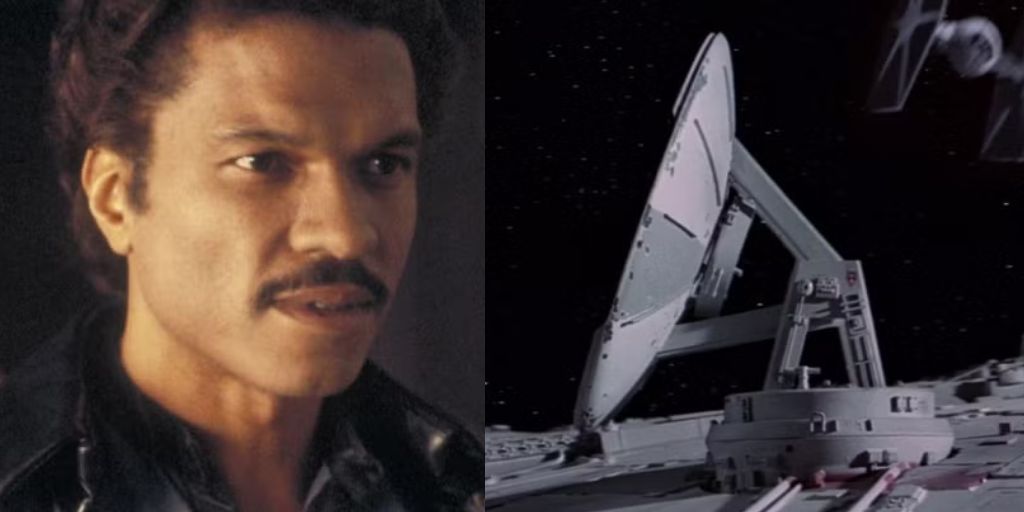
Still from Star Wars (Credit: Disney+)
However, that is not the case, as Han and Luke sit upright. Internal gravity within the ship can explain this, but it only raises more questions. The truth is that the production design creates these inconsistencies, leaving no satisfactory explanation within the story.
The Cockpit is on the Side of the Ship: A major design oversight.
The two most iconic parts of the Millennium Falcon’s design are the mandibles and the cockpit. The cockpit is unique compared to other spaceships and helps the ship stand out, making the Falcon one of the best rebel ships in Star Wars.
Unlike many spaceships, where the cockpit is front and center, the Millennium Falcon has its cockpit on the top right, resembling a sidecar on a motorcycle.
Unlike other confusing parts of the Millennium Falcon, this design actually has an explanation. The ship’s original design carries the cargo in the front, so the outrigger cockpit helps the pilot see better. While this is an explanation, it raises more questions.
Why would a spaceship ever carry cargo in front instead of behind? This makes the ship less maneuverable and hinders the pilot’s sight.
Buttons: Not a very user-friendly design.
Star Wars has many great sounds, from seismic charges to the screeching of TIE fighters. However, buttons provide constant satisfaction whenever someone presses them in movies or real life. It shows how many buttons there are on a spaceship, especially the Millennium Falcon.
When looking at the legendary ship’s cockpit, fans can see many buttons on the dashboard and wall behind them. While fans are meant to suspend their disbelief in this sci-fi world, it is hard to believe that a spaceship needs that many buttons.
Not to mention, there are no labels on the buttons, so it is impossible for anyone to know what to press or what each one does. The buttons are placed randomly, making it seem like they are just there to make the ship look cooler in the sci-fi context; ironically, this has the opposite effect.
The Layout: A confusing and jumbled mess.
Star Wars has many unique and wonderful spaceship designs. However, fans rarely see what they look like inside and only get glimpses of different parts of the ship. While fans should not expect Star Wars to have expertly crafted designs and blueprints, they do expect a clear and logical layout. The Millennium Falcon does not meet these expectations.
The main confusion comes from how the Millennium Falcon looks outside compared to the inside. The ship feels larger on the inside, with areas not matching the layout.
Many areas seem to be in the wrong spot or are too large or small. The Millennium Falcon has an inconsistent layout that does not stay the same across movies, and its dimensions do not add up. With so many design changes, fans wonder if a different design would have made things better or worse.
The Millennium Falcon is Supposedly a Piece of Junk: This is one of the best ships in Star Wars
Star Wars Episode IV: A New Hope introduces the Millennium Falcon as a hunk of junk. Star Wars Episode VII: The Force Awakens reinforces this by referring to it as junk again.
Fans know that the iconic ship was made to be a freighter carrying cargo, which explains why characters call it junk. However, with one of the most amazing Star Wars characters piloting the spaceship, it proves to be anything but junk.
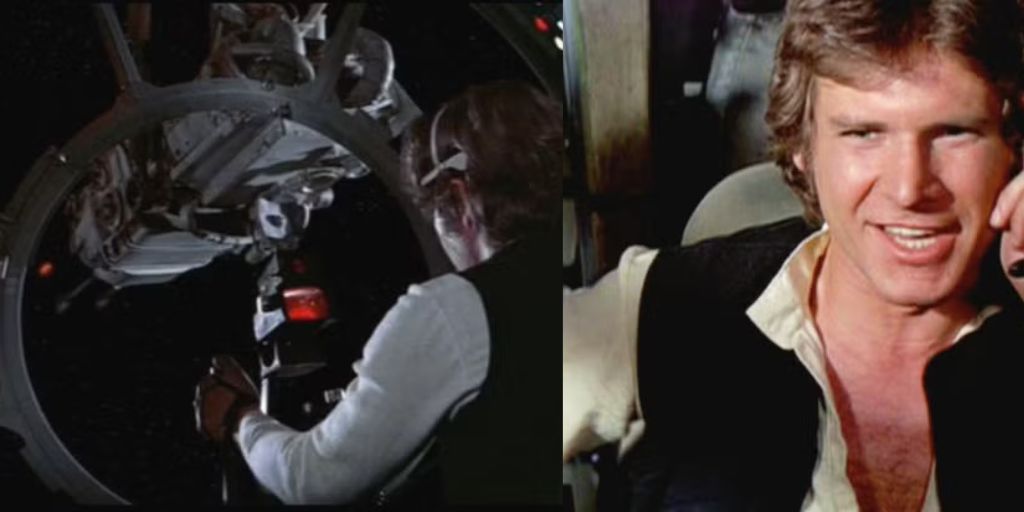
Still from Star Wars (Credit: Disney+)
While this is not exactly a detail, it relates to the aspects of the entire ship. It is one of the greatest mysteries of Star Wars why the Millennium Falcon is called a hunk of junk. Almost every character refers to the iconic ship as such, but fans see the heroic and unbelievable things it does time and time again.
From its powerful weapons and incredible maneuverability to its strong defense and unmatched speed, the Millennium Falcon is one of the best spaceships in Star Wars. It does not make sense why everyone keeps calling it junk; it feels like forced humility at best and cheap writing at worst.
All of Star Wars is available to watch on Disney+ in the U.S.
