The live-action Snow White offers a modern twist on the beloved 1937 animated classic, retaining many elements while expanding upon key themes. This reinterpretation showcases a fresh approach, with a deeper focus on Snow White’s journey and her growth as a leader. The ending, in particular, introduces notable differences, especially regarding Snow White’s rise to power and her role in the kingdom, compared to the original story. Let’s look into how the new ending reinvents the classic narrative.
Snow White Ending Explained
In this live-action remake, Snow White doesn’t just survive the Evil Queen’s wrath—she rises to become a strong and beloved ruler. While the poisoned apple incident mirrors the original, Snow White’s path afterward is far more empowering. After she is awakened by her true love’s kiss, Snow White doesn’t just return to the castle; she takes charge. In a dramatic public confrontation, she faces the Evil Queen, ultimately claiming her position as the queen of the land. This conclusion highlights Snow White’s leadership qualities and her connection with the people, who rally around her as a fair and just ruler.

Snow White cast (Image via Getty)
The demise of the Evil Queen has undergone significant changes. In the original film, the Queen dies in a climactic fall after attempting to ambush the dwarfs. However, the live-action version introduces a more dramatic and magical death. When Snow White confronts the Queen, she shatters the enchanted mirror, causing the Queen to crumble into ash. This death, however, hints at a deeper magical world. As the Queen’s ashes are absorbed into the mirror, the audience glimpses a dark void behind the glass—a mysterious, otherworldly space that briefly opens before being sealed again. This unsettling moment suggests that the Queen’s death may not mark the end of her magical influence, adding an eerie layer to the narrative.
A Bigger Role for Snow White in the Climax
The live-action Snow White departs from the animated classic by shifting the agency in the final act. In the original, Snow White is passive during the climax, only awakened by the Prince’s kiss. In this updated version, Snow White actively confronts the Evil Queen and plays a critical role in her downfall. The Evil Queen doesn’t fall to her death through an accidental mishap; instead, Snow White’s courage and resolve lead to the Queen’s demise. This reimagining emphasizes Snow White’s growth throughout the film, giving her a more active role in her own fate and the fate of her kingdom.
In both versions of the tale, Snow White’s beauty is central to the Queen’s jealousy, but in the live-action remake, the meaning of “fairest in the land” expands beyond physical appearance. While the Evil Queen’s obsession with beauty remains a driving force in her actions, the film also explores the notion of fairness in terms of character and leadership. Snow White’s parents taught her to be a fair and compassionate ruler, qualities that endear her to the people and help her unite the kingdom. By the end of the film, the phrase “fairest in the land” refers not just to Snow White’s external beauty but to her inner qualities as a leader, making her a more complex and admirable protagonist.
The Dwarfs’ Role and Growth
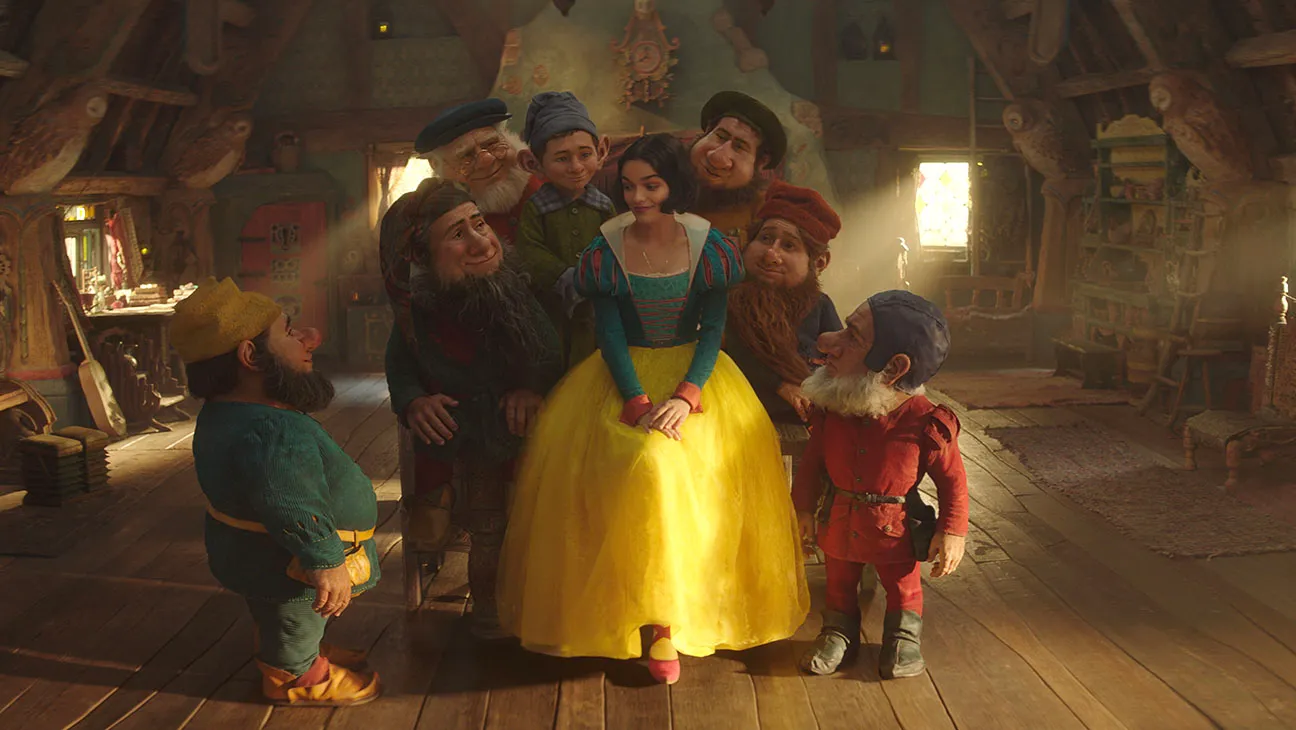
Snow White cast (Image via Getty)
While the dwarfs are secondary characters, the film ensures they aren’t mere comic relief. The dwarfs, who are magical creatures living in isolation, gradually become an integral part of Snow White’s story. They transition from being distant figures to active participants in the kingdom’s future. In a pivotal moment, Dopey speaks for the first time, showing his support for Snow White and her quest to overthrow the Queen. Furthermore, Dopey’s arc is expanded when it’s revealed that he has been narrating the story all along, adding a layer of depth to his character. By the end of the film, the dwarfs join the kingdom, signifying their reintegration into society.
A key theme in this live-action version of Snow White is the idea of “fairness” in leadership. Snow White’s empathy, compassion, and commitment to justice make her an ideal ruler. Unlike the Evil Queen, who rules through fear and vanity, Snow White’s kindness unites the kingdom and earns the trust of her subjects. This contrasts with the Queen’s cold, calculating nature, highlighting Snow White’s strength as a leader not through physical prowess, but through her ability to inspire and unite others. Her growth into a fair ruler is not just a personal victory but a victory for the people she governs.
A Satisfying Conclusion with a Bright Future
The film concludes with a hopeful, celebratory note. Snow White’s rise to power and her eventual triumph over the Evil Queen represent the restoration of peace and fairness to the kingdom. The dwarfs, once isolated, now celebrate alongside Snow White and her people, solidifying their place in the community. The final musical number, reminiscent of the joyful tune from the beginning, echoes the film’s theme of unity and prosperity. Snow White’s kingdom is set on a path of healing, and the characters are finally free from the shadow of the Evil Queen.
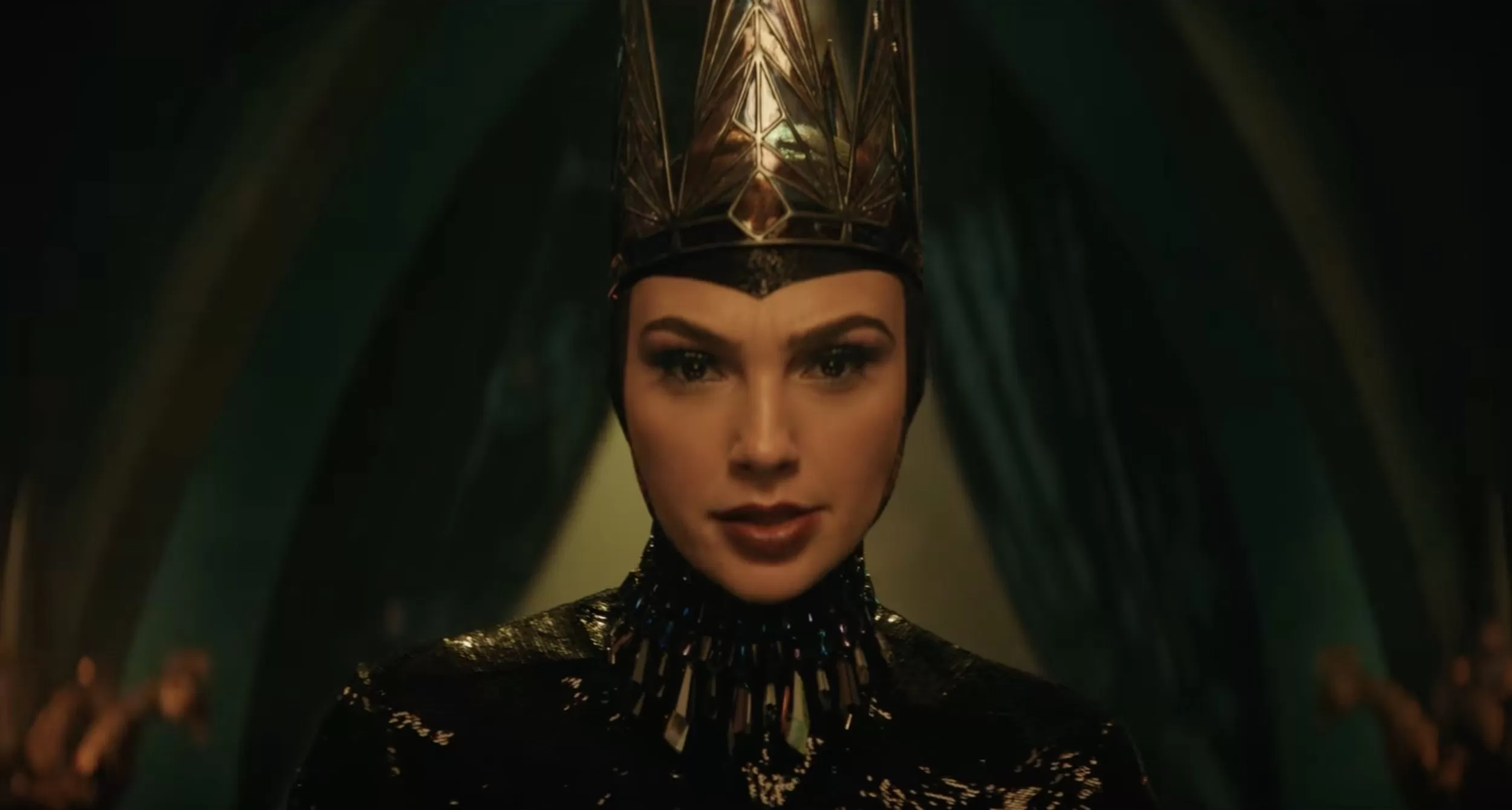
Snow White cast (Image via Getty)
While the film provides a satisfying conclusion to Snow White’s journey, it does leave room for future stories. The movie hints at a rival kingdom to the south, potentially setting up a new conflict for Snow White as she assumes the role of ruler. Additionally, the mysterious magic behind the Queen’s mirror could be further explored, offering a look into a larger magical world. These elements suggest that there is more to discover in Snow White’s universe, although the film itself does not end on a cliffhanger. The conclusion is definitive, with Snow White firmly established as a compassionate ruler.
The Deeper Message of Snow White’s Live-Action Remake
At its core, the live-action Snow White emphasizes the importance of empathy and fairness in leadership. Snow White’s journey is not just about defeating an evil ruler but about proving that true strength lies in kindness and understanding. Her ability to unite people through compassion makes her a more effective leader than the power-hungry Evil Queen. This message is central to the film’s themes, as it suggests that a ruler’s worth is not determined by their beauty or magical abilities, but by their ability to care for others and create a fair society.
The 2025 science fiction horror film Ash , directed by Flying Lotus, combines space thriller elements with a deep psychological unraveling. Starring Eiza González as Riya, the movie explores themes of survival, alien encounters, and the manipulation of the human mind. What begins as a slow-burn thriller evolves into a terrifying journey of horror and violence as Riya tries to piece together the truth about the horrific events that transpired in a derelict space station.
Ash Ending Explained
Ash opens with a chilling scene. Riya wakes up in a space station, disoriented and bleeding, with no recollection of her identity or the events that led to her condition. The space station is eerily empty, and as Riya ventures further, she discovers her crewmates lying dead in pools of blood. Desperate to understand what happened, she meets Brion (played by Aaron Paul), who claims to be the sole survivor of the team.
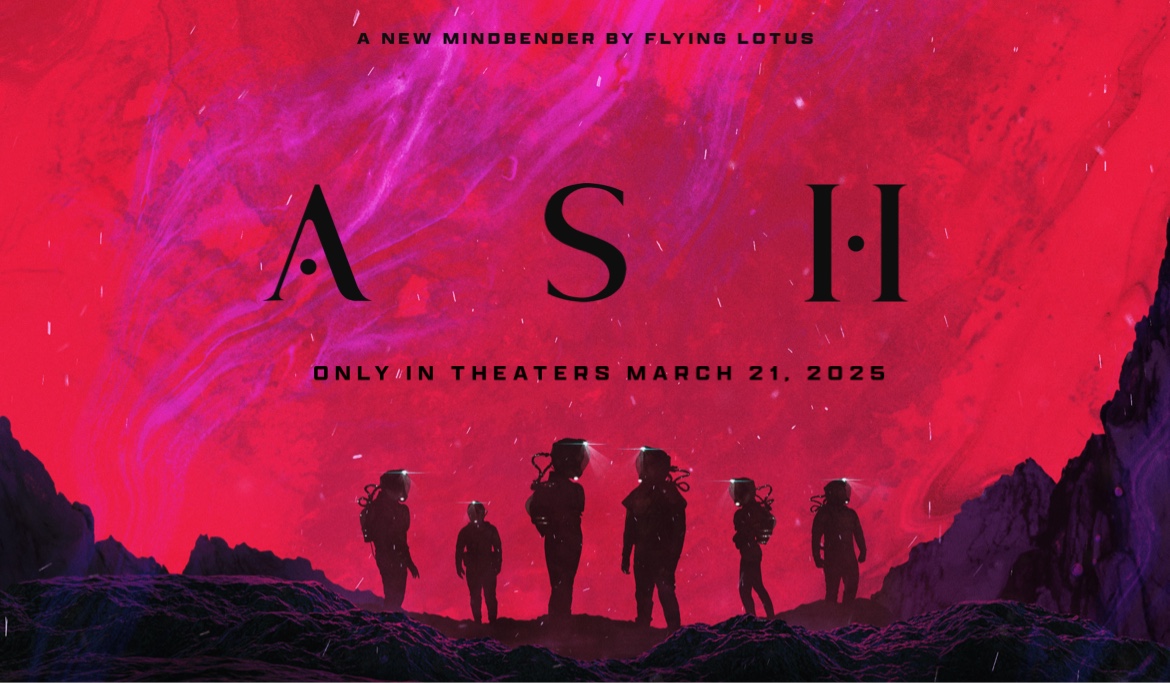
Ash (Image via Getty)
As Riya’s memory starts to return, disturbing flashes of violence and horror flood her consciousness. She soon realizes that she was the one responsible for the deaths of her colleagues. A terrifying race against time ensues as Riya and Brion clash over how to survive the rapidly deteriorating space station, which is running out of oxygen. With her memory returning in fragmented pieces, Riya learns the crew encountered an alien life form, which they unknowingly brought back to the station.
The Alien Parasite: Manipulation and Deception
Throughout the movie, viewers are misled by Brion, who seems to be a trustworthy ally, but his true nature is soon revealed. In actuality, Brion is not a living human but a manifestation of an alien parasite that has taken control of Riya’s mind. This parasite, a highly intelligent organism, originates from Ash, the planet where Riya and her crew were conducting experiments to test the viability of the planet for human habitation.
The parasite used its parasitic abilities to infiltrate Riya’s mind, distorting her memories and interactions. Every time Riya applied medical patches to stabilize her condition, she unknowingly prevented herself from recalling the horrific truth. Brion’s persistent encouragement to escape the planet and his manipulative actions were all part of the parasite’s plan, pushing Riya toward survival so that it could spread to humanity.
The alien parasite itself is designed to resemble a liquid metallic insect, capable of shifting its form to seamlessly integrate into a host. Its appearance is a blend of organic and metallic properties, much like the alien in Invasion of the Body Snatchers and the creatures from Terminator 2: Judgment Day . Its primary goal is not just survival but the expansion of its species.
The parasite is part of a larger hive mind that is determined to prevent humanity from overtaking Ash. Viewing human biology as flawed and self-destructive, the parasite seeks to assimilate humanity by infecting individuals like Riya, enabling it to spread beyond the planet. To achieve this, the parasite jumps from one host to another, ultimately making Riya its primary vessel after the rest of the crew is killed.
The Length of Riya’s Infection
Riya’s encounter with the parasite lasts several days. The creature infiltrates her body after a violent encounter with her crew, using an injury over her eye to gain access to her brain. For at least two days, including the time she spent unconscious, the parasite manipulated her thoughts and memories. The real Brion had died before Riya regained consciousness, and the figure she interacts with throughout the film is merely a projection of the alien’s influence.

Ash cast (Image via Getty)
Confronting the Parasite: The Final Showdown
Realizing the parasite has taken over her mind, Riya decides to eliminate it, resorting to a medical device to surgically extract the alien. However, her efforts are thwarted when the parasite finds a new host: the corpse of the real Brion. The creature reanimates his body and bursts out in a grotesque, monstrous form, reminiscent of The Thing .
In a tense and terrifying sequence, Riya fights to survive, using a flamethrower to burn the creature. The flames seem to defeat the parasite, but the film leaves a lingering sense of uncertainty. The mid-credits scene hints that the creature may have survived, having stowed away aboard the ship Riya uses to escape to an orbiting space station.
The Fate of the Crew: Riya’s Role in Their Deaths
As Riya’s memories come flooding back, the true extent of the tragedy is revealed. The deaths of the crew members were not accidental; they were all killed by the parasite, which used each crew member as a host to turn against their colleagues. Riya, in a desperate fight for survival, ended up killing several of her team members in self-defense.
Adhi and Kevin were the first victims, stabbed by Riya when it became clear they had been overtaken by the parasite. Davis met a violent end when a rock, thrown into the alien pit, was ejected with extreme force and crushed his skull. Clarke, whom Riya mistakenly thought was responsible for the deaths, was drowned in a violent encounter. Finally, Brion’s death occurred long before Riya even regained consciousness, with his body being bludgeoned by Kevin under the parasite’s influence.
Setting the Stage for a Potential Sequel
Despite the apparent conclusion of the film, the mid-credits scene opens the door for a possible sequel. While Riya believes she has destroyed the parasite, its organic remains are shown wrapped around the space station, suggesting that the creature may still be alive. The parasite may have found a new way to survive and could even be on its way to infecting more of humanity, potentially setting up future conflicts.

Ash cast (Image via Getty)
Given the film’s moderate box office reception, a sequel is uncertain. However, the unresolved tension and the ominous presence of the parasite ensure that the possibility remains.
The Deeper Themes of “Ash”
While Ash doesn’t delve deeply into complex metaphors, it focuses on humanity’s vulnerability in the face of an unknown and far superior force. It critiques the self-destructive tendencies of the human species while emphasizing the power of the human will to survive. The film’s haunting visuals, paired with Flying Lotus’ unsettling score, create an intense atmosphere that makes the movie stand out in the crowded sci-fi horror genre.
Ultimately, Ash is an exploration of humanity’s fragility when faced with an alien intelligence that seeks to destroy or assimilate us. It serves as both a thrilling ride through deep space and a reflection on our survival instincts in the face of existential threats.
