The latest Solo Leveling: Arise webtoon release takes fans deeper into the world of Hunter: Origin, spotlighting Esil Radiru, a demonic love interest of Sung Jinwoo. Known for her brief yet unforgettable role in the original manhwa, Esil’s reappearance brings fresh emotional stakes and intriguing storylines to the series.
Netmarble’s newest update dives into Esil’s longing for Jinwoo, capturing her internal struggles and devotion. The two briefly reunite, prompting Esil to confront her feelings in a poignant exchange. Fans of the webtoon can now explore this emotional encounter, which enriches Esil’s character arc while setting the stage for her role in the anime’s upcoming season.

Solo Leveling: Ragnarok Still
As part of her comeback, Esil Radiru also takes the spotlight in Solo Leveling: Arise’s gameplay, armed with impressive abilities. Classified as a Fire-attribute Ranger, her swift attacks and ultimate skills embody the aristocratic demon she is. Voiced by Jad Saxton, a popular actor known for iconic roles like Chika Fujiwara in Kaguya-sama: Love is War, Esil’s fiery personality and unique combat style add excitement to the gaming experience.
In addition to the webtoon, Esil’s Hunter Analysis File on YouTube gives fans deeper insights into her abilities. Her ultimate attack, described as both devastating and elegant, further cements her as a fan-favorite addition to the game. As one of the few established characters to feature in Hunter: Origin, alongside Go Gunhee and Yoo Soohyun, Esil continues to audiences both in the game and the evolving story.
Anime enthusiasts can also anticipate Esil’s return in Solo Leveling Season 2, where her cameo in the opening credits teased her growing significance. As the English dub premieres this Saturday, Esil’s presence promises to bring added depth to the ongoing narrative.

Solo Leveling Arise (Credits: Netmarble)
Released in 2024 by Netmarble, Solo Leveling: Arise continues to expand its lore, blending emotional character moments with dynamic gameplay. The franchise’s unique leveling system and storyline ensure its place as a must-play gacha RPG. Esil Radiru’s comeback, with her fiery abilities and heartfelt narrative, exemplifies the series’ commitment to keeping fans engaged.
For those craving more, Esil’s webtoon and gameplay debut in Hunter: Origin is a must-see. As Solo Leveling: Arise, it’s clear the saga of Jinwoo and Esil is far from over.

Few films from 2024 have received as much praise, speculation, and analysis as The Brutalist, a 215-minute film directed by Brady Corbet. Set in the 20th century, the movie follows László Tóth (played by Adrien Brody), a brilliant architect and Holocaust survivor who immigrates to America.
The film shows his complex relationship with Harrison Lee Van Buren (played by Guy Pearce), a powerful industrialist, and how László’s past and art are manipulated by those around him.
László is eventually able to reunite with his wife, Erzsébet (Felicity Jones), and his niece, Zsófia (Raffey Cassidy), but he grows increasingly frustrated as he watches Harrison take control of his tragedy for his own gain. The movie ends with a shift in time, showing how the relationships in the story have changed.
The Structure and Epilogue
The movie is divided into two distinct parts, with an intermission between them. After the second act ends, the film presents an epilogue titled “The First Architecture Biennale.” The second act, named “The Hard Core of Beauty,” shows how László becomes more upset and disheartened after Harrison sexually assaults him.
In a panic, László tells Erzsébet about the assault while under the influence of heroin. In a moment of shock and anger, Erzsébet accuses Harrison of being a rapist in front of his family. This leads to a dramatic shift in their relationship.
The epilogue takes place in 1980 when László is honored with a retrospective of his architectural work in Venice. By this time, Erzsébet has passed away, and Zsófia is presenting the gala. She talks about László’s art and relates it to his experiences during the Holocaust, which he went through at the end of World War II. However, László is very old and physically immobile, unable to speak for himself.
Zsófia tries to honor her uncle by repeating a phrase he once told her: “No matter what the others try and sell you, it is the destination, not the journey.” She recalls this saying from when she was younger.
However, the phrase was something László said when he was justifying his work with Harrison, even though he felt uneasy about how his own suffering was being used for a larger purpose.
László had often been forced to suppress the painful memories of his past to please Harrison, and the idea of focusing only on the “destination” instead of the “journey” was a way to cope with this.
But the movie shows that the journey is just as important as the destination. In trying to build a new life in America for himself and his family, László went through years of emotional and physical abuse. The Brutalist does not suggest that making art will heal all wounds or make the suffering worthwhile.
Instead, the film shows that László’s work was constantly hijacked by others, including Harrison, who used his tragedy for his own benefit. This makes it very difficult for László to keep his art true to his own beliefs.
There is a deep irony in the way László’s work is now being presented in Venice. At the retrospective, someone else is speaking for him, denying him the chance to explain his art and his life. This is a powerful statement about how people’s suffering is often taken away from them by those in power, who rewrite the narrative to suit their own needs.
Harrison Lee Van Buren’s Role
The character of Harrison Lee Van Buren is crucial to the story, but his whereabouts are never confirmed after he is accused of assaulting László.
He disappears after this, leaving his fate unclear. It is suggested, however, that Van Buren could not understand a world in which he no longer had power over László. For much of the movie, Van Buren is shown as a man who is used to getting what he wants and controlling those around him.
Van Buren had tried to shut down the construction of a community center designed by László, after the project became too expensive and a train carrying materials was derailed. He also sexually assaulted László while they were in Carrara to obtain marble.
Even though Van Buren envisioned the center as a tribute to his late mother, he did not realize that László had created it as a tribute to Holocaust survivors. László even added a secret passage to the design, a hidden element that no one else knew about.
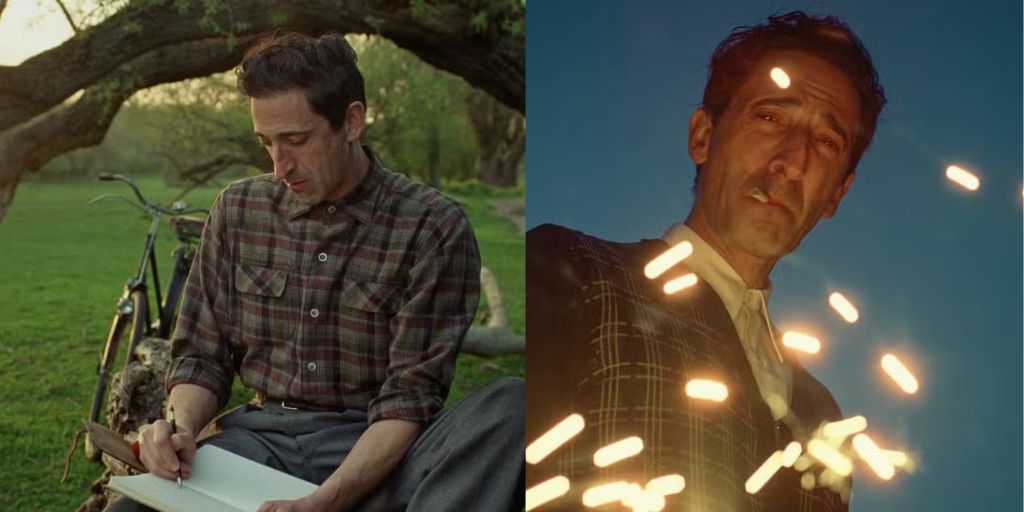
Still from The Brutalist (Credit: A24)
Perhaps, by the end of the movie, Van Buren recognizes that, despite all the pain he caused László, the community center will outlive both of them. Van Buren had made many crude remarks about Zsófia, which eventually caused her to leave America. But László stays behind, trying to make the most of his life despite everything he has endured.
The Critique of the “American Dream”
One of the central themes of The Brutalist is its criticism of the “American Dream.” It is unclear by the end of the film how László feels about his own legacy or how Zsófia has framed his life’s story. What is clear is that Zsófia and her husband eventually move to Jerusalem, even though László had wanted them to stay in America.
This decision suggests that Zsófia values her own independence and capitalistic success more than her uncle’s wishes. Her decision to restart her life in Israel could be seen as a betrayal of László, who has become fearful and powerless after years of torment at the hands of capitalism.
Zsófia’s belief that the destination is more important than the journey represents a misunderstanding of her uncle’s life. László’s journey was filled with suffering, and he was forced to endure a great deal of pain. Zsófia’s interpretation of his words shows how easy it is for people to misunderstand the experiences of others, especially when they come from different backgrounds.
In the final scene of the film, the song “One for You, One for Me” plays. The lyrics suggest that all artists are eventually rewarded with a personal project after years of sacrificing their own desires to please those in power. However, László is never able to achieve this “one for me.”
His work is always taken from him, first by Harrison, who abuses him, and later by Zsófia, who misinterprets his beliefs and life’s work. This shows that the pursuit of power and success in a capitalistic society never truly satisfies one’s deeper needs. László’s life is marked by loss and exploitation, and his artistic legacy is tainted by the forces that shaped it.
The Brutalist’s Message
Ultimately, The Brutalist shows that greatness does not equal justice. László will certainly be remembered for his architectural accomplishments, but his personal story and the pain he endured will not be fully understood. His true legacy, the deeper meaning behind his art, will be lost in the efforts of others to rewrite his history.
The film paints a dark picture of how power, abuse, and capitalism shape the lives of individuals, especially artists. László’s work, which could have been a meaningful tribute to his own experiences and the suffering of others, is instead hijacked by people who want to use it for their own purposes.
The film ends with a sense of unresolved tension, leaving the viewer to wonder whether László will ever be able to reclaim his narrative and find peace.
The Brutalist is a poignant and thought-provoking film that critiques how power and wealth can distort the truth. It tells the story of a man who, despite his immense talent and achievements, is forever shaped and hurt by the forces of capitalism and abuse. It challenges the notion that success in the world is a measure of justice, showing instead that true justice is often denied to those who suffer the most.
Summary
The Brutalist is a 2024 film directed by Brady Corbet, following the life of László Tóth (Adrien Brody), a brilliant architect and Holocaust survivor who immigrates to America. The story revolves around his complex relationship with Harrison Lee Van Buren (Guy Pearce), a powerful industrialist who exploits László’s past and uses his tragedy for personal gain.
László’s artistic integrity is compromised as he is forced to work for Harrison, and his suffering is overshadowed by those seeking to benefit from his pain. The film culminates in an epilogue set in 1980, where László, now elderly and immobile, is honored for his work at a retrospective in Venice.
His niece, Zsófia (Raffey Cassidy), presents the event but misinterprets his beliefs, quoting a phrase he once said to her that dismisses the importance of the journey. The movie critiques how capitalism distorts art, with László’s legacy hijacked by others, leaving him unable to speak for himself.
The Brutalist highlights the harsh realities of power, abuse, and exploitation, questioning whether greatness truly equals justice. Ultimately, the film portrays how László’s achievements are overshadowed by the manipulation of his art and personal tragedy.
