The sun rises over the wide Fijian sea, casting a warm glow on the calm waters. Waves gently roll onto the pristine white sandy beach, the sound of their movement harmonizing with the soft rustling of palm trees. The beauty of the view hides the immense hardships that are about to unfold.
Somewhere in the distance, the familiar voice of Jeff Probst rings out, signaling the return of a show that fans have eagerly been waiting for: Survivor.
This reality series, created by Charlie Parsons, brings together a group of strangers who must battle not only the harsh conditions of the island but also each other, all for the ultimate reward of $1,000,000.
Every season pushes the contestants to their limits, with each person striving to outlast and outplay the others to win the coveted title of “Sole Survivor.”
As this new season begins, excitement fills the air as all the contestants arrive on the same boat. They take this moment to size each other up, giving both the audience and fellow competitors a view into what makes them unique and potentially dangerous in the game.
Right from the start, the audience is introduced to a diverse range of cast members. Tiyana Hallums stands out as the first Native Hawaiian to compete on Survivor, bringing a sense of pride and representation to the game.
Jon Lovett, on the other hand, enters the competition armed with his experience as a co-host of the popular podcast Pod Save America. Each contestant brings their own unique background and personality to the game, creating a dynamic mix of competitors that promises a season filled with twists and turns.
The contestants gather on the beach for their first group chat with Jeff Probst, sharing their excitement and enthusiasm about the adventure ahead.
However, Probst doesn’t let the upbeat mood last long, as he quickly reminds everyone that the competition is fierce and the challenges they will face are intense. Before they know it, the first challenge is upon them. But before we go into the action, we get a closer look at the three tribal divisions for this season:
- Tuku (Blue Tribe): Caroline Vidmar, Kyle Ostwald, Gabe Ortis, Tiyana Hallums, Sue Smey, and Terran “TK” Foster
- Gata (Yellow Tribe): Andy Rueda, Anika Dhar, Sierra Wright, Sam Phalen, Jon Lovett, Rachel LaMont
- Lavo (Red Tribe): Aysha Welch, Solomon “Sol” Yi, Genevieve Mushaluk, Teeny Chirichillo, Kishan Patel, and Rome Cooney
Survivor’s Challenges Heat Up
Survivor is known for its physically and mentally exhausting challenges, which often push players to their breaking points. Season 47 is no different, as it kicks off with a demanding challenge that sees the tribes racing under a muddy net and plunging into the jungle to retrieve heavy blocks.

Still from Survivor 47 (Credit: Paramount+)
They must then bring these blocks back and work together to assemble a giant puzzle. In the end, despite falling behind early on, the Gata tribe pulls ahead and wins the challenge. Their reward is a basic Survivor kit, which includes essential tools like a pot, machete, and flint.
These items are crucial for survival, especially during the early days of the game. The tribes that fall short, however, are forced to make a difficult decision: they must send one of their own on a mystery journey with the possibility of bringing back supplies for their camp.
Aysha from the Lavo tribe and TK from the Tuku tribe are selected for this task and are transported to a separate island. There, they face a new challenge—using clues to find three hidden keys in the jungle. These keys will unlock a box containing the much-needed survival tools.
Both players put in a solid effort, but it’s TK who ultimately finds the final key and returns victorious to his tribe with the necessary supplies. Back at their respective camps, the contestants start forming alliances and establishing early bonds.
These connections could make or break their game, and every interaction counts. TK’s return to the Tuku camp brings joy and optimism to his tribe, and the members seem to rally around him.
Meanwhile, Gabe, another member of Tuku, sees an opportunity in working with Sue, an older player. The two quickly form a bond, and their partnership begins to pay off when Gabe stumbles upon a “Beware Advantage” while building the tribe’s shelter.
Advantage-Hunting Begins
Gabe’s advantage hunt sets off a chain of events that could drastically change the game. The “Beware Advantage” leads him on a complex search for lockboxes, keys, and pieces of driftwood. In the end, Gabe manages to secure an Immunity Idol.
This particular Idol is good for three tribal councils, but if Gabe plays his cards right, he could potentially upgrade it into one that would last until the final five. Though TK catches Gabe in the middle of his search, Gabe keeps his newfound advantage a secret from the rest of the tribe.
Unfortunately for Lavo’s Rome, his approach is not so discreet. Eager to find any advantage he can, Rome immediately starts searching the island for clues. After finding a lead, he digs around in a well and, ignoring his tribe’s attempts to bond with him, secures a one-tribal Immunity Idol.

Still from Survivor 47 (Credit: Paramount+)
Like Gabe’s Idol, it has the potential to be upgraded. However, Rome’s single-minded focus on hunting for the advantage and his lack of social connection with his tribe make him a target. Aysha even jokes, “Hello, Mr. Gamer,” reflecting the tribe’s growing concern that Rome might become a dangerous player if left unchecked.
Anxiety and Alliances
While the Red and Blue tribes are busy searching for clues and forming alliances, the Yellow tribe has its own challenges to face. Andy, a member of the Gata tribe, becomes an example of how internal struggles can be just as difficult as the game itself.
Andy opens up about his past experiences as a social outcast, and it quickly becomes clear that these old feelings of isolation are resurfacing. He begins to feel the pressure of the game, and his anxiety starts affecting his behavior.
Andy tries to form an alliance with Jon, pulling him aside for private conversations early in the game. However, his nervous energy becomes more obvious when he wakes Caroline in the middle of the night to vent about his fears, despite only having known her for one day.
Caroline listens but advises Andy that such open displays of emotion may not be the best strategy for survival. While Andy agrees with her, his anxiety continues to grow.
Small things, like his tribe not celebrating his success when he cracks open a coconut, make him feel even more disconnected. The others cheer for Jon when he performs the same task, leaving Andy feeling left out and convinced that he’s already on the chopping block after just 24 hours.
The First Immunity Challenge and a Dramatic Confession
The first immunity challenge of the season is a true test of strength, endurance, and teamwork. The players must swim out to retrieve heavy chests from the water, use a boat to transport them back to shore, and then work together to complete a large puzzle.

Still from Survivor 47 (Credit: Paramount+)
The stakes are high, with two tribal Immunity Idols and toolkits as the rewards. The Lavo tribe emerges as the clear winner, followed closely by Tuku. This leaves the Gata tribe in last place. Exhausted and overheated, Andy walks off to the shade, where he collapses.
Jeff immediately checks on him, and Andy, still convinced that his time in the game is coming to an end, says, “I gave it my all.” The medical team rushes to Andy’s side, diagnosing him with heat exhaustion. After receiving treatment, Andy rejoins his tribe, but the drama is far from over.
In a surprising twist, Andy decides to make a bold confession. He tells the group that he feels his tribe doesn’t like him and reveals that he had considered betraying Jon, his closest ally, as a strategy to stay in the game. This shocking admission leaves the group stunned as they head back to camp, trying to process what just happened.
The First Elimination: Jon Lovett
Survivor is all about knowing when to make your move and when to stay quiet. Jon quickly learns this lesson when he realizes that Andy, despite his earlier talk of betrayal, is still his only ally on the tribe. Together, the two try to flip the vote in Andy’s favor by convincing Sam to target Anika, who has started to establish herself as the tribe leader.
Sam, however, immediately shares this plan with the women of the tribe. The group debates whether Jon or Andy should be the first to go. While Andy has proven to be an emotional wildcard, he also offers physical strength in challenges, something Jon lacks.
The tribe decides that Jon, with his deep knowledge of the game, poses a bigger threat in the long run. Even Andy, who had been part of the plan to target Anika, goes back on the plan to ensure Jon’s elimination. With a 5-1 vote, Jon Lovett becomes the first player to be voted off Survivor 47.

Still from Survivor 47 (Credit: Paramount+)
Every season’s first episode sets the tone for what’s to come, but few premieres are as action-packed and unpredictable as this one.
From multiple advantages being discovered to Andy’s heartfelt confession, the season is off to a dramatic and thrilling start. If the excitement continues at this pace, Survivor 47 could go down as one of the most memorable seasons yet.
Survivor 47 airs on CBS every Wednesday and is available for streaming on Paramount+.
Zack Snyder is known for his distinctive style in filmmaking, often blending intense action with rich storytelling. His latest project, Twilight of the Gods, marks a shift in medium as he moves into animation.
This new eight-episode series is available on Netflix and promises to deliver the signature bloody battles and intriguing relationships Snyder is famous for.
Set in a world inspired by Norse mythology, the series offers a fresh take on familiar tales, combining well-known mythological elements with Snyder’s unique storytelling approach.
A Visual Feast
Twilight of the Gods boasts stunning visuals that set it apart from many animated series. The animation comes from Xilam Animation, a studio previously recognized for its work on the R-rated film I Lost My Body.
The series utilizes 2D animation, which provides a nostalgic touch, reminiscent of earlier animation styles. This choice contributes to the show’s aesthetic, making it feel both classic and modern.
Unlike Snyder’s previous works, which sometimes suffered from dull color palettes, Twilight of the Gods is vibrant and alive.
The bright colors draw viewers into its world, even during the darker moments of the story. This visual richness complements the intense narratives and emotional depth of the characters, enhancing the full viewing experience.
The Story of Sigrid
At the heart of Twilight of the Gods is the story of Sigrid, voiced by Sylvia Hoeks. Her journey begins with tragedy as Thor, the God of Thunder, brutally murders her family on the night she is supposed to marry King Leif, portrayed by Stuart Martin. Fueled by rage and a desire for revenge, Sigrid sets out to confront Thor and reclaim her life.
What makes Sigrid’s story compelling is the inversion of traditional gender roles often seen in mythological tales. Norse mythology is heavily male-centric, reflecting the patriarchal society of its time. However, Snyder flips this narrative by making Sigrid the central character.
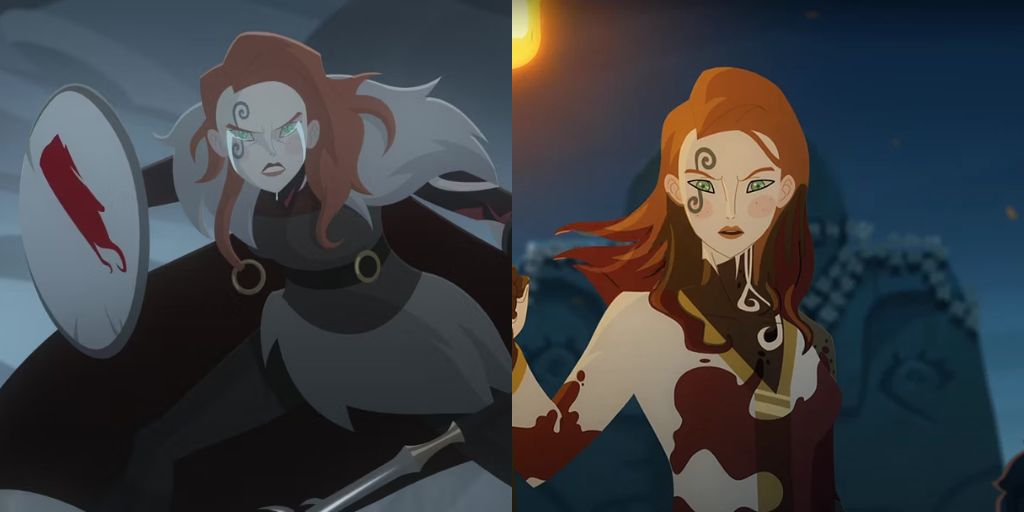
Still from Twilight of the Gods (Credit: Netflix)
Her quest for vengeance not only highlights her strength but also redefines the narrative of female characters in mythology, allowing her to take on a hero’s role typically reserved for men.
Leif’s unwavering support for Sigrid is also noteworthy. Instead of being the typical hero who rescues the damsel in distress, Leif vows to follow Sigrid on her quest, demonstrating a deep sense of loyalty and devotion.
This dynamic subverts expectations and allows for a more nuanced portrayal of relationships, emphasizing partnership rather than ownership.
An Ensemble of Unique Characters
Sigrid’s journey is not solitary; she gathers a diverse group of allies, each with their own motivations and backgrounds. This ragtag crew includes characters like Egill, voiced by Rahul Kohli, and Seid-Kona, a witch played by Jamie Clayton.
Egill, in particular, is a fascinating character inspired by the Viking poet and sorcerer from Egil’s Saga. However, Snyder’s interpretation gives him a more modern and complex persona, transforming him into a tragic, bisexual character.
Loki, the God of Mischief, played by Paterson Joseph, also joins Sigrid’s cause. Loki’s character stands out due to his layered portrayal.
Traditionally, he is known for his trickster nature, but in Twilight of the Gods, he shares a bond with Sigrid, as both have suffered under Thor’s wrath. His motivations are deeply personal, making him a tragic figure whose struggles resonate with viewers.
The interactions between Sigrid, Egill, and Loki provide opportunities for character development and emotional depth.
Each character has a unique backstory that adds richness to the narrative, although the ensemble cast can feel overwhelming at times.
While the characters are visually distinctive, the short length of the episodes sometimes hinders full view of their pasts. This leaves viewers wanting more time to connect with each character’s journey.
Themes of Violence and Intimacy
Snyder’s storytelling is known for its boldness, particularly when it comes to adult themes. In Twilight of the Gods, he does not shy away from depicting violence and intimacy.
Early on, he hinted at “lots of sex,” and while the scenes may raise eyebrows, they serve a purpose. The intimate moments reveal characters’ vulnerabilities, motivations, and relationships.
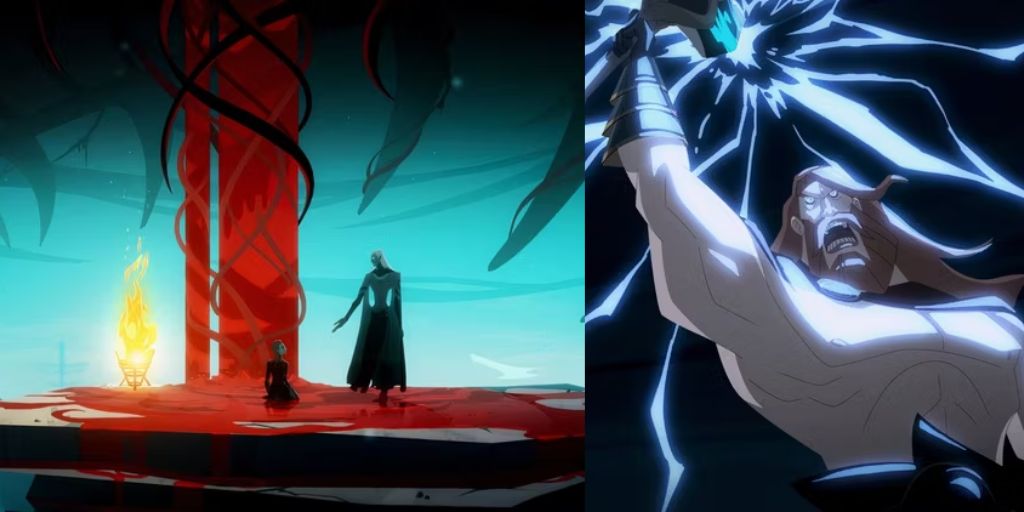
Still from Twilight of the Gods (Credit: Netflix)
The portrayal of violence is equally significant. The blood and gore in Twilight of the Gods are reminiscent of the animated series Castlevania, with a level of intensity that keeps viewers engaged.
Snyder successfully captures the brutality of the Norse world while intertwining it with character-driven narratives. This balance enhances the stakes of Sigrid’s quest, making her journey feel more impactful.
A New Take on Norse Mythology
For those familiar with the Marvel Cinematic Universe’s version of Thor, Snyder’s interpretation may come as a shock. In Twilight of the Gods, Thor is not the heroic figure fans might expect.
Instead, he is portrayed as a more ambivalent character, displaying malice toward giants and a ruthless demeanor. This depiction aligns with traditional Norse myths, which often highlight the darker aspects of their gods.
Snyder takes creative liberties while still respecting the core themes of Norse mythology. One fascinating aspect he shows is the concept of Valhalla.
Instead of depicting it as a peaceful resting place for fallen warriors, the series presents it as a place where they are conscripted by a vengeful god. This twist challenges traditional beliefs and adds layers to the story, prompting viewers to reconsider what they know about these myths.
Music That Enhances the Experience
The musical score of Twilight of the Gods is another standout element. Composed by Hans Zimmer, who is known for his iconic soundtracks in films like Gladiator and Dune, the music adds depth to the visual storytelling. Zimmer’s score complements the animation and heightens the emotional impact of key moments.
However, one unexpected music choice featuring MC Hammer feels out of place within the context of the series. While it may make sense for the scene, it disrupts the atmosphere created by Zimmer’s work. Such contrasts can draw viewers out of the story, highlighting the importance of carefully curating soundtracks that align with the full tone of a series.
Critiques and Areas for Improvement
While Twilight of the Gods is largely enjoyable, it does have its shortcomings. The crowded cast of characters sometimes feels overwhelming, leaving many underdeveloped.
For example, some characters in Sigrid’s crew lack sufficient backstory and character arcs, making it challenging for viewers to form connections with them. This issue is especially apparent when considering the ensemble nature of the series, as many characters compete for screen time.
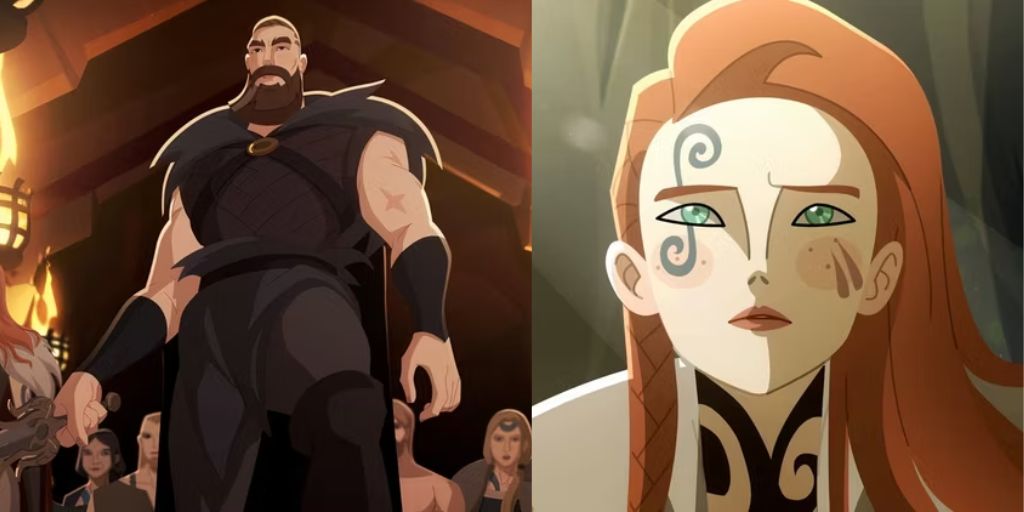
Still from Twilight of the Gods (Credit: Netflix)
Another area for improvement is the pacing. With only eight episodes, the series sometimes rushes through key moments, preventing a deeper history of character relationships and plot points.
A longer season could provide opportunities for more thorough storytelling and character development, allowing viewers to become fully invested in the narrative.
Conclusion
Twilight of the Gods is an attractive addition to Zack Snyder’s body of work. With its stunning visuals, complex characters, and engaging storytelling, the series offers a fresh take on Norse mythology.
Sigrid’s journey of revenge and self-discovery stands out as a powerful narrative, especially in its view of gender roles and character dynamics.
Snyder’s willingness to tackle adult themes and challenge traditional portrayals of gods adds depth to the series. The animation style allows for a creative view of familiar myths, making it accessible to a wide audience.
While the series has its flaws, such as an overcrowded cast and pacing issues, it remains an impressive effort that showcases Snyder’s unique vision.
Twilight of the Gods is now streaming on Netflix, inviting viewers to immerse themselves in a world of epic battles, intricate relationships, and a new perspective on ancient myths.
Whether you’re a fan of Snyder’s previous work or simply looking for a compelling animated series, this show is sure to deliver a memorable experience.
