Jenn Tran from The Bachelorette has had an eventful year since her season ended. Right after wrapping up The Bachelorette, Jenn joined Season 33 of Dancing with the Stars (DWTS), where she was paired with professional dancer Sasha Farber.
The two met just as Jenn was coming out of her engagement with Devin Strader, and the connection between them was immediately apparent to fans. Their chemistry on the dance floor quickly became a talking point, with many viewers speculating about a possible romance.
Jenn and Sasha’s Instant Bond on DWTS
Jenn went through an emotional time after her engagement ended, and her involvement in DWTS came as a surprise. She recounted the moment, saying, “I was crying on stage, I go back, we’re done filming, suddenly somebody comes into my dressing room [and tells me], ‘You have 45 minutes to get on a plane and get to New York because you’re going on Dancing with the Stars.’”
Sasha’s involvement in the season was unexpected as well. He revealed, “I wasn’t even going to be on this season, and everything happened, so at the last minute, I feel like it was fate that we got together and met at the airport and danced.”
From that initial meeting, Jenn and Sasha formed a close bond, and fans noticed how comfortable they seemed with each other.
As they performed together week by week, the pair’s connection became even more evident. Their chemistry shone through their routines, and it wasn’t long before DWTS judges and the cast began commenting on it as well.
After one of their performances, host Julianne Hough asked if their chemistry helped their dancing, to which Jenn replied, “We trust each other so much, we know each other so well, so that’s why this works so well.”
Romance Rumors and Their Ongoing Friendship
Even though Jenn and Sasha were eliminated from the competition during the Halloween-themed episode, they continued to stay in touch after their departure. Their ongoing friendship and frequent interactions on social media have only added fuel to the rumors about a potential romance.
However, both Jenn and Sasha have been careful to avoid confirming anything directly, focusing instead on their shared experience on the show.
In an interview with Extra, Sasha was asked directly if he would consider dating Jenn. He responded, “I wanted her journey to be purely about dance, it wasn’t about our showmanship. Yeah, we have amazing chemistry, and you can see that through our dancing, and I’m really proud of her.”

Jenn Tran and Sasha Farber (Credit: ABC)
A Connection That Goes Beyond Dance
Their friendship continues to draw attention from fans, many of whom are still hoping for a romantic relationship to blossom. While both Jenn and Sasha seem focused on their individual journeys, their chemistry has clearly made an impact on audiences.
For now, their bond remains a strong friendship, but many are watching to see if this connection could eventually lead to something more.
Jenn and Sasha’s journey on DWTS might have ended, but their story off the dance floor seems to have just begun. Fans will no doubt continue to follow their relationship as they decide what comes next.
The finale brings to light the truth behind what happened years ago between young Catherine Ravenscroft (played by Leila George) and Jonathan Brigstocke (played by Louis Partridge).
This revelation is especially painful for Jonathan’s father, Stephen (played by Kevin Kline), who has spent years relentlessly trying to dismantle Catherine’s (played by Cate Blanchett) life in a quest for revenge.
This series, based on Renée Knight’s novel, concludes with a sense of resolution, yet it leaves viewers pondering complex issues about memory, guilt, and forgiveness.
Catherine Shares the Painful Truth
The episode begins with Catherine forcing her way into Stephen’s home. In the previous episode, she had managed to gain access to his house, holding a knife and insisting on the chance to finally tell her story.
Stephen, who initially agrees to listen, tries to calm the situation by offering her tea and secretly adding a drug to her drink.
Despite this, Catherine is able to describe in detail the traumatic events that took place between her and Jonathan years ago in Italy.
She tells Stephen that Nancy Brigstocke’s (Lesley Manville) novel, The Perfect Stranger, indeed captured the atmosphere of that holiday, yet it missed the most critical and painful facts.
Throughout the season, we have seen flashbacks showing events from The Perfect Stranger, where a young mother, restless and left alone during a vacation, begins an affair with a young man who becomes infatuated with her.
Eventually, he proposes that they live together, but she leaves him heartbroken after he saves her son from drowning.
However, as Catherine explains, the reality of that experience was far darker. She reveals that Jonathan actually assaulted and raped her, entering her bedroom and forcing her to take explicit photographs.
During that time, he repeatedly followed her and eventually invaded her bedroom at night. Catherine recalls how Jonathan threatened to kill both her and her young son if she didn’t cooperate.
Stephen initially reacts with disbelief. He demands evidence of her claims, but Catherine tells him that she destroyed all of it after Jonathan’s death, hoping to move forward from the pain.
She wanted to forget the memory of that horrific day and feared that if Jonathan had survived, he might have continued to blackmail or hurt her.
Although he saved her son, Nicholas, from drowning, Catherine saw this as a manipulation rather than a sign of kindness, believing that he might have used it to control her later.
Though she did her best to put the trauma behind her, Catherine explains that she never anticipated the extent to which it would resurface and take over her life years later.
Nicholas Plays a Pivotal Role in Stephen’s Understanding
Catherine’s son, Nicholas (played by Kodi Smit-McPhee), remains in the hospital following a drug-induced stroke. In the previous episode, Stephen had attempted to end Nicholas’s life, yet Catherine arrived just in time to stop him.
Now, after hearing Catherine’s confession, Stephen is still overwhelmed by confusion, disbelief, and anger, but he remains focused on his initial intention.
As he moves to kill Nicholas again, Nicholas unexpectedly wakes up, holds Stephen’s hand, and says, “Mom, I want to go.”
This brief but powerful moment brings a wave of guilt and remorse to Stephen, who later admits his actions to Catherine’s husband, Robert (played by Sacha Baron Cohen).
Nicholas’s brief statement to Stephen hints that he may have been more aware of what happened in Italy than anyone suspected. Later, as Stephen burns the photographs Jonathan took, he notices the faint reflection of a young boy in one of the images—a young Nicholas.
This detail suggests that Nicholas may have witnessed part of the event, though he might have been too young to fully comprehend it.
Nevertheless, the trauma left him resentful toward Catherine, with avoidance being his way of handling the unresolved pain. Finally, mother and son open up to one another, allowing them to begin healing together.
For Stephen, the revelation of Nicholas’s presence in the photograph adds a crucial piece of evidence that affirms Catherine’s story. It aligns with another fact—that Jonathan’s girlfriend, Sasha (Liv Hill), abruptly left during the vacation.
Nancy left this detail out of her novel, The Perfect Stranger, but Stephen’s discovery confirms that there were fractures in Jonathan’s behavior long before the trip. This moment forces Stephen to face a harsh truth he has long suppressed.
He admits to himself that deep down, he always had an unsettling awareness of his son’s dark potential but chose to ignore it out of his loyalty and love for Nancy.
Now, burdened by the terrible things he has done in his son’s name, Stephen feels utterly lost, with nothing left to live for.
Because the story remains faithful to Knight’s original work, a second season would require new material and a creative expansion beyond the original storyline.
The show positions Catherine as the real victim of a harrowing experience, yet the people around her—including her own husband—struggle to believe her side of the story.
After finally learning the truth, Robert feels relieved that she was not unfaithful to him. However, this reaction also suggests his failure to support her when she first needed to explain what happened.
he series underscores the importance of listening to those who are trying to share painful experiences, even when the details seem incomprehensible.
Catherine’s story reflects how easily people can ignore or reject uncomfortable realities, especially when they feel loyalty to those they love. At the same time, Stephen’s journey reveals the consequences of ignoring one’s own suspicions about loved ones.
In the end, Stephen’s refusal to acknowledge Jonathan’s darker side resulted in pain for others and, ultimately, for himself.
Given these complex and resonant themes, a second season might not capture the same emotional impact as the first.
The finale reveals Catherine’s painful past with Jonathan and how her silence was both a survival mechanism and a burden that haunted her life.
Stephen, who once sought revenge, ultimately faces the reality of his son’s cruel nature and his own failures to protect those around him.
By choosing to believe Catherine and acknowledging Jonathan’s actions, he confronts the consequences of his blind loyalty and, in turn, begins to find a sense of resolution.
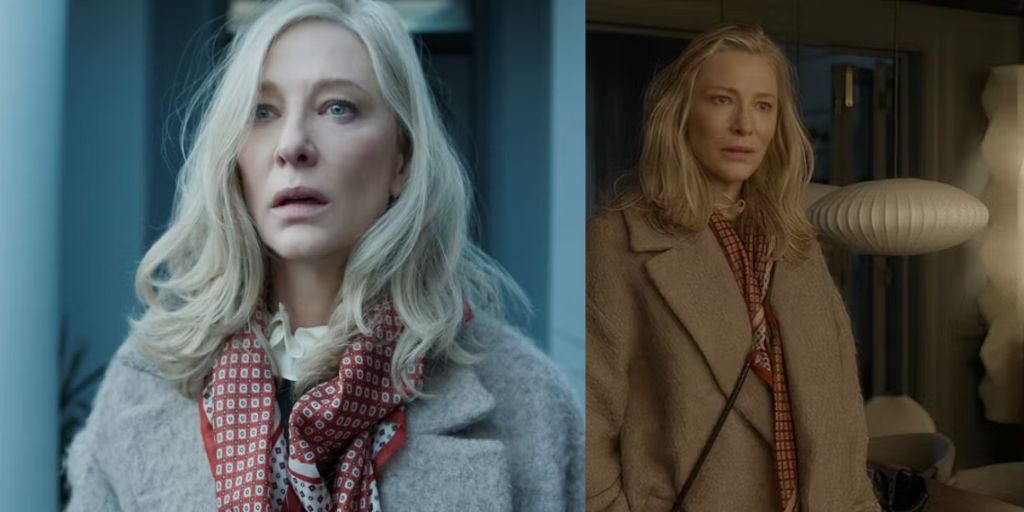
Still from Disclaimer (Credit: Apple TV)
Robert’s initial reaction—his relief that Catherine didn’t betray him—underscores a deeper issue: the tendency to doubt and question rather than support victims. This lack of understanding serves as a reminder of how necessary it is to approach others with compassion.
Alfonso Cuarón’s adaptation of Renée Knight’s novel provides a complete story with a satisfying emotional journey.
Catherine’s path to healing, Nicholas’s recovery, and Stephen’s eventual reckoning wrap the narrative in a way that leaves a lasting impact.
By the end, viewers are left with a haunting yet necessary reflection on truth, trauma, and the importance of facing the past, no matter how painful.
