When we watch classic films like Citizen Kane, Lawrence of Arabia, or modern films like There Will Be Blood or Oppenheimer, we notice that they tell grand stories about great people with big dreams.
We might think, “They don’t make movies like this anymore.” This feeling also comes when we watch Brady Corbet’s third film as a director, The Brutalist.
This film is 215 minutes long and has an opening musical piece and an intermission. It uses VistaVision, a film format not seen much since the 1950s.
Corbet, who co-wrote the film with his wife Mona Fastvold, combines old storytelling styles with modern ideas and experiments. It is a big film that deserves this kind of scope, even though it has some issues in the second half.
Adrien Brody gives his best performance as László Tóth, a Hungarian-Jewish survivor of the Holocaust who arrives in America in the late 1940s.
In Hungary, László was a famous architect who created beautiful buildings. He arrives in America without his wife, Erzsébet Tóth (played by Felicity Jones), and his orphaned niece, Zsófia (Raffey Cassidy).
László writes letters to them, trying to convince them to join him. At first, he works with his cousin Attila (Alessandro Nivola), who owns a furniture shop in Philadelphia, where László makes amazing furniture.
Later, he gets a huge job to redesign a library for wealthy client Harrison Lee Van Buren (Guy Pearce). This job is the biggest and most expensive of his career.
In The Brutalist, it is enjoyable to watch László work. We see him tackle challenges while remodeling the library. He solves problems to create something beautiful. Whether he is building furniture for Attila’s shop or working on Harrison’s big project, László’s skills are exciting to watch.
Even though the film can be tough to watch, László’s joy in showing his talents offers moments of relief from the challenges he faces in pursuing the American dream. Brody portrays László as a hardworking immigrant who is determined to succeed.
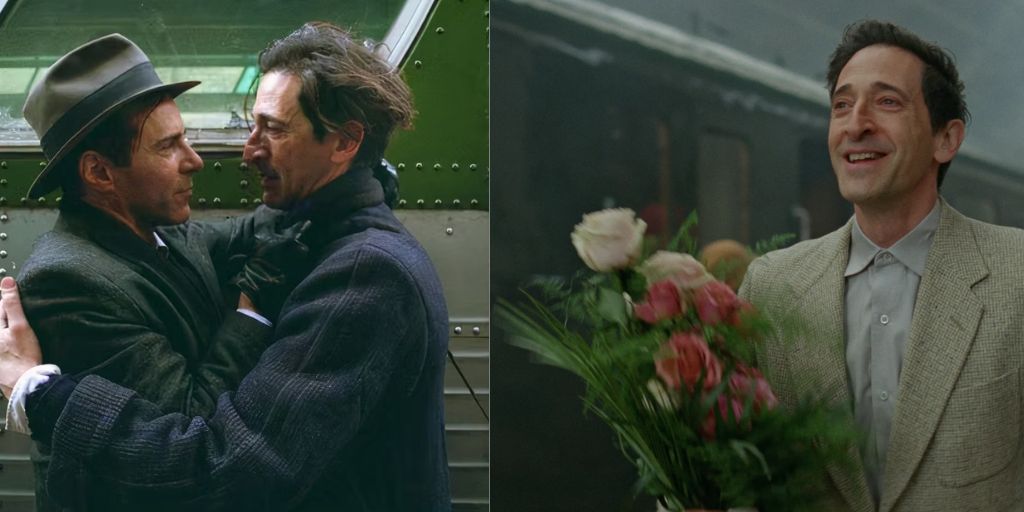
Still from the movie (A24)
As the story unfolds, we see László gain confidence, reminding us of his past and allowing him to showcase his abilities. The Brutalist is mainly about an immigrant’s struggle in America and how hard it is to prove oneself. Brody perfectly captures these emotions, making his performance unforgettable.
It is interesting to see how László’s life changes based on the people around him. When he stays in Attila’s shop, he is shy and keeps to himself. He does his work quietly. But once Harrison discovers László’s talents through old newspapers and offers him a significant job, László takes on the opportunity with enthusiasm.
Pearce gives one of his best performances as Harrison, showing how wealthy men use immigrants’ work to get ahead. Harrison’s character is complex; he can be angry one moment and friendly the next.
Even when the film reveals Harrison’s true intentions in the second half, Pearce plays the character with a mix of stoicism and hypocrisy that makes it work.
Jones’ character, Erzsébet, significantly impacts László’s journey. Her survival motivates him but also challenges him unexpectedly. Erzsébet is strong and supports her husband, but she also seeks to regain her own strength.
While László focuses on Harrison’s project, Erzsébet observes the Van Buren family, noticing their hidden flaws. Their love for each other is evident, but their past suffering does not erase their new problems.
Corbet and Fastvold take László’s story and present it with grandiosity. Every scene is carefully crafted, with beautiful cinematography by Lol Crawley.
The editing by Dávid Janscó skillfully condenses László’s life into the film’s length, knowing when to linger on important moments and when to move quickly through less important details. The film feels like a classic with a modern twist, showing that it could not have been made at any other time.
In their third collaboration, Corbet and Fastvold tackle significant themes, including the immigrant experience and the building of post-war America. Their script thoughtfully handles these issues, but it does have some flaws, such as uneven moments and heavy-handed imagery.
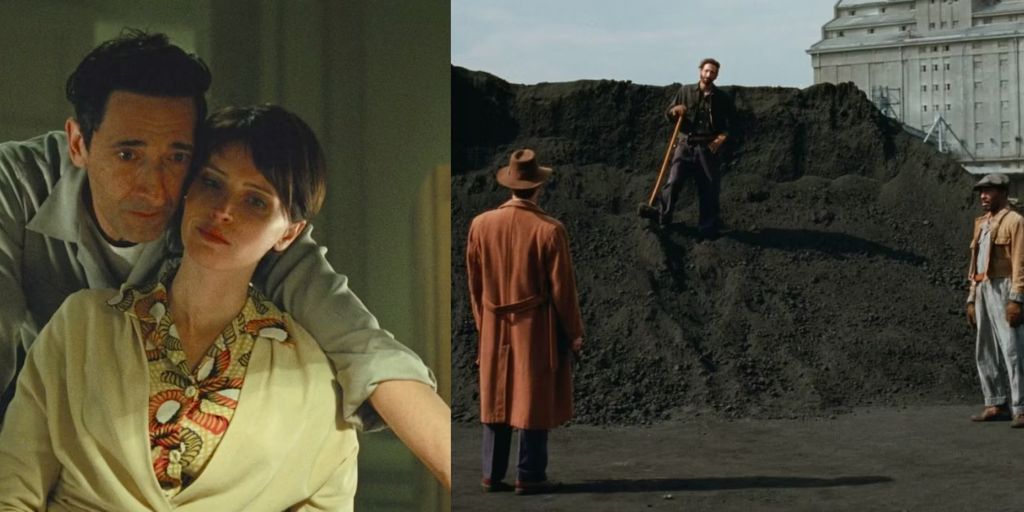
Still from the movie (A24)
Corbet mentioned in a Q&A that he dislikes films that spell out their messages too clearly. Yet, The Brutalist opens with a powerful image of an immigrant arriving in America and seeing the Statue of Liberty upside down. This image is striking but aligns with the straightforward storytelling Corbet criticizes.
The first half of the film is compelling as we see László’s gradual rise to success. However, the second half becomes more complex, and the screenplay struggles to maintain its quality. A notable example occurs when László and Harrison gather materials for the project.
This scene is too direct in showing how wealthy Americans treat poor immigrants, which feels out of place in the narrative. László’s heroin use to cope with his pain also risks becoming cliché at times. Fortunately, these conventional elements are not common in a film that feels quite original.
Corbet’s third film almost reaches masterpiece status, showcasing his incredible talent. It is impressive to see such high quality from a filmmaker early in his career. The Brutalist often addresses themes we have seen before but presents them in a fresh and unique way.
The film highlights the talents of Brody, Pearce, and Jones, who give outstanding performances, and Crawley’s stunning cinematography enhances László’s personal story. Despite some flaws, The Brutalist stands out as one of the best films of the year, proving that Corbet is a filmmaker worth watching.
In addition to the film’s impressive technical achievements, The Brutalist is also a powerful meditation on the immigrant experience, resilience, and personal identity. The struggles László faces in trying to rebuild his life in a new country resonate on both a personal and universal level.
The film doesn’t shy away from the complexities of adjusting to a new culture, especially one where immigrants are often undervalued despite their talents and contributions.
László’s journey is not just about survival; it’s about proving his worth, not just to those around him but also to himself. His determination to create something meaningful in his adopted country is a reflection of the human spirit’s capacity to endure and achieve, even in the face of adversity.
Erzsébet’s role in the film, too, expands beyond just being László’s wife. Her quiet strength and insight into the Van Buren family’s dynamics offer a broader perspective on the challenges of assimilation.
While László is deeply involved in his work, Erzsébet the social aspects of their new life with a keen awareness of the inconsistencies and power dynamics at play. She represents a different type of immigrant experience, one that is not solely defined by labor but by observation and adaptation to the new cultural land.
The film also addresses how art and architecture, László’s chosen profession, can serve as metaphors for self-expression and personal triumph.
László’s creations are more than just buildings; they are a testament to his resilience, his vision, and his ability to leave a lasting legacy, even in a world that often tries to diminish or erase the contributions of immigrants.
His architectural achievements symbolize not just personal success but also the broader idea of immigrants shaping and influencing the cultural fabric of the countries they adopt.
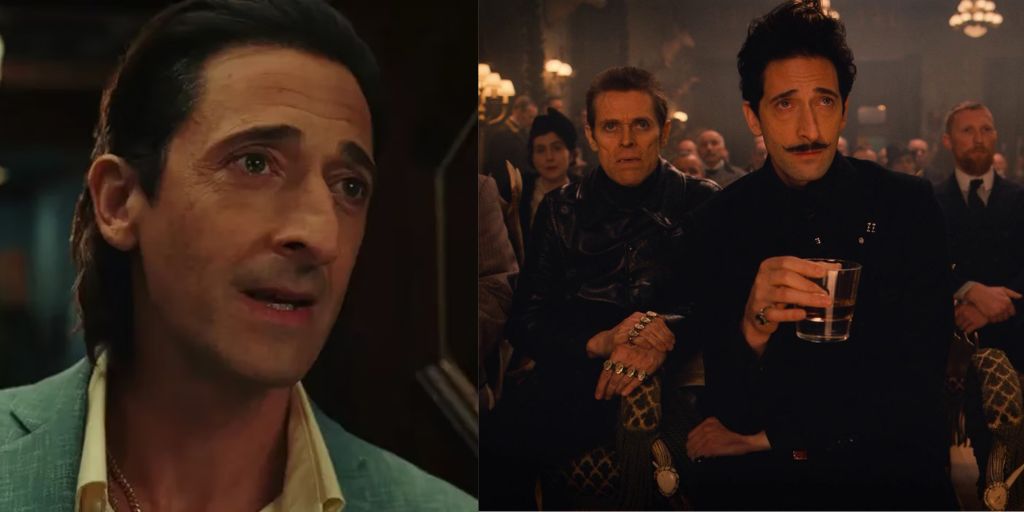
Still from the movie (A24)
Furthermore, The Brutalist deal with the tension between personal ambition and the external forces that seek to control or exploit it.
Harrison Lee Van Buren’s role as both benefactor and oppressor highlights how the wealthy and powerful often use the talents of immigrants for their own gain, while rarely offering the full recognition or support those individuals deserve.
László’s internal conflict, fueled by his dependence on Harrison for both his livelihood and validation, is a reflection of the broader immigrant struggle—how to maintain one’s integrity and sense of self in a system that often seeks to commodify their labor and creativity.
Despite these challenges, László’s journey is ultimately one of hope and achievement. His ability to continue creating, to persist in his artistic endeavors, speaks to the resilience of the human spirit.
Even when faced with exploitation, prejudice, and personal hardship, László never loses sight of his vision.
This persistence allows him to leave a meaningful mark on the world around him, suggesting that the immigrant story is not just one of struggle, but also of contribution and legacy.
In The Brutalist, Corbet delivers a film that does more than tell a story—it challenges us to think deeply about issues of identity, belonging, and the role of art in shaping our world.
The film’s grand scale, combined with its intimate focus on László’s personal journey, creates a powerful narrative that resonates long after the credits roll.
It is a film that asks us to reflect not only on the immigrant experience in America but also on the broader themes of power, ambition, and the human desire to create something lasting and meaningful.
This ability to balance personal storytelling with larger, universal themes is what makes The Brutalist stand out as a significant film in modern cinema. Despite its flaws, The Brutalist remains a bold and thought-provoking cinematic achievement.
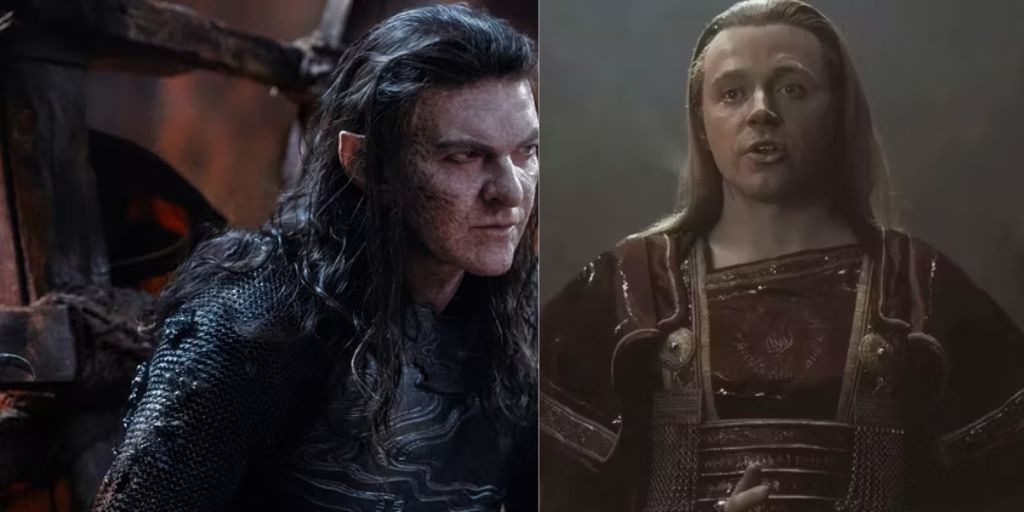
In this week’s episode of The Lord of the Rings: The Rings of Power, a dark and ancient relic from the First Age comes into the light. Adar (played by Sam Hazeldine), in his first conversation with Galadriel (played by Morfydd Clark), reveals Morgoth’s crown.
Morgoth, the first Dark Lord, once wore this crown, but now Sauron (played by Charlie Vickers) seeks it. According to Adar, the Iron Crown’s power, when combined with the Elven Rings of Power, could potentially defeat Sauron.
However, Galadriel finds the crown dangerous and refuses to even look at it. What makes this crown so special, even after Morgoth’s defeat so long ago?
Morgoth’s Iron Crown Held the Silmarils
The Iron Crown of Morgoth immediately seems familiar. It follows the same design and look as Sauron’s famous armor from The Lord of the Rings movies, which The Rings of Power mirrors.
This shows how Sauron sees himself as Morgoth’s heir, even in his armor and equipment. But the history of the Iron Crown goes back much further, to a time before the First Age of Middle-earth.
During the Years of the Trees, when the world’s light came from the two trees Laurelin and Telperi in Valinor, Fëanor, an Elven smith, created the Silmarils. These three gems, known for their unmatched beauty, were among the most beautiful things in Middle-earth.
They held the light of the Trees and had the blessing of the Valar, making them precious beyond measure. Morgoth, obsessed with the Silmarils, destroyed the Trees and stole the gems from Fëanor during the chaos.
In the process, Morgoth also killed Fëanor’s father. Nearly all the conflicts of the First Age stem from these events, as Fëanor’s sons swore to recover the Silmarils and defeat Morgoth.
After stealing the Silmarils, Morgoth returned to his fortress, Angband, and designed the Iron Crown. The crown might not seem special at first, but it is a powerful object.
Although the Silmarils themselves don’t hold magical power, the light they contain and the Valar’s blessing make them harmful to Morgoth. Still, Morgoth desired to wear all three gems in his crown.
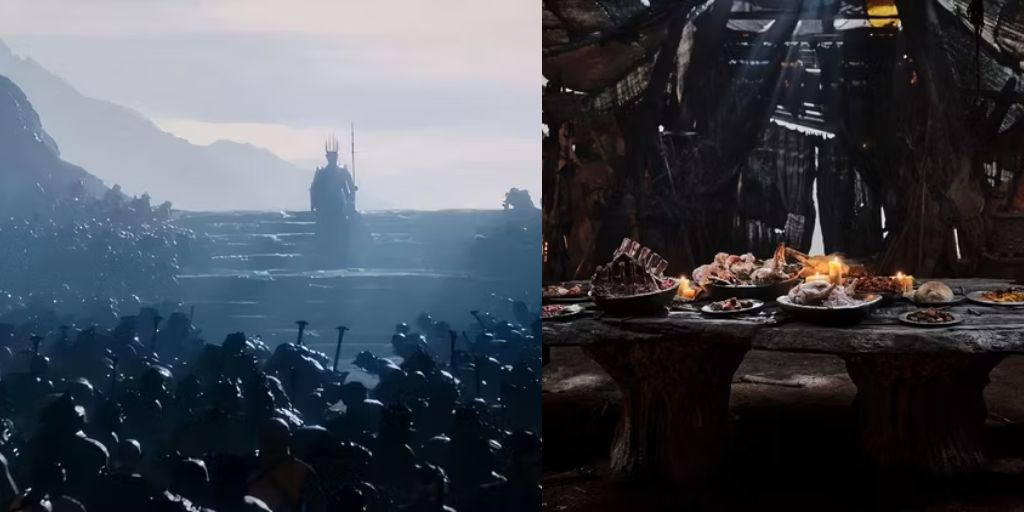
Still from Rings of Power (Credit: Prime Video)
To protect himself, he designed the Iron Crown to hold the Silmarils without letting them hurt him. The Silmarils still burned Morgoth’s flesh when he wore the crown, but he never took it off.
Morgoth’s Crown Is Lost After the War of Wrath
The First Age was filled with battles involving Morgoth and the Silmarils. One of the Silmarils was recovered by Beren and Lúthien and passed down through their family to Eärendil the Mariner and his wife Elwing, the parents of Elrond (played by Robert Aramayo).
With the Silmaril on the bow of their ship, they became the first mortals to reach the Undying Lands of Valinor by themselves. Eärendil pleaded with the Valar to help in the fight against Morgoth, and the Valar agreed.
With the help of the Host of the Valar, a great war called the War of Wrath began against Morgoth. It became the bloodiest conflict in Tolkien’s stories and is shown in the opening scenes of The Rings of Power Season 1, although with some changes from the books.
The destruction was so intense that Beleriand, a continent in Middle-earth where most of the battles took place, sank into the sea. In the end, Morgoth was defeated, losing his crown and the Silmarils.
As punishment, Morgoth was banished to the Void, a place between worlds. To ensure he could never return, the Valar turned Morgoth’s crown into a collar and chains to imprison him. The Silmarils were also lost. Eärendil kept the Silmaril on his ship as he sailed the skies.
The other two Silmarils were recovered by Fëanor’s sons, Maedhros and Maglor, but they could not hold onto them. After committing many cruel acts to get the gems, they found the Silmarils too painful to keep. One gem was thrown into a fiery pit, and the other was cast into the ocean.
Morgoth’s Iron Crown Returns in The Rings of Power Season 2
Before Adar shows Galadriel the Iron Crown, The Rings of Power hinted at its importance. Adar tells Galadriel that he witnessed Sauron reforge the crown for himself and then used it to kill him. This scene is shown in the opening sequence of Season 2 as a flashback.
In this scene, set in Sauron’s fortress in Forodwaith, Sauron declares himself the new Dark Lord to the Orcs. However, the Orcs do not trust him and refuse to follow him into another deadly war. Pretending to accept Sauron’s leadership, Adar uses the crown to kill him.
Still from Rings of Power (Credit: Prime Video)
The survival of the Iron Crown and its use in the Second Age is a major change from Tolkien’s original writings, but it works within the series. Adar does not explain how he recovered the crown, only saying that “there are many stories” about what happened to it.
The crown also appears in teasers for Season 2 in different scenes, including one where Sauron holds it while fighting Galadriel. Charlie Vickers, who plays Sauron, also mentioned the crown in an interview, so it will likely play a key role in the final episodes of the season.
Season 2 of The Rings of Power is now streaming on Prime Video in the U.S. New episodes are released every Thursday.
