Author J. R. R. Tolkien revitalized the fantasy genre with his epic work, The Lord of the Rings. This series, a follow-up to his earlier story, The Hobbit, takes readers to the magical land of Middle-earth.
Here, various beings like humans, elves, dwarves, and hobbits fight against dark forces. Among the many ancient creatures in this world, the Balrogs stand out as some of the most memorable and fearsome.
The first appearance of Balrogs is in The Fellowship of the Ring. They are described as ancient demons, taking the shape of living shadows and flames. They wield whips and swords made of fire. Tolkien goes deeper into their background in his mythological work, The Silmarillion.
According to this book, the Balrogs were originally part of a celestial order called the Maiar. These beings were created by Eru Ilúvatar, the supreme deity in Tolkien’s universe, to serve the Valar. The Valar are powerful entities responsible for governing the world of Arda.
However, when Melkor, the most powerful of the Valar, rebelled, some of the Maiar joined him and were corrupted into Balrogs.
Along with Sauron, another fallen Maia, the Balrogs became Morgoth’s chief lieutenants in his quest to dominate and destroy Arda. Ultimately, the Valar defeated Morgoth in the War of Wrath, banishing him from the world. The surviving Balrogs went into hiding, waiting for Morgoth’s return.
Tolkien’s views on the number of Balrogs varied over time, but he eventually settled on a range of three to seven. Outside of this range, four Balrogs are described in detail in his writings, and three of them have specific names and titles.
Despite their relatively small role in the series, Balrogs remain iconic figures in fantasy literature due to their terrifying appearance, their status as fallen angels, and the great effort required to defeat them.
Glorfindel’s Balrog in The Silmarillion
One of Morgoth’s most significant challenges was the hidden city of Gondolin. The Ñoldor elves, led by King Turgon, resisted Morgoth’s conquest from this city. Morgoth learned the city’s location after capturing the elf Maeglin. He then attacked Gondolin with all his forces, including Balrogs flying on dragons.
A Balrog led orcs against the survivors who were trying to flee. However, this Balrog was stopped by the elven hero Glorfindel, who was killed in the battle.
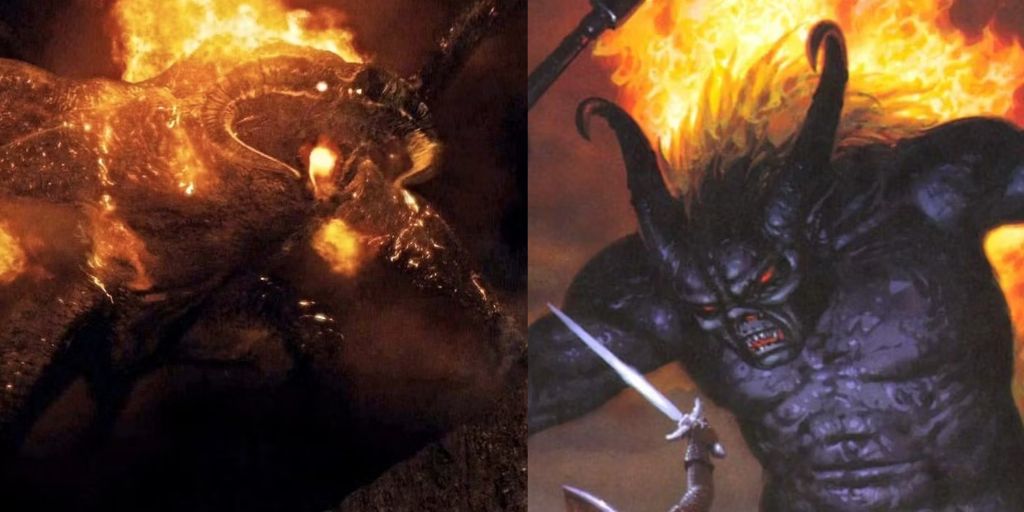
Still from The Rings of Power (Credit: Prime Video)
This particular Balrog, which is not named, is considered the least impressive among the Balrogs, but its role in the fall of Gondolin adds to the city’s tragic end. The battle between Glorfindel and the Balrog is similar to Gandalf’s battle in The Fellowship of the Ring.
The films by Peter Jackson portray Glorfindel’s role as being played by Arwen, who helps Frodo reach Rivendell. This parallel reflects how powerful and memorable these battles are in Tolkien’s work.
Lungorthin in The Silmarillion
Of the three Balrogs with names, Lungorthin is the least developed. Known as “Lord of Balrogs,” he was a subordinate to Gothmog, the chief of the Balrogs. Lungorthin was notorious for his sadistic nature and used his flaming whip to inflict pain and suffering.
He assisted Gothmog in killing King Fingon during the Battle of Unnumbered Tears and tortured Húrin, a human hero who had defied Morgoth many times.
Lungorthin’s character is described as cruel and malicious. He took pleasure in causing pain and spreading Morgoth’s dark will. However, little is known about his fate after the War of Wrath. He may have been killed in the conflict, or he might have escaped underground.
There is also a possibility that Lungorthin could be the Balrog that fought Glorfindel or the one that drove the dwarves from Khazad-dûm, though these theories are less likely. What remains clear is Lungorthin’s reputation as a malevolent force in Tolkien’s legendarium.
Gothmog in The Silmarillion
Gothmog, the high-captain of Angband, was the true Lord of the Balrogs and Morgoth’s chief servant. He wielded a powerful black battleaxe and led Morgoth’s armies against the Ñoldor elves and their allies.
Gothmog was responsible for the deaths of two High Kings of the Ñoldor: Fingon and Fëanor. He met his end during the Fall of Gondolin when the elf Ecthelion of the Fountain sacrificed himself to extinguish Gothmog’s flames in the Fountain of the King.
Gothmog’s legacy continues through an orc bearing his name, who served under the Witch King of Angmar in the attack on Minas Tirith.
Gothmog was second only to Sauron in Morgoth’s service and, in many ways, surpassed Sauron with his battlefield victories. He was a formidable warrior, leaving a path of destruction and flames. His influence extends beyond his death, highlighting his significant role in Tolkien’s world.
Durin’s Bane in The Silmarillion, The Fellowship of the Ring, and The Two Towers
After the War of Wrath, one Balrog hid deep within the Misty Mountains. The dwarves built the kingdom of Khazad-dûm above it, and during the Third Age, they accidentally awoke it by mining too greedily in search of mithril.
This Balrog, known as Durin’s Bane, killed their king, Durin IV, and drove the dwarves from their home. Many years later, Durin’s Bane attacked the Fellowship as they travelled through Khazad-dûm, leading to a legendary battle with Gandalf the Grey.
Durin’s Bane is notable for its role in The Fellowship of the Ring. Its surprise attack on the Fellowship hinted at ancient horrors lurking in the dark corners of the world.
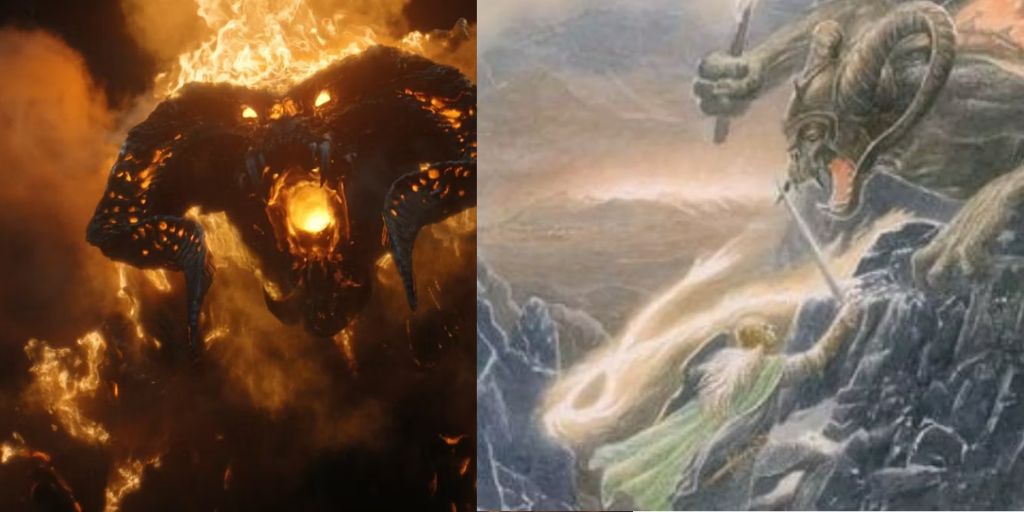
Still from The Rings of Power (Credit: Prime Video)
The battle with Gandalf showcases the struggle of good against evil. Gandalf’s defiant stance and ultimate sacrifice to defeat Durin’s Bane are memorable moments in Tolkien’s work. Gandalf’s victory over this Balrog demonstrates that even the greatest evil can be overcome, although it comes at a significant cost.
The Balrogs are among the most striking and memorable creatures in Tolkien’s legendarium. Each Balrog has a unique role and story, contributing to the rich view of Middle-earth’s history. Their fearsome appearance, tragic backstories, and epic battles continue to attract readers and fans of Tolkien’s work.
As “The Lord of the Rings: The Rings of Power” reaches the midpoint of its eight-episode second season, the focus on Galadriel (Morfydd Clark) and Sauron (Charlie Vickers) deepens. The series continues to show Galadriel’s complex emotions regarding her break with Sauron.
Initially, she believed Sauron was a human ally, but this turned out to be a deception. This season, viewers see Galadriel grappling with the emotional aftermath of this revelation.
Meanwhile, Sauron has taken on a new persona as Annatar, the seemingly benevolent Lord of Gifts, and infiltrated Eregion, the forge of the master elven-smith Celebrimbor (Charles Edwards). His goal is to create the corruptive Rings of Power.
The tension between Galadriel and Sauron is evident as the season progresses. Sauron’s new guise allows him to manipulate and deceive those around him while hiding his true intentions. It takes time for viewers to get a clear picture of how Sauron is handling Galadriel’s rejection.
According to Episode 5, his reaction is not positive. Despite the physical distance between them and the moral and strategic conflicts they face, Sauron is still fixated on Galadriel. He seems unable to move on and is intent on making her pay for her rejection.
This obsession is highlighted in a specific moment from Episode 5, which escalates his dark, manipulative behavior to new levels. This moment is memorable and stands out in the season’s portrayal of Sauron’s fixation.
Sauron’s Hidden Feelings in ‘The Rings of Power’ Season 2
Celebrimbor (Charles Edwards) and Sauron as Annatar (Charlie Vickers) share a tense but intriguing dynamic. Given the revelation in Season 1 that “Halbrand is Sauron,” Season 2 goes into Galadriel’s emotional turmoil.
She is burdened by the shame of being deceived, the grief of losing a friend, and the fear that Sauron still has some emotional sway over her. Despite these challenges, she is determined to defeat him.
Her feelings are further complicated by her growing relationship with her own Ring of Power and her strained friendship with Elrond (Robert Aramayo). The conflict with Sauron is far from resolved, and it becomes increasingly intense as the series progresses.
On the other side, Sauron-as-Annatar has skillfully hidden his true emotions behind a facade of charm and manipulation. His false persona has successfully attracted Eregion’s smiths, who are in awe of him.
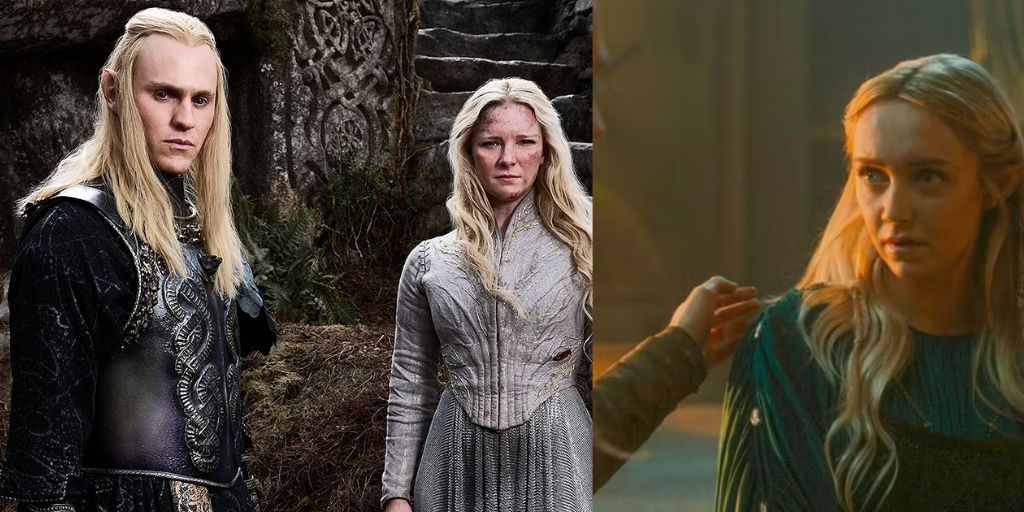
Still from The Rings of Power (Credit: Prime Video)
Any real emotions Sauron feels are shown in brief, subtle moments, inferred from Vickers’ nuanced expressions. In Episode 5, Sauron’s frustration with Celebrimbor’s reluctance to make Rings for Men is evident.
Despite this frustration, Sauron adapts to the situation, displaying a “I’ll do it myself” attitude while keeping his true feelings hidden.
Sauron’s Creepy Comparison to Galadriel
Sauron’s interaction with Mirdania (Amelia Kenworthy) is particularly noteworthy. The scene begins innocuously. Earlier in the episode, Mirdania shows kindness to Sauron and briefly wears one of the forge’s experimental Rings.
This ring reveals Sauron’s terrifying true form: a tall being with flaming skin and cold, pitiless eyes. After this shocking vision, Sauron reaches out to Mirdania, attempting to comfort her and address her fears. He pretends to confide in her about Celebrimbor’s supposed darkness, trying to distract her and prevent suspicion.
Sauron then turns his attention to Mirdania’s physical appearance. He compares her beauty to Galadriel’s, acting as if the resemblance is surprising. Mirdania, flattered, smiles at the compliment. Sauron then intensifies his dark romantic behavior by gently brushing back a lock of Mirdania’s hair, almost touching her shoulder.
This gesture is both unsettling and enchanting. It leans towards being overtly suggestive, adding a layer of creepiness to Sauron’s otherwise charming demeanor. This interaction highlights Sauron’s obsession with Galadriel and his tendency to project his feelings onto others.
The Significance of Sauron’s Obsession with Galadriel
Sauron’s fixation on Galadriel is a central theme in Season 2. Charlie Vickers, who plays Sauron, has compared Sauron’s offer in Season 1 to a marriage proposal. He describes their relationship as a “cosmic connection” and mentions that Sauron is driven by the need to overcome Galadriel’s rejection.
In an interview, Vickers explained that Sauron’s motivation in the second season involves addressing the disappointment of being rejected by Galadriel and seeking to make things right in his own way.
Despite Vickers’ claims that Sauron’s feelings are not romantic, his actions suggest otherwise. Sauron’s smirk, prolonged stare at Mirdania, and the way he touches her hair all point to his deep-seated obsession with Galadriel. The production team of Rings of Power is clearly aware of the dynamic between Sauron and Galadriel. Co-showrunner Patrick McKay mentioned that producer Gennifer Hutchison recognized the potential for this dynamic before Season 1 even aired.
Hutchison’s prediction that viewers would be interested in their relationship has proven accurate. The marketing for the show has also highlighted the dramatic moments between the two characters, building anticipation for their future confrontations.
Speculation and Theories
There is speculation among fans that Mirdania might be Celebrían, Galadriel’s daughter. However, this theory seems unlikely. Mirdania is probably an original character designed to remind Sauron of Galadriel.
The constant presence of a character who resembles Galadriel serves to aggravate Sauron’s emotional wounds and reinforce the conflict between them. This adds an extra layer of drama to their interactions and highlights the emotional stakes of their rivalry.
The interactions between Sauron and Galadriel are characterized by a rich blend of drama and romance. Episode 5, in particular, underscores Sauron’s obsession with Galadriel through his behavior towards Mirdania.
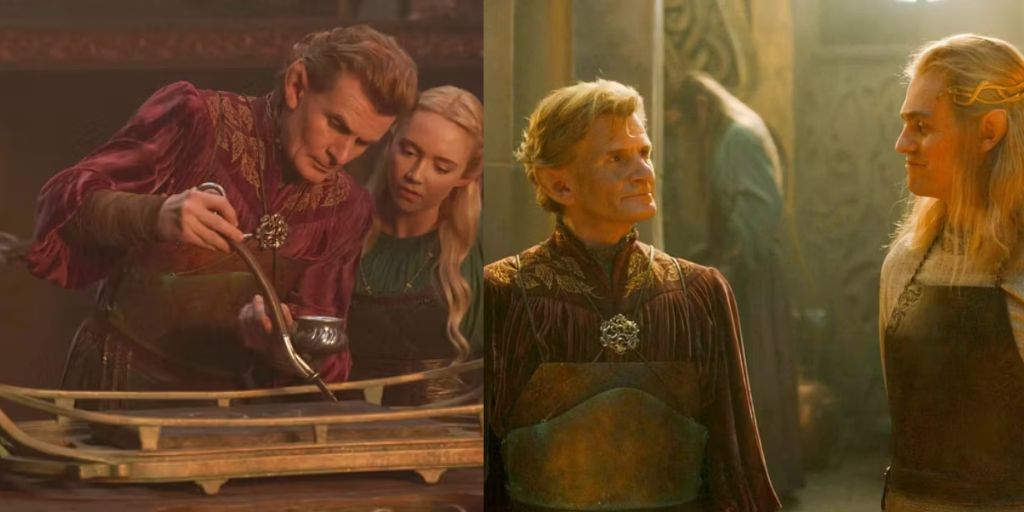
Still from The Rings of Power (Credit: Prime Video)
His touching of her hair while reminiscing about Galadriel is a chilling yet thrilling portrayal of his fixation. This episode effectively captures the complexity of Sauron’s emotions and his struggle with rejection.
Conclusion
Season 2 of “The Lord of the Rings: The Rings of Power” continues to show the intricate dynamics between Sauron and Galadriel. Sauron’s obsession with Galadriel is a key theme, driving much of the drama in the series. His actions towards Mirdania reveal the depth of his fixation and the impact of Galadriel’s rejection.
As the season progresses, it will be interesting to see how this dynamic evolves and what further revelations will emerge about Sauron’s true feelings. The series masterfully blends elements of romance and dark intrigue, making it a compelling watch for fans of the saga.
