You gotta love the in-laws. Or maybe you don’t. Brandy Norwood’s Belinda experiences this firsthand in the new horror film, The Front Room, directed by Max and Sam Eggers.
The film, produced by A24, tells the story of Belinda, an expectant mother whose peaceful life is disrupted when her elderly mother-in-law, Solange (played by Kathryn Hunter), moves in.
As Belinda prepares to give birth, she faces a power struggle with the very religious Solange. This leads to a uniquely comedic and thrilling battle over the future of Belinda’s family and home.
What Is ‘The Front Room’ About?
The Front Room follows Belinda and her husband Norman (played by Andrew Burnap), who are eagerly awaiting the arrival of their second child. This moment of joy is shadowed by the loss of their first child, a tragedy that weighs heavily on their hearts.
Their financial situation adds to the emotional burden of the new arrival. The story takes a turn when Norman’s father passes away, leaving behind a final request: Norman must allow his estranged mother, Solange, to move in with them.
Solange is not an easy guest. She is an elderly woman with a challenging personality, characterized by her incontinence, manipulative behavior, and a deeply religious and racist worldview. Her past relationship with Norman is strained due to her harsh and controlling manner as a stepmother.
Solange believes she is frequently possessed by the Holy Spirit, which adds another layer of complexity to her character. Despite her numerous flaws, she comes with a significant inheritance, which complicates Norman’s decision to refuse her request.

Still from The Front Room (Credit: Two & Two Pictures)
Once Solange moves in, the tension between her and Belinda quickly escalates. The film portrays a dramatic and often darkly comedic conflict over who will have control in the household, with significant stakes for the future of Belinda’s family and their home.
Belinda and Solange Square Off Over Who Gets To Be Matriarch
The central conflict of The Front Room revolves around the power struggle between Belinda and Solange. Norman’s initial reluctance to let Solange live with them is rooted in their troubled past.
As a stepmother, Solange was stern and strict, imposing her rigid version of Christianity on Norman. This upbringing left Norman with deep emotional scars and contributed to his estrangement from his mother.
Solange’s arrival reintroduces her domineering presence into the household. At first, she pretends to respect Belinda’s role as the maternal figure. However, her subtle criticisms soon become more overt.
Solange disapproves of Belinda’s cooking, her interest in Goddess figures, and the lack of Christian symbols in their home. She even criticizes the baby’s name and feeding practices. Belinda becomes increasingly aware of Solange’s attempts to undermine her, leading to a significant clash of wills.
As tensions rise, Belinda finds herself fighting to maintain her place as the matriarch of the family. The conflict is not just about who gets to be the primary mother figure but also about the control and influence over the household.
Solange’s attempts to replace Belinda lead to a dramatic confrontation, with Belinda declaring, “I am her mother!” and Solange retorting, “Oh no ya ain’t!” The battle for maternal dominance intensifies, reflecting the deep-rooted issues between the two women.
Solange’s Supposed Powers Are Likely Fake
Another intriguing aspect of The Front Room is the portrayal of Solange’s supposed supernatural abilities. Solange, who is deeply religious, believes she is often possessed by the Holy Spirit, which she refers to as “signs and wonders.”
Her church community seems to support these beliefs, adding a layer of credibility to her claims. As the conflict with Belinda progresses, Solange’s supposed powers become more pronounced.
After the birth of Belinda’s baby, Laurie, Belinda develops a large, crooked C-section scar. The next morning, the scar appears to improve significantly.
This change, along with other strange occurrences, such as Solange appearing as a Virgin Mary figure holding the baby, leads Belinda to question what is real. Exhausted from sleepless nights and Solange’s intimidating presence, Belinda begins to doubt her own perceptions.
Despite the eerie occurrences, Belinda also notices signs that Solange may be faking her disability and manipulating situations to gain sympathy.
Solange’s walker seems less necessary than she lets on, and Belinda catches her in several deceitful acts. The evidence suggests that Solange’s “powers” are not genuine but rather a result of Belinda’s extreme fatigue and the stress of her situation.
How Does ‘The Front Room’ End?
The mounting tension and Solange’s relentless torment push Belinda to her breaking point. The situation reaches a climax when Belinda discovers a large bite mark on the baby, Laurie, which she suspects is caused by Solange.
The film depicts a night of Solange lamenting her own death, and the next morning, she is found dead. Initially, it seems that Solange died in her sleep, but the film later reveals that Belinda secretly smothered Solange with a pillow.
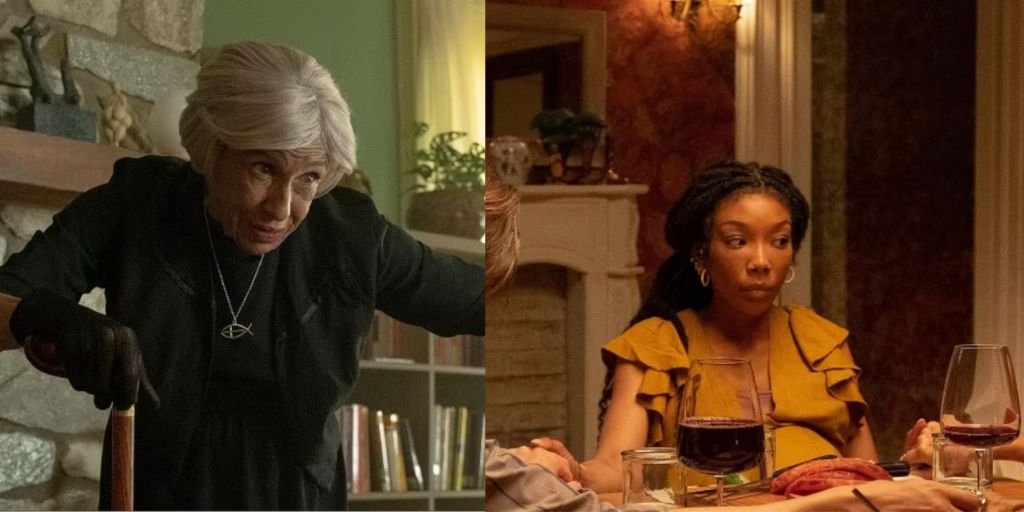
Still from The Front Room (Credit: Two & Two Pictures)
Belinda’s drastic action underscores the extreme measures she has been driven to by Solange’s behavior. Throughout the film, Belinda is portrayed as a compassionate and caring person, making her act of killing Solange seem like a desperate and justified response.
The film’s conclusion shows Belinda’s life improving dramatically after Solange’s death. She gets a new job, the family’s financial troubles are resolved, and they move into a new house. The film ends on a note of dark humor, suggesting that Belinda’s choice was the right one for her and her family, despite the horrific nature of the act.
Jeremy Saulnier has established himself as one of the most impressive filmmakers in the genre. His earlier works, Blue Ruin and Green Room have left audiences stunned with their intense and shocking narratives.
After taking a short break from feature films to direct two episodes of HBO’s critically acclaimed crime drama True Detective, Saulnier has returned with a new film, Rebel Ridge, now streaming on Netflix.
This latest project continues his streak of compelling storytelling, offering an exhilarating experience with plenty of unexpected moments. Despite being one of his longest films to date, Rebel Ridge features a finale that significantly challenges and redefines the genre.
What Is ‘Rebel Ridge’ About?
In Rebel Ridge, Aaron Pierre takes on the role of Terry Richmond, a former marine who finds himself in a perilous struggle against the corrupt police force in the small town of Shelby Springs.
The film begins with a dramatic turn of events: Terry’s $36,000 in cash is seized by local officers Evan Marston (David Denman) and Steve Lann (Emory Cohen).
The officers falsely accuse Terry of being involved in a drug smuggling operation. Terry’s intent was to use the money to bail out his cousin, Mike Simmons, who was in jail and trying to return to a more honest way of life.
When the police refuse to return the money, Terry decides to report the incident to the local station. Unfortunately, his complaints are met with indifference.
Police Chief Sandy Burnne (Don Johnson) and Officer Jessica Simms (Zsané Jhe) dismiss his concerns. However, Summer McBride (AnnaSophia Robb), who works at the courthouse, offers to help Terry retrieve at least $10,000, which he needs to post Mike’s bail.
Terry attempts to get the remaining funds from his business partner, Mr. Liu (Dana Lee), but his efforts are unsuccessful. His interaction with the police escalates, leading to a heated confrontation with Burnne that results in Terry being briefly imprisoned.

Still from Rebel Ridge (Credit: Netflix)
With Summer’s help, Terry is released from jail. Tragically, Mike is stabbed in prison soon after being processed, dying from his injuries at the hospital. Devastated and angry, Terry decides to take matters into his own hands and expose Burnne’s corruption.
The Dark Side of Justice
As Terry seeks justice, he uncovers a darker side of the local justice system. Summer is attacked at her home and drugged by the corrupt cops, who fear that she might reveal their actions. Despite the danger, she is reluctant to go to the hospital, fearing that drug tests might jeopardize her custody battle for her child.
Meanwhile, Terry’s quest for truth leads him to confrontations with Lann and further revelations about the corruption within the police force.
They learn from a local judge (James Cromwell) that the police are involved in a major cover-up. This cover-up relates to a legal settlement that nearly drove the town of Shelby Springs into bankruptcy, revealing their desperate need for money.
Terry’s Fight for Justice
Determined to expose the corruption, Terry and Summer manage to infiltrate the courthouse and gather evidence of the conspiracy stored on a series of SD cards. However, their mission hits a major setback when the police start a fire to destroy the evidence.
Summer is kidnapped and Terry is left in a dire situation. He strikes a tense deal with Lann to exchange the evidence for Summer’s safety, but when the deal falls apart, Terry decides to storm the police station. He confronts Burnne, threatening him over the phone.
In a betrayal, Lann destroys the SD cards and reveals that Summer’s life is at risk because she has been injected with more drugs. Marston, who tries to intervene, is shot by Burnne, who plans to pin Marston’s death on Terry.
Despite the dangerous circumstances, Terry’s Marine Corps training allows him to overpower several police officers, including Lann. He manages to escape the station with Marston and Summer, driving them toward the hospital in a police car.
The Climax and Resolution
As they head to the hospital, Terry learns from Marston that turning on the police siren will activate the dashcam in the police car, capturing crucial evidence needed to prosecute Burnne and his accomplices. Terry’s escape from the station leads to a dramatic rescue by Officer Sims, who uses a PIT maneuver to run Burnne off the road.
In a surprising twist, other officers then escort Terry to the hospital, suggesting that Burnne was the primary instigator behind the cover-up. Marston and Summer are taken for medical treatment, and Terry secures the dashcam footage, which includes evidence of Burnne shooting Marston.
The film concludes on an ambiguous note, leaving it uncertain whether Terry’s efforts will result in justice being served. The ending reflects the real-life uncertainties within the criminal justice system, highlighting the possibility that those responsible for such serious misconduct might escape accountability.
Is ‘Rebel Ridge’ Based on a True Story?
While Rebel Ridge is not directly based on actual events, it draws inspiration from real issues within the justice system, particularly regarding the seizure of cash suspected of being linked to drug activities.

Still from Rebel Ridge (Credit: Netflix)
Saulnier was motivated by the concept that law enforcement can seize property from ordinary citizens without needing solid evidence of criminal activity. The film also addresses racial issues, as Terry is targeted and harassed due to his race, making it a relevant commentary on current social issues.
The film’s ending mirrors the real-world uncertainty surrounding criminal justice. It is unsettling to think that someone like Burnne might continue their duties after being involved in such a grave incident, but Rebel Ridge stands out as a powerful revenge thriller and one of the best action films of 2024.
Rebel Ridge is available for streaming on Netflix.
