Horror movies have always been more than just entertainment. Often, filmmakers use the genre to comment on serious social issues. Over the years, directors have hidden messages about inequality, injustice, and oppression within the scares and thrills of horror movies.
This unique method of storytelling allows creators to discuss uncomfortable topics while keeping audiences engaged through suspense. One of the best examples of this is Galder Gaztelu-Urrutia’s The Platform.
Released on Netflix, The Platform quickly grabbed the attention of viewers with its unusual story and haunting visuals. The movie is set inside a large vertical tower where prisoners live, stacked on top of each other, with a platform of food slowly moving from the top to the bottom.
This setup might seem strange at first, but it’s a clever way to represent how society works. Those at the top of the tower have more than enough food, while those at the bottom often starve. The film uses this as a metaphor for how the wealthy and powerful often take more than they need, leaving those with less to suffer.
The movie doesn’t just rely on this powerful idea; it also features several plot twists, intense performances, and a dark message about the nature of power and greed. It shocked viewers and left many thinking about how those in charge of society often ignore the suffering of the people beneath them.
With such a strong response, it’s no surprise that fans were excited when Netflix announced a sequel, The Platform 2. However, as successful as the first movie was, the sequel faces the challenge of living up to its predecessor’s high expectations.
The Platform 2: A Return to the Horrors of the Tower
The Platform 2 brings audiences back to the same terrifying tower, filled with many of the same challenges and horrors that made the first film so gripping. The movie does a good job of recreating the tension, fear, and unsettling moments of the original.
But at times, it feels like the sequel is trying too hard to repeat the success of the first film, without adding much new to the story. In some ways, this approach hurts both the new movie and the first one.
The story of The Platform 2 centers on a new main character, a woman named Perempuán (played by Milena Smit). Like the protagonist of the first movie, Goreng, she finds herself trapped in the tower and must fight to survive.
The tower still operates in the same way, with prisoners living on different levels and only having access to food as the platform descends.
The higher you are in the tower, the better chance you have of eating. As the platform moves down, there’s less and less food, leaving those at the lower levels to starve. This setup creates a brutal environment where people are forced to either fight for survival or accept their fate.
Just like Goreng, Perempuán faces impossible choices as she shows her way through this nightmarish tower. Throughout the film, we see how people turn against each other in desperate attempts to survive, reflecting how societies often pit the powerless against one another.
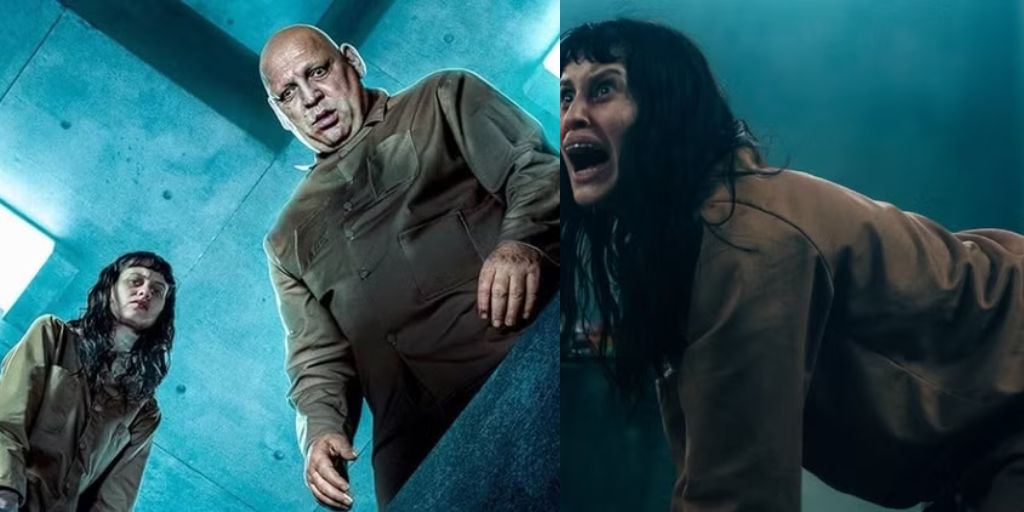
Still from The Platform 2 (Credit: Netflix)
Those at the top don’t need to worry about anything, but everyone else must either take what they can or starve. The film’s horror isn’t just in the violence or gore, but in how it forces viewers to confront uncomfortable truths about how power works in the real world.
The Problem with Repeating the Same Story
While The Platform 2 has many strengths, one of its biggest weaknesses is that it tries too hard to copy the original film’s ending. In the first movie, Goreng’s journey through the tower ends when he finds a young girl who had been sent to prison, much like himself.
In a final act of sacrifice, Goreng gives up his own life to save hers, sending her to the top of the tower on the platform.
He hopes that those in charge will see the girl and understand the suffering they’ve caused, possibly leading to change. This bittersweet ending is both tragic and hopeful, leaving viewers with a sense of how one person’s actions can inspire others.
However, The Platform 2 tries to repeat this emotional impact with Perempuán’s story, and it doesn’t quite succeed. Just like Goreng, Perempuán finds a child in the tower and sacrifices herself to save him. At first, this seems like a touching moment that reflects the same themes of selflessness and hope.
But then the movie reveals that this has happened many times before. We see a montage of other adults who have found children in the tower and sacrificed themselves in the same way.
This twist strips away much of the emotional weight of both Perempuán and Goreng’s sacrifices. Instead of being unique acts of bravery, they are shown as part of a cycle that keeps repeating without any real change.
This revelation undermines much of what made the first movie’s ending so powerful. Goreng’s sacrifice was supposed to be a symbol of hope and rebellion against the oppressive system. But by showing that many others have done the same thing before him, the sequel makes it clear that these actions have had no real effect.
The people in charge of the tower continue to ignore the suffering of those below, and the cycle of oppression continues without end. This leaves both movies feeling more bleak and hopeless than they otherwise would have.
The Ending of The Platform 2 Weakens Its Message
Despite the disappointment of its final moments, The Platform 2 still manages to shown important ideas about society and power. The film continues to shine a light on how the ruling class, represented by the unseen overseers of the tower, keeps the lower classes divided and weak.
By forcing prisoners to fight over food, the people in charge make sure that no one ever questions why they’re in this horrible situation in the first place. This reflects real-life tactics used by those in power to keep the oppressed from rising up.
The idea that the people with the least are made to fight each other while the wealthy remain comfortable is a clear commentary on the unfair systems that exist in many parts of the world today.
However, the final scene of The Platform 2 creates a problem for this message. By showing that Perempuán’s sacrifice, like Goreng’s before her, had no lasting impact, the film suggests that resistance against an oppressive system is pointless.
The audience follows both characters as they endure horrific experiences and make the ultimate sacrifice, only to find out that their efforts were meaningless in the grand scheme of things.
While this might be a realistic portrayal of how hard it is to bring about change, it also leaves viewers with a sense of hopelessness. It’s one thing to show that change is difficult, but another to suggest that it’s impossible.
The decision to repeat the same ending from the first movie, but with a darker twist, weakens the full impact of both films.
It makes it hard to care about the characters’ sacrifices when the movie itself tells us that those sacrifices won’t make a difference. Instead of building on the emotional depth of the original, The Platform 2 undermines it, leaving both films with a sense of futility that wasn’t present in the first movie.
What Could Have Made The Platform 2 Stronger?
There are many ways The Platform 2 could have improved its story and made the ending more meaningful. One option would have been to focus on a different kind of resolution. Instead of repeating the same plot twist from the first movie, the sequel could have shown new ways for the characters to challenge the system of the tower.
Perhaps Perempuán’s sacrifice could have led to a small but significant change, showing that even in the face of overwhelming power, small acts of resistance can still matter.
Another possibility would have been to goes deeper into the world of the tower itself. In both movies, we learn very little about who controls the tower or why it exists. The sequel could have expanded on this mystery, giving viewers more insight into the larger forces at play.
By revealing more about the people behind the tower, the film could have offered new perspectives on power, control, and the possibility of rebellion. Instead, The Platform 2 sticks closely to the formula of the first movie, which makes it feel repetitive rather than fresh.
Finally, the film could have made better use of its new protagonist. Perempuán is a compelling character with her own unique story, but the movie often seems more interested in mirroring Goreng’s journey than showing her as an individual.
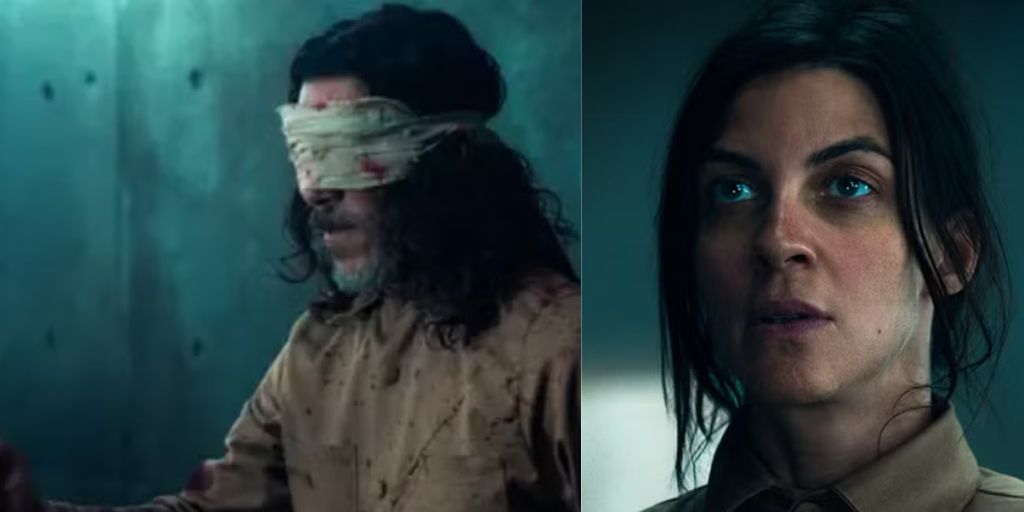
Still from The Platform 2 (Credit: Netflix)
By giving her a more distinct arc and a different kind of ending, the film could have avoided the feeling that it was simply retelling the same story with different characters.
The Platform 2: Still Worth Watching?
Even with its flaws, The Platform 2 is still a strong film that offers plenty of intense moments and thought-provoking ideas. Fans of the original movie will find much to appreciate in the sequel, from its eerie setting to its chilling portrayal of human nature under extreme pressure.
The film continues to offer a sharp critique of how those in power use fear and scarcity to maintain control, forcing people to turn on each other rather than question the system itself.
For viewers who enjoy horror with a deeper message, The Platform 2 is worth watching, even if it doesn’t quite live up to the high bar set by the first movie. It’s a film that raises important questions about inequality, sacrifice, and the struggle for change — even if it doesn’t always provide satisfying answers.
At some point, every child tries to go against their parent’s wishes to do something that their parents wouldn’t approve of. Unfortunately for Emjay Anthony, he gets caught while trying to pull off such a stunt during a time when the fear of Satanic influence was at its peak.
This fear, often referred to as the “Satanic panic,” swept through the 1980s, creating a sense of fear and suspicion about anything that seemed even remotely connected to the occult or “dark arts.” Anthony’s character is about to face some serious consequences for his actions, and this storyline plays a major part in Peacock’s new series, Hysteria!.
Collider has shared an exclusive look at one of the scenes from Hysteria!, where Anthony’s character Dylan tries—and fails—to sneak out with his friends. In this sneak peek, Dylan is stopped in his tracks by his mother, played by Julie Bowen.
She catches him in the middle of a lie, all while the town is in the middle of a moral panic over supposed supernatural activity. The scene shows her laying down the law in a strict and intense manner, making it clear that there will be no dishonesty in her household, and certainly no “devil worship.”
In the scene, we see Dylan finishing up a phone call with his friends, planning to hang out with them. But as soon as he turns around, he realizes that his mother Linda, played by Bowen, has overheard the entire conversation.
Dylan quickly tries to cover his tracks, explaining that he and his friends were only planning to go see the cult comedy UHF by “Weird” Al Yankovic at the local drive-in theater. But as his mom starts asking more questions, Dylan’s story starts to fall apart. It becomes clear that he’s not being completely honest.
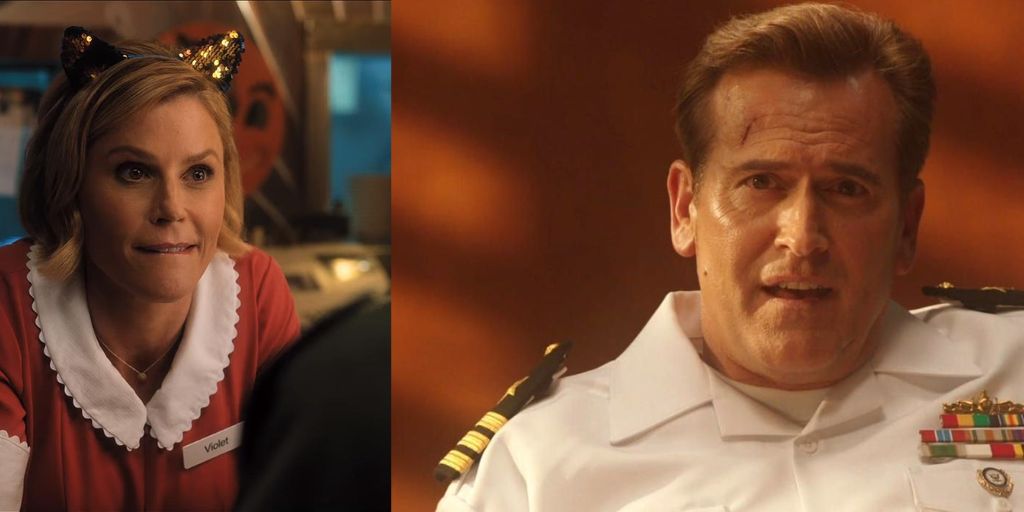
Still from the season (Peacock)
Linda, catching onto his lies, points out that he has his guitar out and ready, and shows him a flyer for a concert by the metal band “Dethkrunch.” This band, which has embraced the town’s obsession with Satanic themes and the occult, is a new favorite among some of the town’s youth—and Dylan seems to be involved in it.
The band’s imagery and style have stirred up the fears of the adults in the town, who see it as a threat to their children’s morals and safety. Linda is furious, and Dylan’s lies, combined with his plans to attend the concert, land him in deep trouble. His punishment? He’s grounded for the weekend, stuck in his room, with his mom determined to make sure that no “dark arts” will come into her house or influence her family.
The show, Hysteria!, focuses on the high school metal band “Dethkrunch,” the very band that Dylan is caught planning to see. The band starts out as just a struggling group of friends trying to make it big in their small town. But as the town becomes more and more obsessed with the idea of Satanic influence, the band decides to change their image to match what the town fears.
They rebrand themselves as a Satanic metal band, taking advantage of the town’s fear to boost their popularity. This shift in their identity leads them down a strange and dangerous path. The town, known as Happy Hollow, has been thrown into chaos after the sudden disappearance of the high school’s star quarterback. This event sends the local community into a frenzy, as everyone starts searching for answers.
People begin to suspect that something more sinister is at play. Rumors about Satanic rituals and dark forces start to spread, and the town quickly becomes gripped by fear. It’s in this atmosphere that the metal band “Dethkrunch” starts to gain more attention—though not always in a positive way.
As more strange and violent events happen in Happy Hollow, including kidnappings and murders, the community starts to turn its suspicions toward the band. Their decision to embrace Satanic themes and the occult makes them easy targets for the town’s hysteria.
The town’s adults, already on edge because of the Satanic panic, are quick to point fingers at the band, blaming them for the strange happenings. A “witch hunt” begins, with the local citizens going after the band members, believing that they are responsible for the evil forces that seem to be at work in their town.
The show, Hysteria!, brings together an impressive creative team. At the helm of the series is Matthew Scott Kane, known for his work on the sci-fi series Stitchers, and David A. Goodman, the showrunner of The Orville and a producer on Family Guy. These two bring their talents to this unique series, blending elements of horror, thriller, and comedy to tell the story of the town’s descent into hysteria.
The cast of Hysteria! is also star-studded, featuring a mix of well-known names and up-and-coming actors. Julie Bowen, who is best known for her role in Happy Gilmore, takes on the role of Linda, Dylan’s strict and protective mother.
Bowen’s portrayal of Linda shows the intense pressure that parents felt during the Satanic panic, as they struggled to protect their children from what they believed were dangerous influences. Emjay Anthony, who starred in Krampus, plays Dylan, the rebellious teenager who finds himself caught up in the town’s chaos.
Alongside Bowen and Anthony, the series also features a strong supporting cast. Anna Camp, Chiara Aurelia, Kezii Curtis, and Nikki Hahn round out the group of series regulars. Each of these characters brings something unique to the story, whether they’re part of the metal band or caught up in the town’s panic in other ways.
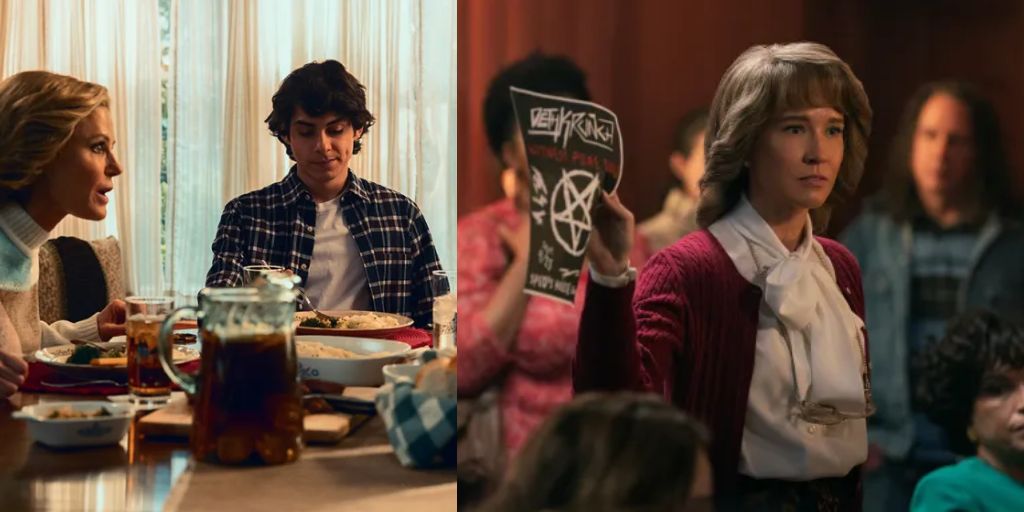
Still from the season (Peacock)
The guest stars for Hysteria! are equally impressive. Leading the group of guest actors is Bruce Campbell, the iconic star of the Evil Dead series. Known for his role as the chainsaw-wielding Ash Williams, Campbell’s presence in Hysteria! adds a fun, horror-themed touch to the series.
Other guest stars include Garret Dillahunt, Nolan North, Elijah Richardson, Milly Shapiro, Allison Scagliotti, and Jessica Treska. With such a talented group of actors and actresses, Hysteria! promises to deliver a thrilling and entertaining viewing experience.
Behind the scenes, the show is produced by Good Fear Content’s Chris Bender and Jake Weiner, alongside Matthew Scott Kane and David A. Goodman. The team also includes John Francis Daley and Jonathan Goldstein, who recently directed Dungeons & Dragons: Honor Among Thieves. With such a strong team of producers, writers, and directors working on the show, Hysteria! has all the ingredients for success.
At its core, Hysteria! explores the way fear and panic can spread through a community, especially when people are unsure of what’s really happening. The Satanic panic of the 1980s serves as the perfect backdrop for this story, as it shows how quickly people can turn against each other when they feel threatened. The show also looks at the role that music and pop culture played in the hysteria, particularly how heavy metal music became a scapegoat for the fears of the time.
While Hysteria! is set in the past, its themes are still relevant today. Fear and misinformation continue to affect society, and the show’s portrayal of how these elements can tear a community apart is both timely and thought-provoking. By blending real historical events with fictional elements, Hysteria! creates a story that is both entertaining and reflective of larger societal issues.
With its mix of horror, humor, and drama, Hysteria! is shaping up to be an exciting new addition to Peacock’s lineup. Fans of shows like Stranger Things and American Horror Story will likely enjoy the show’s dark, yet often comedic, tone. And for those who lived through the Satanic panic of the 1980s, the show will provide a nostalgic look back at a time when fear of the unknown ruled the day.
Hysteria! not only revisits the paranoia and fear that defined the Satanic panic of the 1980s but also delivers a thought-provoking narrative about how communities react when confronted with the unknown. By focusing on a small-town metal band that adopts a Satanic image to rise to fame, the show cleverly taps into the fears and misunderstandings that surrounded heavy metal music at the time.
It presents a vivid portrayal of how easily people can be swept up in hysteria, driven by rumors and fear-mongering, often without seeking the truth. The band, once harmless and struggling, becomes a symbol of everything the town fears, even as they only play into those fears to boost their image.
At the heart of the series is a complex commentary on the dangers of mass hysteria. The show highlights how quickly a community can turn on its own members when fear and suspicion take hold. Through Dylan’s struggles with his strict mother and the rising panic in Happy Hollow, Hysteria! effectively captures the tension between rebellion and conformity, freedom of expression, and societal pressure to conform to moral expectations.
The way the series blends these elements with horror and dark comedy makes it an engaging and timely exploration of themes that resonate beyond its 1980s setting. The series also examines the power of misinformation, showing how false assumptions can lead to real consequences. In today’s world, where misinformation spreads faster than ever, the lessons of Hysteria! feel especially relevant.
By revisiting the past, the show offers a mirror to the present, reminding viewers of the importance of questioning what we’re told and being cautious about how quickly we judge others. In doing so, Hysteria! proves itself not only as a thrilling story but also as a reflection on the lasting impact of fear-driven narratives.
