The second season of The Lord of the Rings: The Rings of Power has been a attractive journey through Middle-earth, filled with evolving storylines and deepening mysteries.
As the narrative unfolds, Episode 5 delivers significant developments that push the boundaries of both character arcs and plot dynamics.
The intricate interplay between ambition, power, and legacy takes center stage as the various factions in Middle-earth grapple with their own destinies and dilemmas.
In this episode, we witness dramatic shifts in Khazad-dûm, Eregion, and Númenor, setting the stage for future conflicts and revelations.
Revisiting Khazad-dûm and the Dwarven Rings
In Episode 5, the focus returns to Khazad-dûm, the ancient Dwarven kingdom, where the seven rings intended for the Dwarf Lords are about to be distributed. The episode begins with King Durin, portrayed by Peter Mullan, receiving his ring.
This ring, like the others meant for the Dwarves, is designed to enhance the abilities of its bearer. As Durin holds the ring, viewers can hear faint, eerie whispers that suggest the ring’s subtle, corrupting influence.
The Dwarves are shown to be significantly impacted by these rings, though the exact nature of this influence varies.
King Durin’s initial actions with the ring appear promising. He confidently selects a new mine site, guided by the ring’s suggestions.
This decision proves successful when sunlight floods the newly discovered shaft, showcasing the ring’s ability to reveal hidden resources.
However, the episode subtly hints at the growing tension within the Dwarven realm. Despite the apparent benefits, there is an underlying sense of unease about the ring’s true impact.
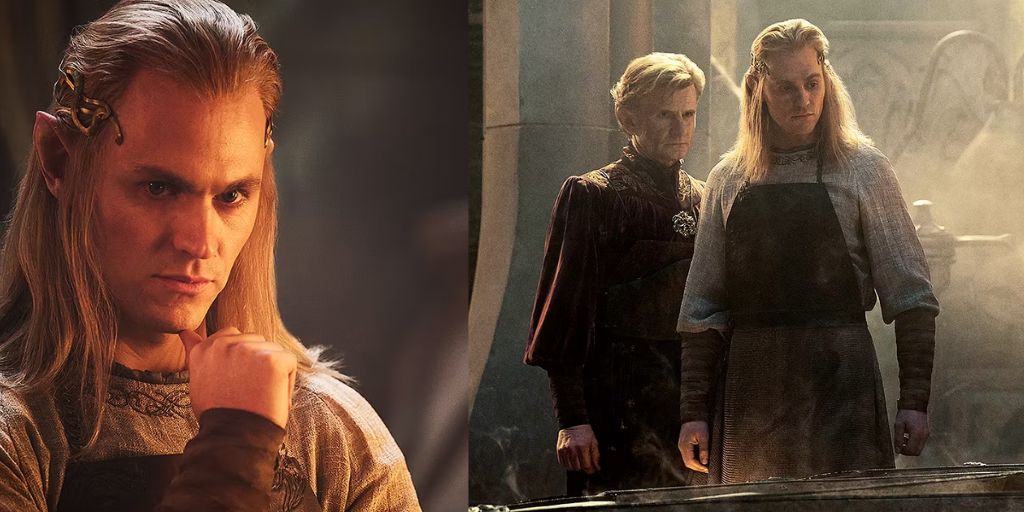
Still from The Rings of Power (Credit: Prime Video)
Princess Disa, portrayed by Sophia Nomvete, is particularly worried about the potential dangers associated with the ring, though her concerns are not fully addressed by the King.
As the episode progresses, the complexities of the Dwarven rings become increasingly apparent, setting the stage for future conflicts and challenges within Khazad-dûm.
Celebrimbor’s Celebration and Annatar’s Scheme
In Eregion, Celebrimbor (Charles Edwards) is seen celebrating the successful creation of the Dwarven rings. This celebration includes a grand gathering where the newly completed Doors of Durin are revealed.
Celebrimbor, proud of the collaboration, is surrounded by key figures such as Narvi and other Dwarven emissaries. The scene reflects the high spirits and achievements of Celebrimbor’s work, though it is marred by underlying tensions.
Annatar (Charlie Vickers), who has been subtly influencing Celebrimbor, uses this opportunity to further his own agenda. He expresses sympathy for the Men suffering in Mordor and suggests that creating rings for Men could stabilize Númenor, implying that these rings might be used to alleviate the hardships faced by the people. Celebrimbor, however, is wary of this suggestion.
He fears that rings meant for Men could be corrupted, much like the ones created for the Dwarves. Annatar’s persuasive arguments, while compelling, are met with resistance from Celebrimbor, who remains cautious and hesitant.
This interaction reveals Annatar’s manipulative tactics and his desire to sway Celebrimbor’s decisions to fit his own plans. The scene underscores the growing tension between Celebrimbor’s integrity and Annatar’s hidden motives.
Pharazôn’s Ambitions and Kemen’s Concerns
In Númenor, Pharazôn (Trystan Gravelle) reflects on his newfound role and the nature of immortality, believing it to be an unattainable ideal for Men. His son, Kemen (Leon Wadham), expresses concerns about Pharazôn’s ambitions, urging him to focus on his current responsibilities rather than seeking more power.
Pharazôn recounts a prophecy related to Kemen’s mother but chooses to keep its full meaning a secret until Kemen fulfills a specific task.
Miriel (Cynthia Addai-Robinson), still reeling from the failed coronation, struggles with the political and personal ramifications of her defeat. Elendil (Lloyd Owen) reassures her of the continued support from their allies and suggests that the vision he saw in the palantir may offer hope despite the current adversity.
The episode goes into Miriel’s inner conflict and her struggle to maintain her position amidst mounting pressures. Elendil’s presence provides a source of comfort and stability, even as he is cautioned to avoid immediate conflicts. The interactions between Pharazôn, Kemen, and Miriel highlight the shifting dynamics and political intrigue within Númenor.
Elendil’s Struggles and Miriel’s Vision
As Elendil returns to the harbor, he faces a challenging situation. The Sea Guard, loyal to Miriel, are seen surrendering their uniforms under Kemen’s and Eärien’s (Ema Horvath) watchful eyes.
Valandil (Alex Tarrant) explains that those loyal to Miriel have been stripped of their ranks, adding to the political tension. Elendil’s reaction to this action is one of disapproval, particularly towards Eärien, who has taken a decisive role in this purge.
Elendil’s gesture of handing over his sword to the former Sea Guard members is a powerful act of defiance and loyalty. Despite Kemen’s attempt to undermine Elendil, the remaining sailors show their respect by saluting him. The episode shows the complex dynamics of loyalty, power, and resistance within Númenor.
Eärien’s efforts to persuade Valandil to change his stance are met with resistance, further complicating the political view. The internal conflicts and shifting alliances within Númenor underscore the growing instability and the personal sacrifices made by key characters.
Disa’s Discovery and the Dwarven Dilemma
Disa (Sophia Nomvete) is depicted grappling with her feelings about King Durin’s use of the ring to find new mine sites. She perceives the King’s reliance on the ring’s guidance as unfair, especially when compared to traditional methods of stone-singing.
While searching for a birthday gift for their daughter, Disa and Durin encounter increased market prices due to the King’s new tax law, highlighting the economic impact of the ring’s influence.
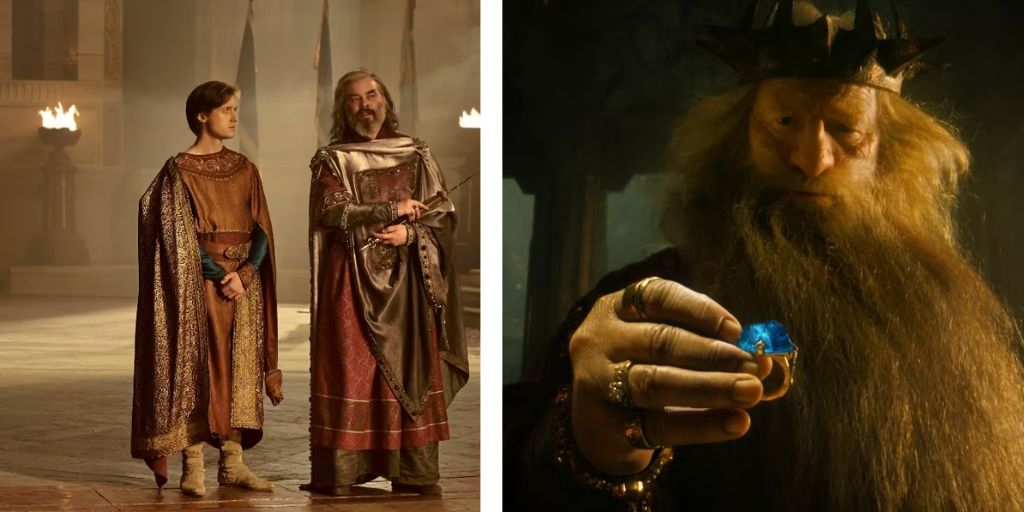
Still from The Rings of Power (Credit: Prime Video)
A pivotal moment occurs when Disa accidentally drops a tuning crystal into a tunnel. This seemingly minor event leads to the discovery of a hidden cavern with a lake. Disa’s stone-singing attempts awaken something within the water, hinting at ancient and potentially dangerous forces beneath Khazad-dûm.
This discovery raises concerns about the risks associated with further mining and the broader implications of the rings on the Dwarven realm. The episode goes into the growing sense of unease and the potential dangers posed by the King’s decisions and the rings’ influence.
The Dwarven Rings and the Mounting Tensions
King Durin continues to distribute the remaining rings to emissaries from other Dwarven realms, emphasizing that these rings come with a significant cost.
His eagerness to dig deeper into the mines, driven by the ring’s guidance, leads to increasing tension and disregard for safety measures. The episode highlights the King’s obsession with acquiring jewels and treasures, overshadowing concerns about potential risks.
Prince Durin’s warnings about an ancient evil beneath the mines are dismissed by the King, reflecting a dangerous lack of foresight. The episode portrays the growing peril within Khazad-dûm as the Dwarves’ focus shifts from safety to the allure of the rings’ benefits.
The escalating tensions and disregard for traditional precautions underscore the potential consequences of the King’s decisions and the broader implications for the Dwarven realm.
Celebrimbor’s Suspicion and Annatar’s Manipulation
In Eregion, Celebrimbor’s growing suspicion about the rings’ corruption becomes a central theme. Mirdania (Amelia Kenworthy) experiences a troubling vision related to the ring she was resizing, intensifying Celebrimbor’s concern. The episode shows the effects of the rings on the Elves and their craftsmanship, highlighting the impact of Annatar’s manipulation.
Annatar’s influence is evident as he downplays the corruption issue and suggests that Celebrimbor’s dishonesty has tainted the rings. He manipulates Mirdania’s perception of her vision to align with his own agenda.
Celebrimbor’s anxiety about the rings’ corruption is compounded by Annatar’s subtle coercion. The episode goes into the complexities of Annatar’s schemes and the growing tension between Celebrimbor’s integrity and the corrupting influence of the rings.
Valandil’s Tragic End and the Power Struggles in Númenor
The episode reaches a dramatic climax with Kemen’s actions resulting in a tragic confrontation. Elendil’s anger leads to a physical altercation with Kemen, and Valandil intervenes to protect Elendil. Despite Valandil’s efforts, he is fatally injured by Kemen, highlighting the deepening power struggles within Númenor.
Elendil’s subsequent arrest by Kemen further complicates the situation, leaving him in a precarious position. The episode underscores the internal conflicts and shifting alliances within Númenor, reflecting the broader impact of Pharazôn’s ambitions and the instability facing the realm.
The tragic turn of events highlights the personal sacrifices and the growing tensions within Númenor’s political view.
The Looming Threat and the Convergence of Plots
As the season progresses, the various storylines begin to converge, creating a sense of looming danger. In Eregion, Celebrimbor’s realization about the rings’ corruption and Annatar’s manipulation adds urgency to the situation. The threat of the Orcs, now advancing toward Eregion, exacerbates the sense of impending peril.
Gil-galad’s struggle to balance the threats from Adar and Sauron further complicates the Elves’ position. Galadriel’s arrival in Mordor introduces a new dynamic as she seeks to address the mutual threat with Adar.
The episode shows the interconnectedness of the characters’ journeys and the escalating stakes. The convergence of these plotlines sets the stage for significant developments and increased tension as the season progresses.
The Future of Khazad-dûm and Númenor
The episode concludes with a focus on the future of Khazad-dûm and Númenor. The consequences of the rings’ influence and the power struggles within Númenor become more pronounced.
The Dwarven realm faces increasing risks as the rings’ impact becomes evident, while Númenor grapples with internal conflicts and political instability.
The characters’ decisions and actions in the face of these challenges will shape the future of their respective realms.
The episode leaves viewers with a sense of anticipation and uncertainty, setting the stage for the unfolding events in the next season. The intertwined fates of Khazad-dûm and Númenor reflect the broader themes of power, corruption, and resilience in the face of adversity.
Episode 5 goes into the repercussions of the Dwarven rings and the political turmoil in Númenor. In Khazad-dûm, King Durin receives a powerful Dwarven ring that augments his abilities but starts causing instability.
His reliance on the ring leads to problematic decisions that affect the realm’s safety and economy. Princess Disa is troubled by the ring’s effects, fearing it might bring more harm than benefit.
In Eregion, Celebrimbor celebrates the successful creation of the Dwarven rings but remains concerned about their potential to corrupt.
Annatar, manipulating Celebrimbor, pushes for the creation of rings for men, citing their ability to stabilize Númenor. Celebrimbor, however, is skeptical and fears the possible damage these rings might cause.
Númenor’s internal conflict intensifies with Pharazôn’s growing ambitions and Kemen’s concerns about the stability of their leadership.
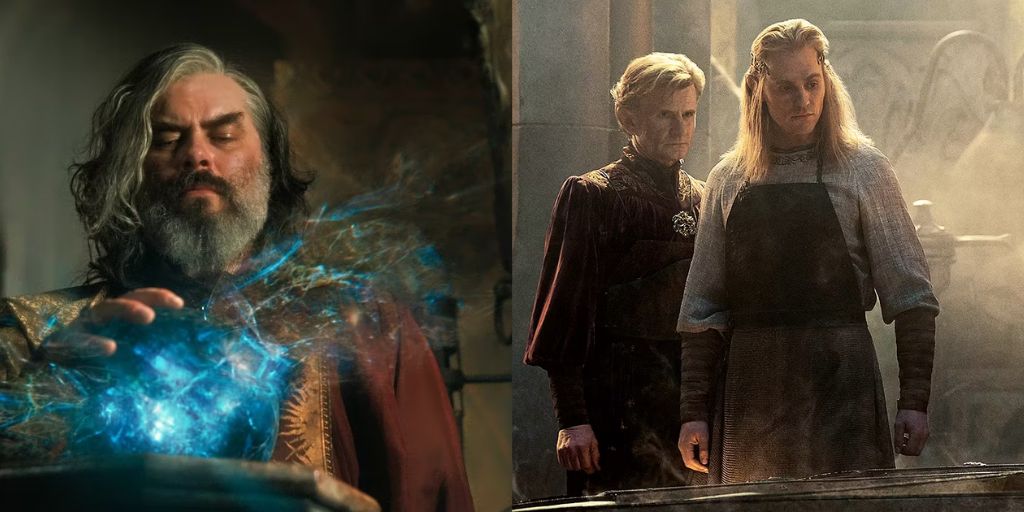
Still from The Rings of Power (Credit: Prime Video)
Miriel struggles with the fallout from a failed coronation and the political instability it has caused. Elendil faces betrayal and violence, culminating in a tragic confrontation that results in Valandil’s death and his own arrest.
The episode also highlights the impending threat of Orcs, with the narrative setting the stage for future conflicts. It reflects the themes of power, corruption, and resilience as characters confront the consequences of their choices. The intertwined fates of Khazad-dûm and Númenor drive the story forward, leaving viewers anticipating the next developments in this epic saga.
Season 4 Part 2 of Emily in Paris starts strong but quickly loses continuity, leaving fans puzzled. While Sylvie (Philippine Leroy-Beaulieu) and Mindy (Ashley Park) provide stability, Camille’s (Camille Razat) inconsistent storyline creates confusion. The finale introduces Marcello (Eugenio Franchesini), offering a hopeful twist for future episodes.
A Shaky Start for Part 2
When we last saw Emily Cooper (Lily Collins) in Emily in Paris, it seemed like her life was finally falling into place. She was in a stable relationship with Gabriel (Lucas Bravo), her friendship with Camille (Camille Razat) was improving, and her professional life with Sylvie (Philippine Leroy-Beaulieu) was on solid ground.
The anticipation for Season 4 Part 2 was high, as fans hoped to see these positive developments continue. However, the second part of the season has not met these expectations.
It appears to have overlooked the progress made in Part 1, leaving many viewers frustrated and confused.
Part 2 of Season 4 starts with a sense of discontinuity. The character arcs that were carefully developed in Part 1 seem to unravel, leading to a disjointed narrative.
For instance, Emily’s stable romance with Gabriel is quickly overshadowed by new complications, while her professional growth is sidelined.
This lack of continuity affects the full viewing experience, making it difficult for fans to stay invested in the storylines.
The show’s tendency to shift focus and change character dynamics without clear resolution contributes to a sense of unpredictability that many viewers find off-putting.
The lack of a coherent storyline in Part 2 makes it hard to appreciate the developments that were set up in the previous episodes. What initially seemed like a promising continuation has turned into a fragmented narrative.
As the season progresses, fans are left questioning whether the series will ever achieve a stable direction or if it will continue to reinvent itself at the expense of narrative clarity. This uncertainty adds to the growing dissatisfaction with the show’s progression.
Sylvie and Mindy Bring Sensibility to Part 2
Amid the chaotic and inconsistent plotlines of Part 2, Sylvie (Philippine Leroy-Beaulieu) continues to be a stabilizing force. Her role as Emily’s boss has always been vital, and her strong, composed presence remains a cornerstone of the series.
Sylvie’s character is crucial for maintaining a sense of balance amidst the often tumultuous narrative. Her decisions and actions are grounded and deliberate, providing a counterpoint to the often erratic behavior of other characters.
In Season 4 Part 2, Sylvie gets new romantic developments with clarity and purpose. Unlike many other characters who seem to fluctuate between extremes, Sylvie’s storyline is marked by her ability to set boundaries and make thoughtful choices.
This consistency makes her a reliable character in a show that often feels disjointed. Fans can trust that Sylvie will handle any challenges with her characteristic poise, making her storyline one of the most engaging aspects of the season.
Mindy (Ashley Park) also adds a sense of realism and stability to Part 2. For the first time, Mindy faces significant struggles in both her career and personal life. Her departure from her usual glamorous appearance and her grappling with uncertainty offer a more grounded perspective.
The scenes where Mindy’s singing talent is showcased provide a welcome break from the show’s typical chaos, highlighting her growth and depth. Together, Sylvie and Mindy offer a balanced and compelling counterpoint to the show’s more unpredictable elements.
Confusion with Camille’s Storyline
Camille’s storyline in Season 4 Part 2 stands out as a major source of confusion. The show seems to ignore important aspects of her past, particularly her emotional breakup with Sofia (Melia Kreiling) and her previous plans to co-parent a baby.

Still from Emily in Paris (Credit: Netflix)
This oversight creates a disjointed narrative that affects Camille’s character development and her role in the story. The sudden shift in focus to Gabriel, coupled with Camille’s fluctuating status as either friend or rival to Emily, disrupts the full flow of the plot.
Camille’s inconsistent portrayal highlights a broader issue within the series: a tendency to prioritize drama and surprise twists over character consistency.
While this approach may create short-term excitement, it often undermines the depth and believability of the characters.
Camille’s confusing arc is a prime example of how the show’s frequent changes can detract from its full impact. Viewers are left struggling to understand Camille’s motivations and intentions, which affects their engagement with the storyline.
The lack of coherence in Camille’s character arc points to a need for greater narrative consistency. While soap operas and melodramas often thrive on constant changes, Emily in Paris would benefit from a more cohesive approach.
By addressing past storylines and maintaining character consistency, the show could enhance its full appeal and provide a more satisfying viewing experience.
A Refreshing Twist in the Finale
Despite the challenges of Part 2, the season finale offers a refreshing twist that sets it apart from the rest of the episodes. The introduction of Marcello (Eugenio Franchesini) adds a new and interesting dynamic to the show.
As an unexpected love interest for Emily, Marcello brings a grounded and level-headed perspective that contrasts with the usual melodrama. His straightforward attitude and refreshing presence offer a welcome change from the show’s often chaotic plotlines.
The finale itself is a highlight of Season 4 Part 2. It features strong writing, direction, and performances that make it feel like a new chapter for the series.
The major twist at the end hints at a potential new direction for Emily, suggesting that the show could benefit from a reset. This twist provides a sense of hope that the series might find a more cohesive and satisfying path in future seasons.
Marcello’s addition, along with the smart writing and strong performances in the finale, helps to redeem some of the shortcomings of Part 2. They offer a view of what the show could become if it builds on these positive elements.
While it remains uncertain how the series will continue, the ending of Part 2 suggests that there is potential for a more engaging and coherent storyline.
Fans are hopeful that the show will capitalize on this momentum and deliver a more consistent and satisfying experience in future seasons.
In Season 4 Part 2 of Emily in Paris, the narrative suffers from a lack of continuity, confusing fans who were eager to see the positive developments from Part 1 continue.

Still from Emily in Paris (Credit: Netflix)
Emily Cooper’s (Lily Collins) previously stable romance with Gabriel (Lucas Bravo) and her improved professional and personal relationships seem to unravel, leaving viewers frustrated. The season begins with promise but quickly becomes disjointed, making it difficult for fans to stay invested.
Despite these issues, Sylvie (Philippine Leroy-Beaulieu) and Mindy (Ashley Park) offer stability and depth.
Sylvie’s composed nature and thoughtful decisions remain a strong anchor, while Mindy’s struggles and growth provide a relatable and grounded perspective. Their storylines stand out amidst the chaos of other characters.
Camille’s (Camille Razat) arc is particularly confusing, as the show overlooks her previous emotional breakup and shifts her focus abruptly. This inconsistency affects her role and disrupts the narrative flow.
The finale, however, introduces Marcello (Eugenio Franchesini), a new love interest for Emily, bringing a refreshing change.
The strong ending and Marcello’s grounded presence hint at a potential reset for the series, offering hope for a more cohesive storyline in future seasons.
