Prime Video’s The Lord of the Rings: The Rings of Power adds to the story of Middle-earth by showing events from the Second Age, which takes place thousands of years before Peter Jackson’s films. This series tells a unique story of good versus evil as characters fight for their homes.
Conflict spreads across Middle-earth, and characters face many dangers, including threats from Sauron (Charlie Vickers) and Adar (Sam Hazeldine), as well as from dangerous creatures that live in the world.
The Rings of Power has shown many creatures in Middle-earth, from giant spiders to balrogs. In Season 2, Episode 6, called “Where Is He?”, the show introduces a sea worm that connects to the Numenórean story.
This beast is big and scary, with tentacles, huge teeth, and a pointed nose. It is no surprise that the Numenóreans see it as a danger. But what is the mysterious sea worm, and is it as dangerous as it appears?
The sea worm plays a small but important role in the series, showing proof of the Valar’s favor. Its presence adds to the Numenórean story, which is about a struggle for power. Míriel (Cynthia Addai-Robinson), the former King’s daughter, is one of the few Faithful who serve the Valar.
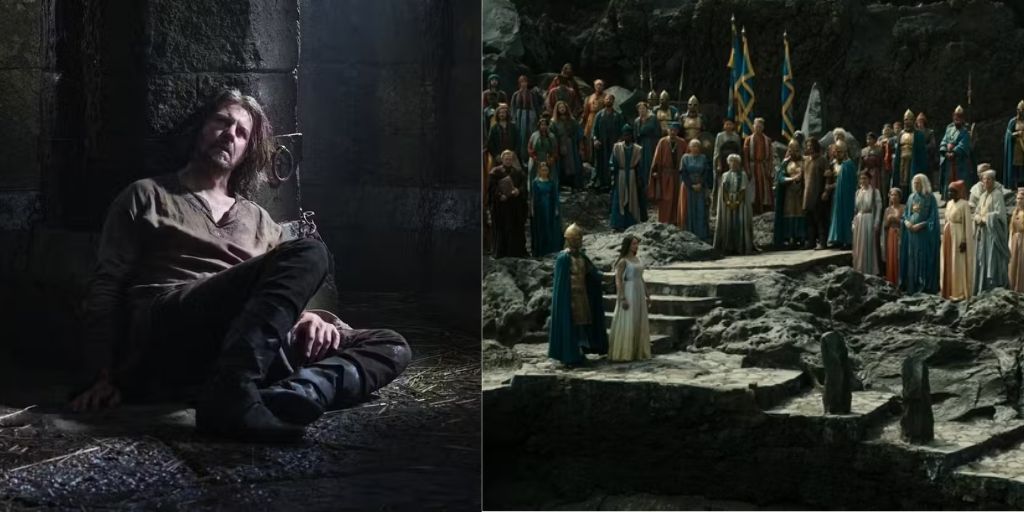
Still from the show (Prime Video)
But she has lost favor with the Numenóreans, who chose Pharazôn (Trystan Gravelle) to be the new King.
Pharazôn has no connections to the Faithful and even persecutes them. Although it appears only for a short time, the sea worm changes the conflict between these two rulers.
Elendil (Lloyd Owen) supports Míriel, but a fight in Episode 5, called “Halls of Stone,” leads to his arrest. Elendil refuses to reject his beliefs and swear loyalty to Pharazôn, so he is put on trial.
Ironically, Pharazôn decides to punish Elendil in an old way, following the traditions of the Faithful that he wants to destroy as King.
Instead of executing Elendil for his rebellion, Pharazôn plans to summon the monster, intending to throw Elendil into the sea to face it, giving him a slim chance to survive. However, according to their beliefs, Míriel takes Elendil’s place because his so-called treason was done in her name.
Míriel goes into the water, and the sea monster’s tentacle pulls her under. But when Míriel meets the beast, it does not attack her. Instead, it watches her for a moment, lets out a loud sound, and spits her back out.
Míriel’s miraculous survival wins her favor with the Numenórean once again, showing that the sea worm has power even as the old ways fade.
This connection links ancient Numenór to the frightening creature and shows a relationship between the sea worm and the Valar, as the beast is trusted to deliver their judgment. However, there is still much we do not know about the creature.
Although many differences exist because of the limits on what Prime can adapt, much of The Rings of Power is inspired by J.R.R. Tolkien’s writings.
The series includes familiar characters, like Galadriel (Morfydd Clark) and Elrond (Robert Aramayo), and the growing conflict between Míriel and Pharazôn is part of that.
However, no sea worm is mentioned in Tolkien’s extensive writings.
The Rings of Power created the idea of a trial by sea monster as a new twist, making it an interesting part of the series. It adds tension to Míriel’s story and gives the Valar a chance to intervene, if Numenór will listen.
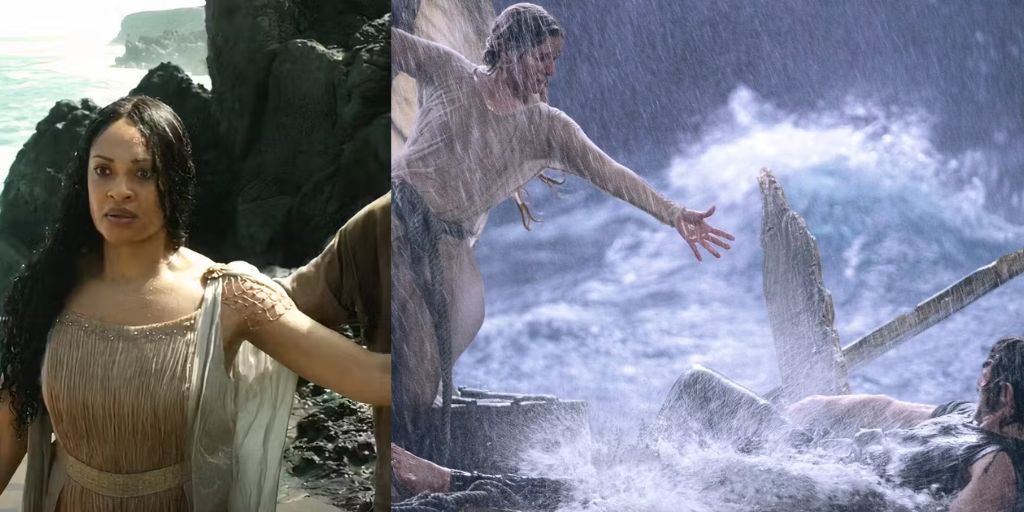
Still from the show (Prime Video)
While Tolkien did not create a sea worm or similar creature for Numenór, he mentioned sea monsters in Middle-earth. In The Lost Road and Other Writings, Tolkien talks about sea serpents or fish-dragons, but these are mostly Elvish legends.
It is important to note that few of Tolkien’s stories take place near the sea, so sea monsters are not a big concern. Since Numenór is an island nation, adding the sea worm to The Rings of Power makes sense.
The biggest issue with having no equivalent to the sea worm in Tolkien’s writings is that there is little information about the creature. Its role in the show, though important, is short.
However, Season 2 is not the sea worm’s only appearance. It had an earlier role in The Rings of Power.
At the beginning of the story, Galadriel is sent to Valinor as a way for the Elves to honor her, but she refuses to give up her quest for Sauron. She jumps off the boat as it enters the Undying Lands and tries to swim for shore. During her swim, Galadriel meets a monster, which is a sea worm.
It is unclear if this is the same creature that judges Míriel, but it is at least the same species. In Season 1, the sea worm scares the crew of a ship that held Halbrand (who is actually Sauron).
Galadriel joins the survivors, setting up her deception by Halbrand. Elendil eventually saves both of them, bringing Galadriel and Halbrand to Numenór.
This is another brief part for the sea worm, but it helps show where the creature is located. Given that Galadriel lost her ship just outside Valinor, it makes sense that Elendil meets Galadriel and Halbrand in that direction.
This hints that these creatures live in the waters between Numenór and Valinor, reinforcing the link between the sea worm and the Valar.
Although it judges Míriel innocent, the sea worm is less calm when it meets a ship carrying Sauron, who is an enemy of the Valar.
If the sea worm truly follows the orders of Eru Ilúvatar and the Valar, then it may not be as dangerous as it looks.
The lack of explanation about the sea worm creates a new mystery for Middle-earth, adding to the world in a surprising way
The Simpsons has stuck to certain familiar patterns over the years. Regardless of whether Homer Simpson (voiced by Dan Castellaneta) gets fired or stumbles into a new job, he continues working at the Springfield nuclear power plant.
Lisa (Yeardley Smith) remains the intelligent and responsible one, while Bart (Nancy Cartwright) never stops being the troublemaker.
Fans of The Simpsons have often tried, without success, to figure out where Springfield is located in the USA. Eventually, series creator Matt Groening revealed that he named it after Springfield, Oregon.
The biggest thing that stands out about The Simpsons is that the characters have not aged much during the 35 years the show has been on air.
This fact has led to many fan theories. Some believe Homer is in a coma, while others suggest that Springfield is stuck in a time loop. However, the most straightforward explanation is that The Simpsons uses something called a “floating timeline.”
This approach allows the show to keep updating itself while maintaining its key elements. Comic books, especially from Marvel and DC, have used this method for years.
The Simpsons was the first animated sitcom to adopt this tradition. While the floating timeline has helped the series stay relevant by addressing current trends, it has also created some inconsistencies in the storyline — but this might be coming to an end.
The Floating Timeline of ‘The Simpsons’ Has Created Some Conflicts
The floating timeline in The Simpsons allows the show to keep up with current pop culture trends. It also plays a part in the show’s strange habit of predicting events that later come true in real life. Since the characters do not age, anything is possible when it comes to comedy.
However, this floating timeline has caused the show to contradict itself, especially regarding Homer and Marge (Julie Kavner)’s relationship.
In Season 2’s episode “The Way We Was,” we see their first meeting in high school, with other episodes covering the early days of their marriage and the births of Bart, Lisa, and Maggie. However, newer episodes have changed this history.
For instance, Season 19’s “That ’90’s Show” (which is unrelated to the Netflix spinoff) alters the details of Bart’s conception. Season 29’s “3 Scenes Plus a Tag from a Marriage” takes it even further, showing that Homer and Marge lived in a different city from Springfield at one point.
These changes have upset some fans, but producer Matt Selman told IGN that the show was never meant to follow a strict timeline.
“We don’t have the pressures that other shows have — like needing to be serialized or having a season-long arc.
We’re a classic ’90s show where every episode could be the first or last episode of The Simpsons. We’re not really tied to continuity, even though some people love it. Each episode is like its own mini-movie.”
That approach, however, could change with Season 36.
‘The Simpsons’ Latest Season Might Introduce Real-Time Aging
Season 36 of The Simpsons is set to begin with an episode titled “Bart’s Birthday.” This will be the first time one of the Simpsons family members has an on-screen birthday.
Bart has always been shown as a 10-year-old, but now The Simpsons seems open to the idea of moving away from its floating timeline by aging Bart.
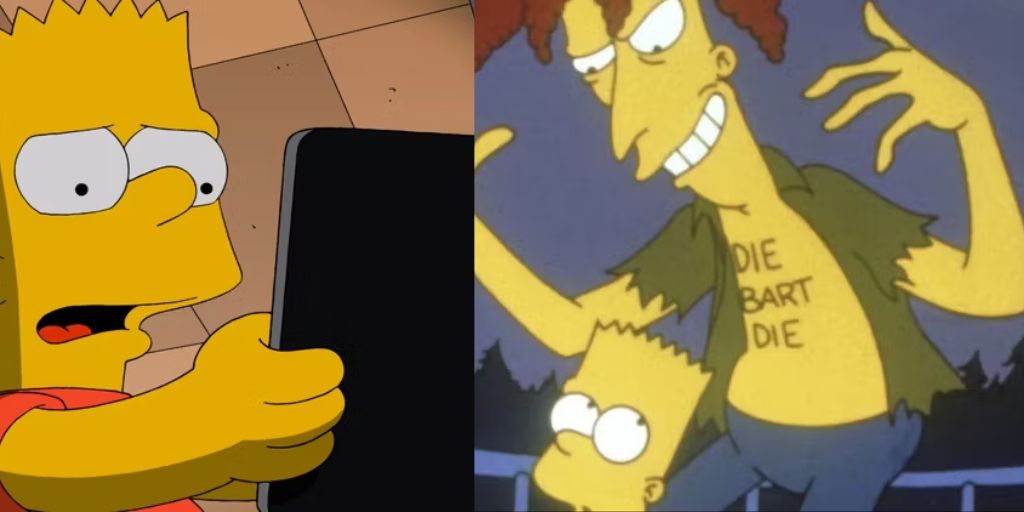
Still from The Simpsons (Credit: Disney+)
The show has experimented with glimpses of the future before, such as in the episodes “Lisa’s Wedding” and “Holidays of Future Passed,” where older versions of Bart, Lisa, and Maggie are shown.
However, Bart growing up became a real possibility in Season 35’s episode “A Mid-Childhood Night’s Dream.”
In this episode, Marge realizes that Bart is almost ready for fifth grade, making her come to terms with the fact that her “special little guy” is growing up.
This episode was praised for its emotional approach and may also have hinted that after 35 years, the creative team behind The Simpsons is ready to head in a new direction.
It remains to be seen whether “Bart’s Birthday” will truly mark a shift in the show or if the residents of Springfield will continue to live without aging.
The Simpsons can be streamed on Disney+, and Season 36 premieres on September 29, 2024.
