In 2016, South Korean director Na Hong-jin released “The Wailing,” a gripping film that blends black comedy with chilling horror. Combining elements of zombie thrillers, psychological terror, and occult horror, the film earned its place as one of the most underappreciated Korean horror films. The complex narrative and surprising twists have left audiences fascinated with many trying to unravel the meaning behind its mysterious conclusion.
“The Wailing” revolves around Jong-goo (played by Kwak Do-won), a police officer, husband, and father. In the small, isolated village of Gokseong, strange and violent murders begin to unfold. Ordinary villagers are inexplicably turning into savage killers, leaving everyone puzzled. However, when these events coincide with the arrival of a mysterious Japanese man (Jun Kunimura), the village starts to suspect that something supernatural might be happening.
The Wailing Ending Explained
Despite the terrifying murders, Jong-goo remains initially skeptical about supernatural causes. His doubts begin to fade when his young daughter, Hyo-jin (Hwan-hee Kim), begins showing bizarre symptoms, such as violent behavior and a mysterious skin condition. In an attempt to find answers, Jong-goo consults with a local deacon, Yang Yi-sam (Do-yoon Kim), and confronts the Japanese man, who insists he knows nothing of the murders. Despite his suspicions, Jong-goo pressures the Japanese man to leave.
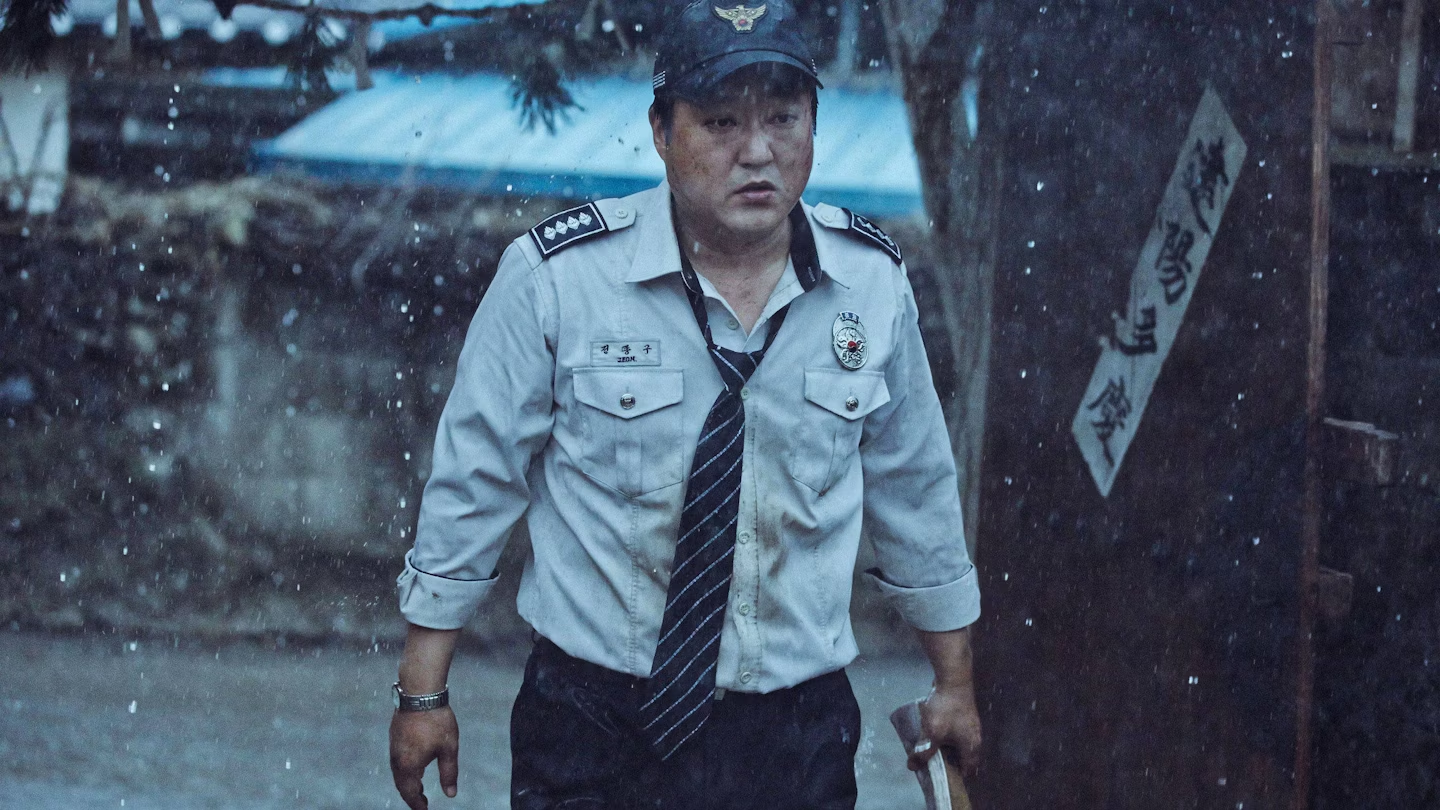
Jong-goo (Image via Getty)
Jong-goo’s Investigation Deepens
As the violence intensifies, Jong-goo finds himself increasingly caught in a personal battle. Even after a chilling encounter with a strange apparition and disturbing nightmares, he remains unconvinced that a spirit or demon is behind the chaos. His world is turned upside down when he finds a disturbing photo of the Japanese man with images of past murderers and victims. This discovery intensifies his desperation, and he warns the Japanese man to leave, or face deadly consequences.
Desperate for help, Jong-goo’s mother-in-law calls upon Il-gwang (Hwang Jung-min), a well-known shaman specializing in possession and demonic exorcism. Il-gwang reveals a terrifying theory: the Japanese man is not an ordinary human but a demon in disguise, whose presence in the village has corrupted the people. Jong-goo, still doubtful of the supernatural, is reluctantly forced to accept the shaman’s assistance when his daughter’s condition worsens.
The Climax: Unraveling the Truth
After sabotaging the exorcism, Jong-goo returns home to discover that his daughter has vanished. Il-gwang then reveals a surprising twist : the true demon is not the Japanese man but Moo-myeong (Chun Woo-hee), the mysterious woman who has been lurking around the village. The Japanese man, in truth, is a shaman who has followed the demon to Gokseong with hopes of ending its reign of terror.
In a tense confrontation with Moo-myeong, Jong-goo is torn between two choices. Moo-myeong claims to be the only one who can save Hyo-jin, and she urges Jong-goo to wait for her trap to catch the demon. The alternative is to trust the warnings of the shaman and rush back home to prevent further violence. Ultimately, Jong-goo opts to rush home, only to find that his daughter has killed his entire family, now fully possessed by the demon.
The Final Moment
In the heartbreaking conclusion, Jong-goo, overcome with grief, promises to protect his now-possessed daughter. The film ends ambiguously, leaving viewers to question the true nature of the demon and what it truly wanted. Was the demon targeting the village for its sins, or was there a deeper, more personal reason for its destructive path?
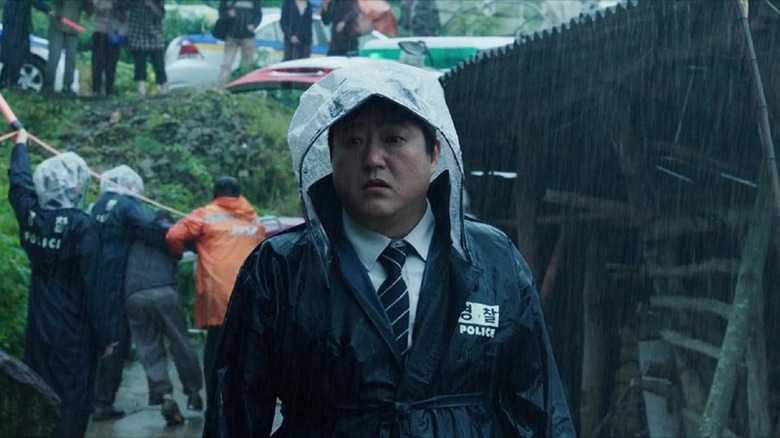
Jong-goo (Image via Getty)
Unraveling the Demon’s Identity
In the film’s final moments, the mystery surrounding the demon begins to unfold. The Japanese man, who had been believed to be the demon, is revealed to be a ghost — a demonic entity that has taken the form of a human. In an unsettling transformation, the Japanese man sheds his human disguise, revealing his true form as a monstrous, twisted creature with red eyes and grotesque features.
The identity of Moo-myeong remains unclear, though it is suggested that she may have been the true shaman, attempting to stop the demon’s destruction. However, her efforts were ultimately unsuccessful. Meanwhile, Il-gwang, once considered an ally, is revealed to have been corrupted by the demon, helping it to kill the villagers. In a chilling final scene, Il-gwang takes photos of Jong-goo and his possessed daughter, seemingly to add to the demon’s collection of souls.
Interpreting the Ending
The ending of “The Wailing” is deliberately ambiguous, leaving audiences with more questions than answers. While it’s clear that the demon has succeeded in overtaking Hyo-jin, the true reason for its arrival remains elusive. One interpretation suggests that the demon was drawn to the town because of its inhabitants’ collective sins, as implied by Moo-myeong. This theory aligns with the idea that the evil in Gokseong is not just supernatural but also tied to human wrongdoing.
Possible Alternative Explanations
The film’s ambiguity has spurred various interpretations, with some viewers suggesting that the supernatural elements are a red herring. One popular theory posits that the violence in the village is the result of a poisonous mushroom epidemic, which causes hallucinations and madness. This theory suggests that the demonic presence in the film is simply a hallucination induced by the mushrooms, with the violence being a natural consequence of the epidemic.
While the film’s themes of religion and family are central, there is an undercurrent of xenophobia in the portrayal of the Japanese man. The village’s immediate suspicion of the foreigner and the derogatory language used to describe him reflect an unintentional subtext of fear and mistrust toward outsiders. Director Na Hong-jin has explained that he did not intend to focus on xenophobia but instead wanted to highlight the mystery and fear that arise from the presence of an unknown threat.
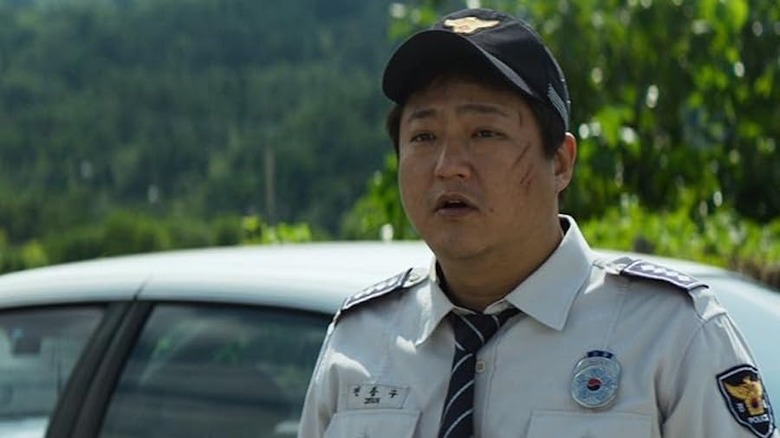
Jong-goo (Image via Getty)
Na Hong-jin’s Approach to the Ending
Director Na Hong-jin crafted the film’s ending to allow for multiple interpretations, aiming to satisfy a wide range of audiences. In interviews, he discussed how he deliberately left the conclusion open-ended, allowing viewers to come up with their own interpretations. This approach paid off, as the film’s ambiguity sparked intense discussions and theories from fans around the world.
Critical Reception of the Ending
While “The Wailing” received widespread critical acclaim, the ending itself generated mixed reactions. Some critics, such as those from Empire, praised the film’s stunning conclusion, while others felt that the twists were clumsily executed. Audiences, too, were divided, with some embracing the ambiguity and others seeking more concrete answers.
The Castlevania animated series has been a favorite among fans of dark fantasy, action, and adventure. Based on the popular video game franchise, Castlevania: Nocturne continues the story of the Belmont family and their fight against powerful vampires and dark forces.
Season 2 of Nocturne reaches its fiery conclusion with the final battle between good and evil. The characters face incredible dangers, and the fate of France and humanity hangs in the balance. While the main threats are defeated, the series ends with lingering questions, leaving the door open for future seasons.
The Vampire Hunters End the Threat of the Eternal Night
Throughout Castlevania: Nocturne, the primary villain has been Erzsebet Báthory (Franka Potente). Báthory seeks to gain the powers of the Egyptian goddess Sekhmet to bring about a solar eclipse. This eclipse would plunge the world into eternal darkness, where vampires would rule over humanity.
Báthory attempts to absorb Sekhmet’s powers by eating the goddess’s heart. However, Annette discovers a piece of Sekhmet’s soul in the spirit world. The spirit of Sekhmet enters Annette’s body, giving her the power to defeat Báthory.
In a shocking twist, Drolta (Elarica Johnson) betrays Báthory and kills her. Drolta drains the remaining powers from Báthory. In the finale, the spirit of Sekhmet, still inside Annette, rejects Drolta and absorbs the pieces of her soul that Drolta had stolen. But this process is not easy. The strain of having Sekhmet’s spirit inside Annette nearly kills her.
As the battle intensifies, Drolta faces off against Alucard (James Callis), stabbing him with his sword. However, Richter’s (Edward Bluemel) confession of love for Annette helps bring her soul back from the spirit world. Annette’s relatives, along with the spectral being Ogun, assist Annette in returning to her body. Annette wakes up in Richter’s arms, safe from harm.
With Annette now back to normal, Richter finally finds the strength to fight against Drolta. Throughout the series, Richter has struggled to control his magical powers. But in the finale, he unlocks his full potential. This moment is significant, as Richter is not only a vampire hunter but also the descendant of two powerful figures: Trevor Belmont and Sypha Belnades.
These two ancestors played vital roles in past Castlevania stories. Richter’s final battle against Drolta is an emotional and satisfying one. He unleashes his powerful magic, dealing the final blow to the vampire lord and ending the eclipse.
The battle is intense and full of action. As Richter uses his powers, fans finally get to see him achieve the strength and balance his ancestors would have been proud of. The vampire Olrox (Zahn McClarnon) also returns to assist Richter in his battle, providing some backup in the fight against Drolta.
After the fight, Richter uses Alucard’s sword to unleash a powerful attack that ends Drolta’s reign of terror. With the defeat of Drolta, the vampire eclipse is lifted. Richter’s journey comes full circle, as he has overcome his personal struggles and unlocked his true potential.
Richter’s Departure from France and the Beginning of a New Journey
With the vampire threat finally ended, Richter makes a life-changing decision. He decides to leave France with Annette and Eduoard (Sydney James Harcourt), a close friend of Annette.
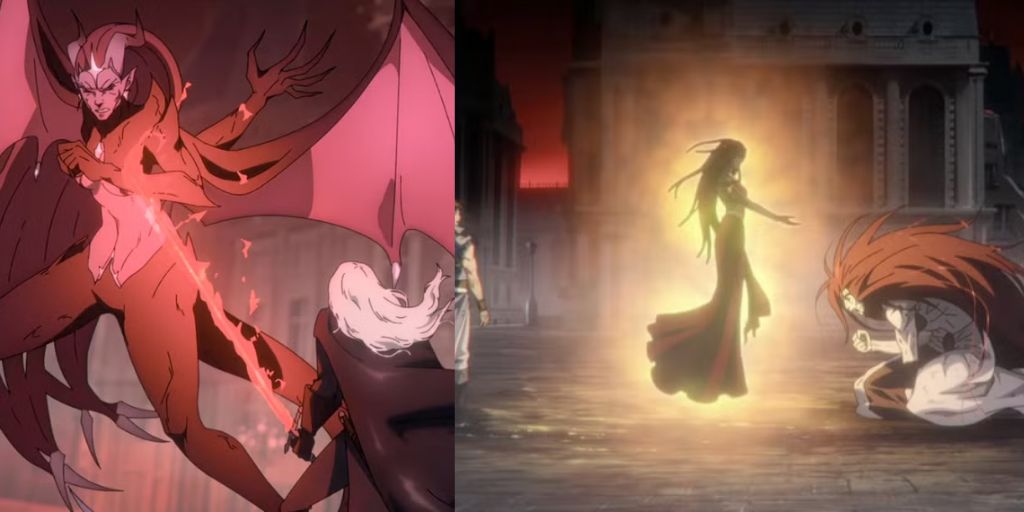
Still from Castlevania Nocturne Season 2 (Credit: Netflix)
Eduoard had been killed and later revived as a Night Creature, but he kept his human mind and eventually returned to support his friends. The trio prepares to sail to Annette and Eduoard’s home in Saint-Domingue, which is in the Caribbean.
Before leaving, Richter says goodbye to his adopted sister, Maria Renard (Pixie Davies). Maria has chosen to stay in France to continue fighting in the French Revolution.
Alucard, who has traveled the world for centuries, is inspired by the human revolutionaries who fought against Báthory and Drolta. He decides to stay in France for a while, leaving the shadows behind to witness the ongoing changes.
Richter’s grandfather, Juste Belmont (Iain Glen), also stays in France to watch over Maria and train her. Juste has regained his magical powers and is ready to continue his work. Meanwhile, Olrox turns his human lover, Mizrak (Aaron Neil), into a vampire to save him. Mizrak had been gravely injured in the fight against Báthory and Drolta, and Olrox chooses to transform him to preserve his life.
Richter and Annette share a bittersweet farewell with Alucard, Juste, and Maria. They board a boat, leaving France behind and setting sail toward a new life. Alucard and Juste both encourage Richter not to waste his life. They remind him to “seize the day,” as he has finally found love and happiness with Annette.
This moment marks a turning point for Richter. He has grown into a powerful and wise character, ready to face whatever challenges the future may bring.
As the boat departs from France, Eduoard sings a beautiful song. The final scene of the show features Annette tending to Richter’s burn wounds from the final battle. The two share a loving embrace, and fans can feel the emotional weight of their journey together.
Meanwhile, in Paris, Juste, Alucard, and Maria watch as the French revolutionaries execute the humans who had allied with the vampires. Maria remarks that the traitors “deserve to die,” but Alucard seems concerned. His unease signals that there may be more to come, and the finale ends with a sense of foreboding. The heroes have triumphed, but the future remains uncertain.
Hints at a Third Season and New Threats
While the finale provides closure for many of the main character arcs, it also sets the stage for future storylines. In the final moments, the mysterious figure of Tera Renard (Nastassja Kinski), Maria’s mother, appears in the crowd. She has become a vampire, and her sinister presence suggests that she may play a crucial role in the future of the series.
Tera watches the executions with a creepy, eerie satisfaction. She is not alone. Standing next to her is the ominous, shadowy being known as “Old Man Coyote,” who was mentioned by Olrox earlier in the series. This being could be another form of the villainous entity Death (Malcolm McDowell), who was seemingly defeated in Castlevania Season 4.
Alternatively, Old Man Coyote might be an incarnation of Satan or the Devil. In the Castlevania: Lords of Shadow video games, Satan is a significant villain, and the show has loosely adapted elements from these games.
The identity of Old Man Coyote remains a mystery, but his eerie smile as he watches the executions suggests that he may play a larger role in future seasons. The final moments of the show leave viewers with a chilling sense of unease, as Tera and Old Man Coyote prepare for what lies ahead.
While the main threats have been defeated in Castlevania: Nocturne Season 2, these unresolved threads point to a potential third season. The return of Tera Renard and the shadowy figure of Old Man Coyote hints at future battles and dangers. Fans are left wondering what the next chapter in the Castlevania saga will bring.
The Future of Castlevania: Nocturne
The ending of Castlevania: Nocturne leaves fans eagerly awaiting news about a possible third season. While many character arcs are resolved, the introduction of new threats and mysteries suggests that the story is far from over. The Castlevania franchise spans generations, with characters like Alucard, Tera Renard, and Old Man Coyote potentially playing major roles in future storylines.
The Castlevania animated series has been praised for its deep characters, complex plots, and intense action. If Netflix renews the show for a third season, fans can expect even more thrilling moments and new adventures. Whether the story shifts to a new era of the Belmont family or continues the current storyline, there is no shortage of potential for the series to grow and evolve.
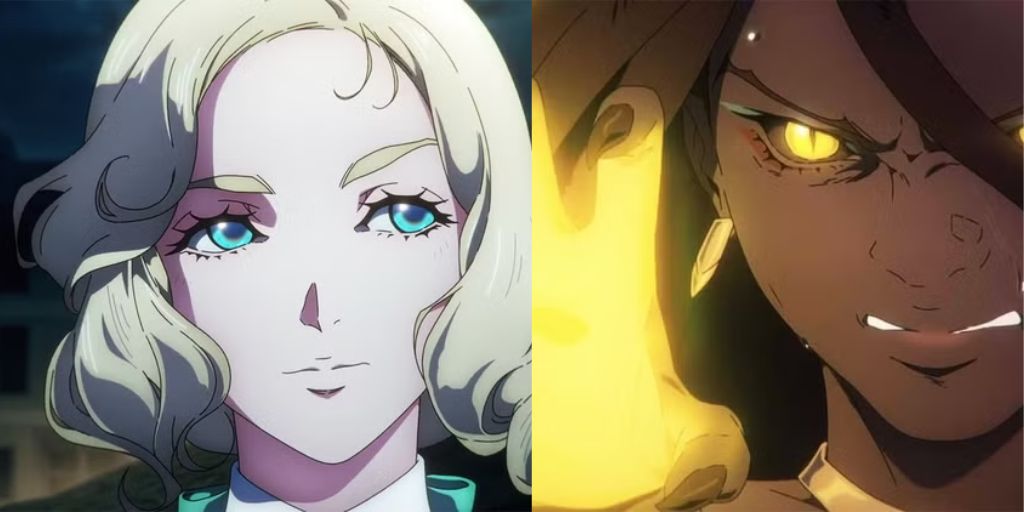
Still from Castlevania Nocturne Season 2 (Credit: Netflix)
For now, viewers will have to wait and see what happens next. But one thing is certain: the world of Castlevania is full of dark mysteries, powerful enemies, and heroes who are ready to face whatever challenges come their way.
Conclusion
Season 2 of Castlevania: Nocturne ends with a satisfying conclusion to many character arcs, while also leaving room for future developments. Richter, Annette, and Alucard defeat the main threats, and Richter finally unlocks his true magical potential.
As the characters prepare to move forward, the series hints at new dangers on the horizon. With the looming presence of Tera Renard and Old Man Coyote, the future of Castlevania remains uncertain, but one thing is clear: the battle against dark forces is far from over.
Fans can stream both seasons of Castlevania: Nocturne on Netflix and look forward to the possibility of a new chapter in this epic saga.
