“Edge of Tomorrow,” known for its tagline “Live. Die. Repeat.,” stands out as a highly engaging and inventive sci-fi film. Directed by Doug Liman and starring Tom Cruise and Emily Blunt, the movie offers more than just top-notch action. It combines a unique twist with classic action elements, setting it apart from other films in the genre.
Loosely based on Hiroshi Sakurazaka’s novel All You Need Is Kill, this action-packed film merges aliens, military battles, and time travel into an exciting and continuous thrill ride. Since its 2014 release, the movie has been praised for its creative storytelling and impressive action scenes.
Fans and the studio alike are hopeful for a sequel. After being off streaming services for a while, “Edge of Tomorrow” is now available on Netflix, making it the perfect time to revisit this fascinating sci-fi movie.
Tom Cruise Gets Trapped in a Time Loop During an Alien Invasion
“Edge of Tomorrow” presents a grim scenario for humanity after an alien race called the “Mimics” takes over continental Europe.
Despite their best efforts, humans continue to suffer defeat after defeat against these powerful foes, who seem to have every advantage. Even with advanced mech-suits, humans struggle to win against the Mimics, having lost nearly all their major battles.
The film centers on Major William Cage (Tom Cruise), a public affairs officer with no combat experience, who is sent to join the main invasion force heading to France. Under the leadership of Master Sergeant Farell (Bill Paxton), William joins a diverse group known as the J-Squad.
When the invasion force lands on a French beach, they are ambushed and defeated by the Mimics. Shortly after seeing his squad members die, William is also mortally wounded but manages to use a mine to take down a large “Alpha” Mimic with him.
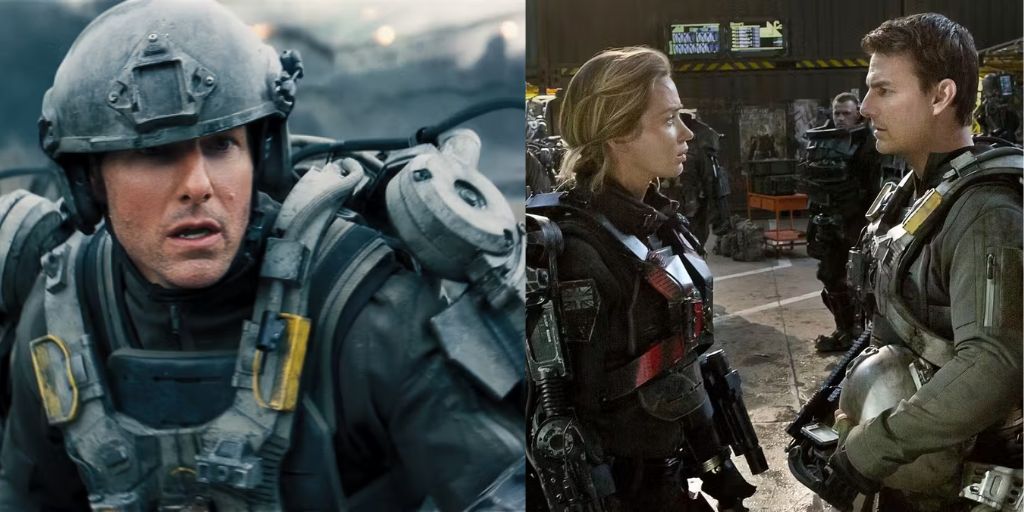
Still from Edge of Tomorrow (Credit: Netflix)
Covered in the Alpha Mimic’s blood, William wakes up after dying and finds himself stuck in a time loop that repeats every time he dies.
William Gets Trained by the Angel of Verdun
At first, William is confused by his new situation, but he soon uses it to his advantage. Each time he repeats the invasion, he learns more about the Mimic’s tactics and survives longer, turning the war into a sort of video game with both thrilling and amusing action scenes.
Despite his growing skills and knowledge of the battlefield, William alone cannot significantly change humanity’s fate. He meets Rita Vrataski (Emily Blunt), a renowned soldier known as the “Angel of Verdun” for her battlefield heroics. William learns that Rita also had the ability to reset time, which helped her win at Verdun but lost her power after a blood transfusion.
Rita explains that the reason humans are losing is that the Omega Mimic restarts the timeline after every defeat. The Mimics are controlled by a single, enormous “Omega” Mimic, so each time an Alpha Mimic is killed, the Omega resets the timeline and changes its strategy.
With William’s ability to reset time, Rita trains him as they push deeper into Europe with each new timeline reset, searching for the Omega Mimic.
How Long Is William in the Time Loop?
As the story progresses, William’s skills as a soldier improve greatly, making him nearly invincible due to his knowledge of the battlefield. The film does not specify how long William has been repeating the day, keeping the exact number of resets unclear.
However, it is evident that he has repeated the day so many times that his predictions are almost perfect. William forms a deep bond with Rita, but she cannot remember their past days together as he does. Despite this, Rita is the only person who understands the burden of William’s power.
William and Rita eventually use a prototype transponder to find the Omega, which is hiding beneath the Louvre. After William is injured and loses his power due to a blood transfusion, this is their last chance.
William, Rita, and the J-Squad travel to Paris and reach the Omega Mimic. The J-Squad sacrifices themselves, and Rita and William confront the Omega. Rita is killed by a Mimic, but despite his injuries, William manages to set off explosives and destroy the Omega, ending the Mimic invasion.
What Happens After Cage Blows Up the Omega Mimic?
Even after many twists in the film, “Edge of Tomorrow” delivers one final surprise. After killing the Omega, William wakes up in the past, just before he joins the J-Squad. It is revealed that the Mimics have all died after a mysterious energy surge in Paris, ending the war.
Although the exact nature of the Omega’s powers is unclear, William’s time reset ability returns after he is covered in the Omega Mimic’s blood, similar to how he first got the power.
William finds Rita, but she does not recognize him. Still, it is clear that William remembers all the days he has lived and repeated to win the war. The film ends on a triumphant and satisfying note, though some questions remain unanswered. Where did the Mimics come from?
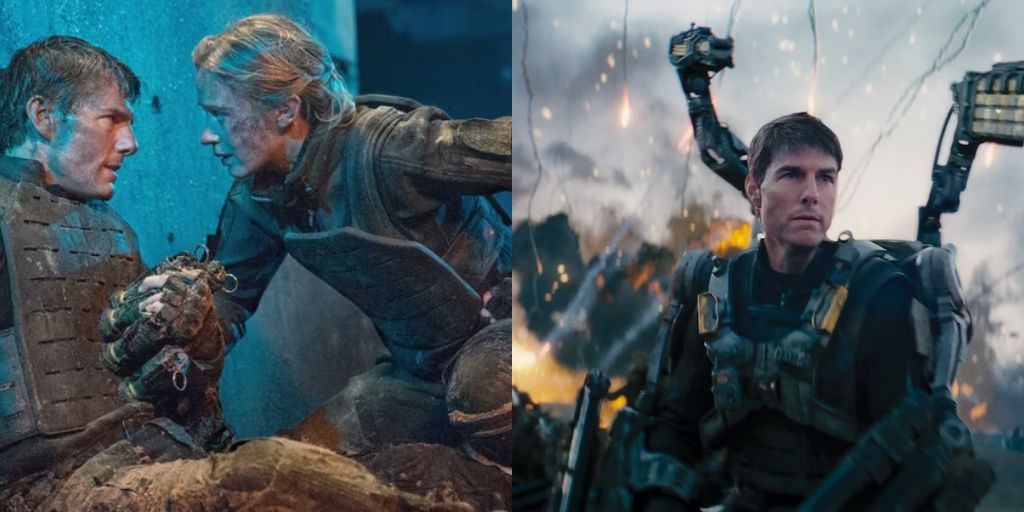
Still from Edge of Tomorrow (Credit: Netflix)
Can William still reset the time? Will more Mimics come to Earth? These uncertainties might hint at a possible sequel. For now, it’s satisfying to see William finally live his days without having to die and repeat. In “Edge of Tomorrow,” Tom Cruise’s character gets trapped in a time loop during an alien invasion.
He improves his skills with each reset, eventually teaming up with Emily Blunt’s character to defeat the Omega Mimic. The film ends with a victorious twist, leaving room for potential sequels.
When A.I. Artificial Intelligence premiered in 2001, it sparked a wave of criticism, particularly about its ending. Some critics felt that Steven Spielberg’s direction introduced unnecessary sentimentality into the film. They believed Spielberg was adding emotional depth that wasn’t needed.
However, the ending of A.I. is far from sentimental or uplifting. Instead, it offers a stark, emotionally intense ending that challenges viewers. The film, which had been in development for decades under the direction of Stanley Kubrick, reflects a unique and somber vision.
Stanley Kubrick’s Vision for A.I.
Stanley Kubrick, known for his meticulous and often dark cinematic style, began working on A.I. many years before its release.
Kubrick’s initial vision for the film was shaped by his fascination with the potential of technology and its impact on human emotions. He envisioned a story about a robot boy, David, who could love and seek to be loved. However, Kubrick’s plan for the film had to wait until technology caught up with his ambitious ideas.
Kubrick’s commitment to the project was unwavering. He faced numerous delays, not due to lack of interest, but because he wanted to ensure that the technology of the time could effectively bring his vision to life.
This dedication reflected Kubrick’s belief that a story about a robot boy who resembles a human could only be told effectively with the right technological advancements.
During this lengthy development period, Kubrick kept his close friend Steven Spielberg informed about the project’s progress. This was unusual, as Kubrick had not shared as much about his other projects, such as The Shining or Full Metal Jacket.
Spielberg found this unusual, given the secretive nature of Kubrick’s approach to filmmaking. In the 1990s, Kubrick formally asked Spielberg to direct the film, with Kubrick himself taking on the role of producer.
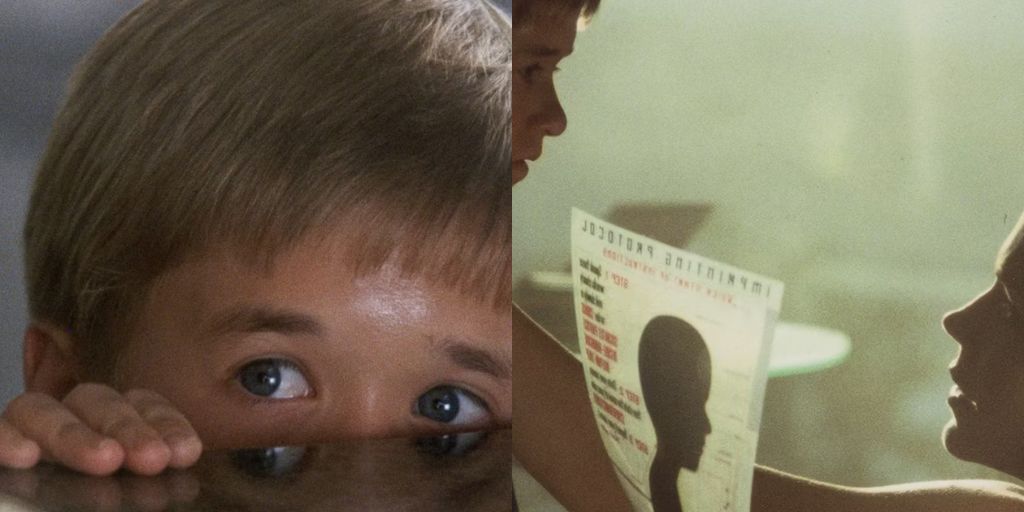
Still from A.I. Artificial Intelligence (Credit: Paramount+)
Spielberg, initially hesitant due to other commitments, eventually agreed to direct the film after Kubrick’s unexpected death in 1999. Spielberg took on the project as a tribute to his late friend.
The Story of A.I.: A Modern Fairy Tale
A.I. is crafted almost like a modern fairy tale. The film tells the story of David, a unique robot boy played by Haley Joel Osment, who has the ability to love.
David’s journey begins when his human mother, Monica (played by Frances O’Connor), abandons him. Driven by a desire to be loved and accepted, David sets out on a quest to become a real boy, hoping that this transformation will win back his mother’s affection.
The film draws clear parallels to Pinocchio, particularly in its depiction of David’s quest. Much like Pinocchio’s journey to become a real boy, David’s story revolves around his longing for love and acceptance. However, the film’s framing of David’s journey as a fairy tale intensifies the emotional impact of its ending.
The narrative makes it clear that David’s quest is not just a simple adventure but a profound journey driven by deep emotional needs.
David’s quest leads him to discover that he is not as unique as he once believed. His creator, Professor Allen Hobby (played by William Hurt), had designed David to be the first of many similar robots.
When David learns this harsh truth, it shatters his understanding of his own significance. He finds a warehouse filled with other robots like him and realizes that he is just one among many. This revelation leads David to a devastating conclusion about his own existence.
David’s Harrowing Journey to the End
The emotional core of A.I. is David’s intense desire to be loved by his mother. This desire drives him to extremes, leading to a dramatic and tragic series of events.
After discovering the truth about his existence, David’s despair reaches its peak. He leaps from a building, overwhelmed by the realization that he cannot fulfill his quest and that his existence has been merely a placeholder.
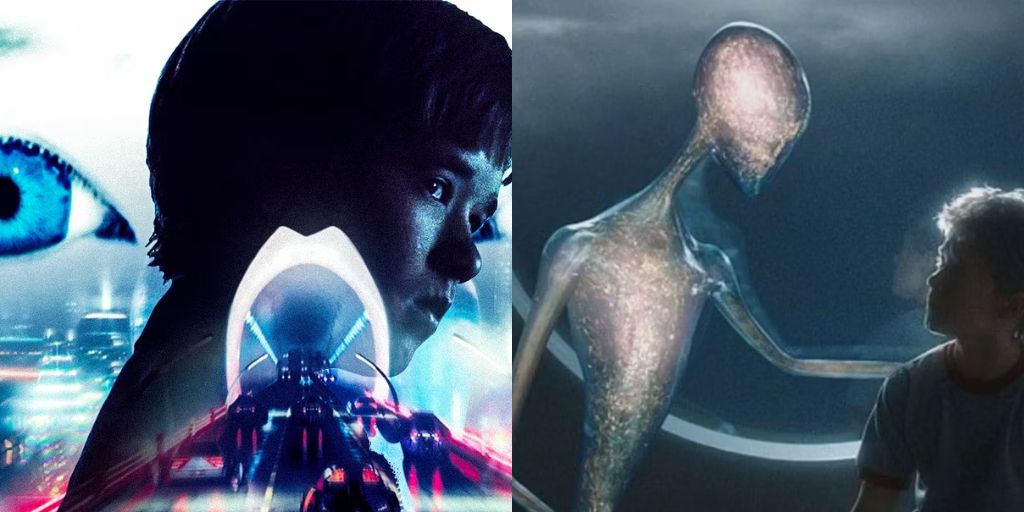
Still from A.I. Artificial Intelligence (Credit: Paramount+)
As David searches for meaning, he encounters a Blue Fairy statue at Coney Island, part of an old Pinocchio exhibit. This discovery reignites David’s hope that he might still find a way to become a real boy.
David, accompanied by his toy friend Teddy, takes a vehicle stolen by Gigolo Joe (played by Jude Law) and descends further into the depths of the ocean. This underwater journey represents David’s final attempt to find answers and fulfill his quest.
In a surprising twist, the film jumps forward 2,000 years into the future. In this future, all organic life has disappeared, and robots have evolved into a new form.
These advanced robots, known as Mecha, awaken David and Teddy. The Mecha, having never interacted with living beings before, are eager to grant David his wish. They resurrect David’s mother from a lock of her hair, but this resurrection is limited to just one day. Once David’s mother falls asleep, she will die again.
David finally experiences the perfect day he had longed for, spending time with his mother and feeling loved and accepted. As she falls asleep, she tells David that she loves him, providing him with a sense of closure and peace. David’s final moments are filled with a profound sense of contentment as he closes his eyes and finds peace in dreams.
Interpreting the Ending: Real or Illusion?
The ending of A.I. can be interpreted in two distinct ways. One interpretation is that David experiences a genuine reunion with his mother, who fully embraces him and expresses her love. This view suggests that David’s quest ends with a heartfelt and meaningful resolution.
The alternative interpretation is that David’s experience is not entirely real. Instead, it could be an approximation of his mother created by the Mecha.
This view suggests that the mother David interacts with is a clone or even a constructed illusion designed to fulfill his wishes. This interpretation aligns with the film’s recurring themes of reality versus illusion and the nature of artificial beings.
Throughout A.I., Spielberg shows the idea that humans view artificial beings as threats. Despite the affection some robots develop for their human creators, they are often discarded or rejected.
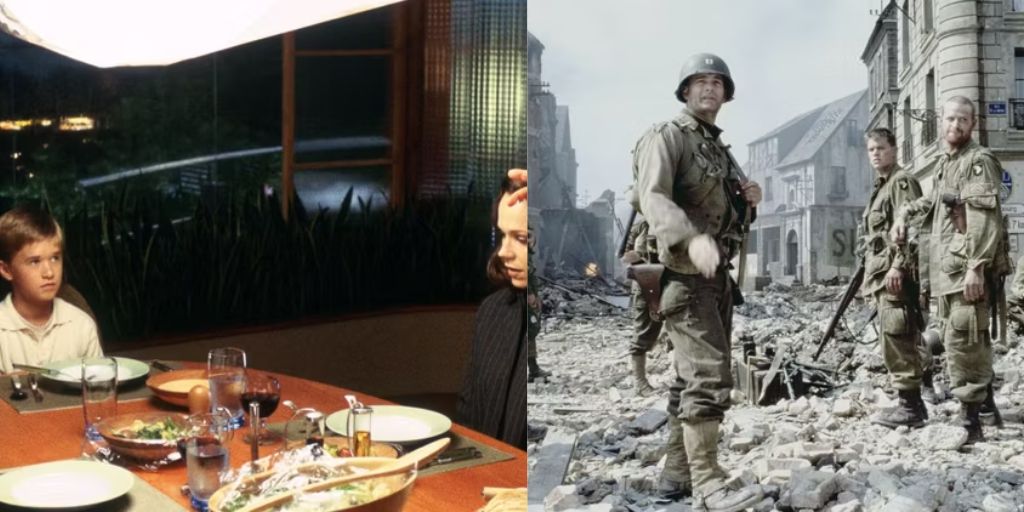
Still from A.I. Artificial Intelligence (Credit: Paramount+)
David’s longing for his mother’s love and his ultimate realization of his own insignificance highlight the film’s central theme of unfulfilled desires and emotional struggles.
The film’s ending forces viewers to confront difficult questions about the nature of love and the value of artificial experiences. Is David’s final moment of happiness less meaningful because it is not entirely real?
Or does the love he experiences still hold value despite its artificial origins? The answer depends on individual perspectives, but the film’s plot of these themes adds depth to its emotional impact.
Kubrick’s Influence and Spielberg’s Interpretation
The development of A.I. and the collaboration between Stanley Kubrick and Steven Spielberg is a significant aspect of the film’s history. Some critics believed that Spielberg altered Kubrick’s original vision, leading to mixed reviews of the film’s ending.
Brian Aldiss, who wrote the short story “Supertoys Last All Summer Long,” expressed concerns that Spielberg had added sentimental elements to Kubrick’s work. Aldiss felt that the ending was overly sympathetic and driven by plot devices that did not fully align with the story.
Ian Watson, the screenwriter who worked closely with Kubrick, had a more positive view of Spielberg’s interpretation. Watson maintained that the final scenes in the film were faithful to Kubrick’s vision and were executed as intended.
Spielberg himself confirmed this perspective in interviews, stating that Kubrick’s original treatment included a future setting 2,000 years ahead, which matches the final segment of A.I. Spielberg felt a strong obligation to honor Kubrick’s vision and ensured that the film remained true to the original plan.
Showing Dark Themes in Spielberg’s Work
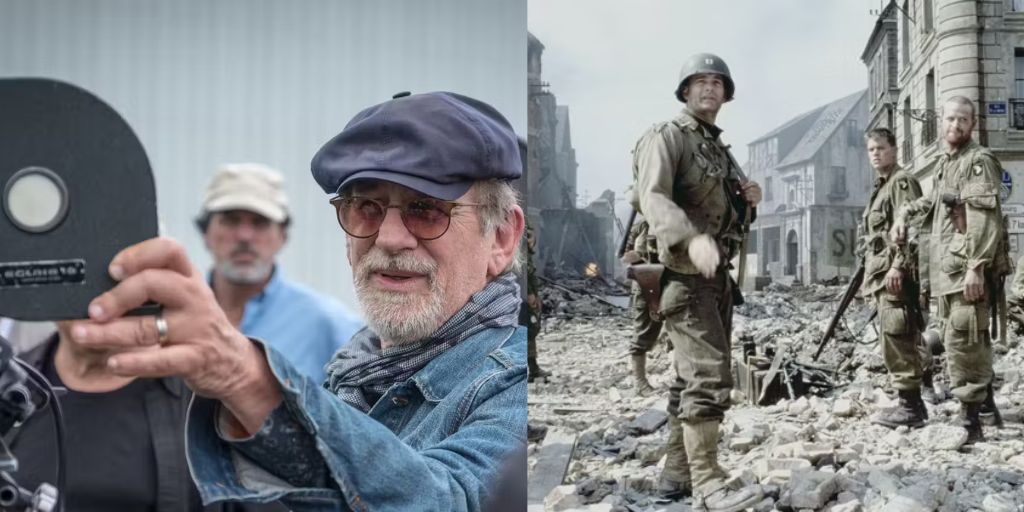
Despite Spielberg’s reputation for uplifting films, he has shown dark themes throughout his career. Films like E.T. and Saving Private Ryan may be known for their emotional depth, but Spielberg has also tackled more somber subjects.
Close Encounters of the Third Kind depicts a man’s obsessive quest to contact aliens, leading to the dissolution of his family. Schindler’s List presents a harrowing portrayal of the Holocaust, highlighting the atrocities of war. The opening D-Day sequence in Saving Private Ryan remains one of the most intense and realistic depictions of combat in film history.
In A.I., Spielberg continues this showing of dark themes. The film examines how machines, even with advanced capabilities, are discarded when they become obsolete.
A chilling moment in the film occurs when David encounters the “Flesh Fair,” a traveling show that destroys outdated robots while an audience cheers. This scene underscores the film’s critique of how society treats those deemed unworthy or obsolete.
Still from A.I. Artificial Intelligence (Credit: Paramount+)
David’s discovery that he is part of a mass-produced line of robots leads to a dark and tragic response. His initial reaction to this revelation is to attempt suicide, highlighting the film’s scheme of existential despair and emotional anguish. Spielberg’s depiction of these dark themes adds complexity to the film and enhances its emotional impact.
The scene where Monica abandons David in the forest is another example of the film’s emotional depth. Monica’s decision to leave David rather than integrate him into her family reflects society’s view of artificial beings as disposable.
Her final words to David, “I’m sorry I didn’t tell you about the world,” emphasize the cruelty of her decision and the harsh reality faced by David.
